A startup founded by a former SpaceX engineer says it can build family-sized rowhomes for 30% to 50% less than a conventional homebuilder by treating construction like an engineering problem instead of a trade, according to an exclusive interview with Realtor.com.
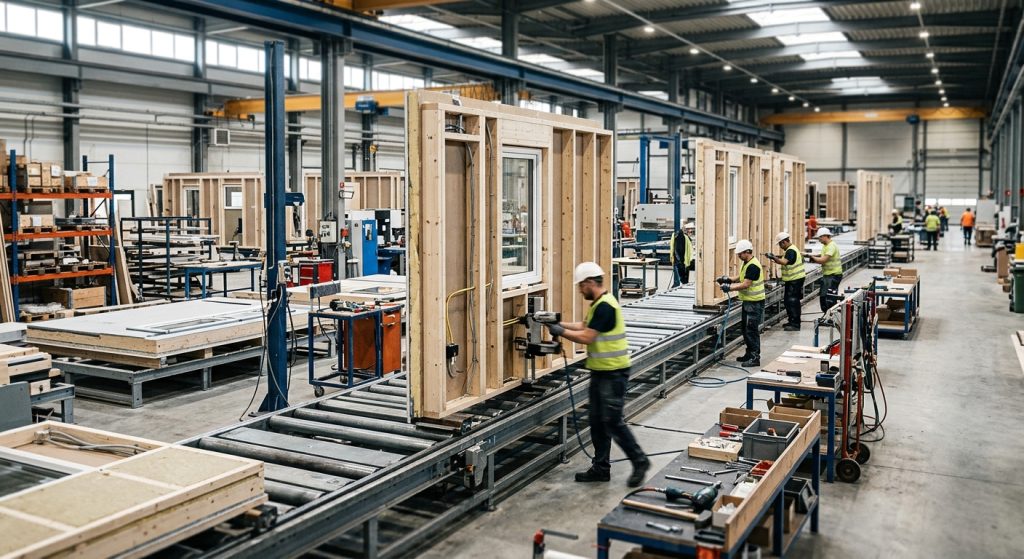
American Housing Corp., based in Austin, Texas, is a vertically integrated developer and manufacturer that builds pre-fabricated components — insulated wall panels, floors, stairs and roofing — that are flat-packed into shipping containers, trucked to a site and assembled “like Lego” into three-story townhomes, according to CEO and co-founder Riley Meik.
From Starship flaps to housing “missing middle”
Meik, a mechanical engineer, left Brigham Young University to start a suborbital rocket-launch company before being hired by SpaceX to work on Starship’s aeronautic flaps. He told Realtor.com the idea for AHC came from watching housing get built by hand near Los Angeles job sites while working at SpaceX. “There has been so much evolution and progress over the past 50 years introducing robotics and automation into the production process,” Meik said. “Look at housing during that same timeline: quality has been going down while cost has been going up. It’s the opposite.”
AHC’s approach borrows directly from SpaceX and Tesla’s playbook: full vertical integration, with raw materials entering one door and finished components leaving the other, and a focus on a single, engineered building material. The company’s structural wall panels use magnesium oxide board reinforced with fiberglass — a Class-A fire-rated material Meik said was chosen after “lots of trial and error” for its acoustic, thermal and cost properties. Floors use cold-formed steel rather than lumber trusses, assembled with rivets “more common in aerospace and automotive” than in home construction.
The company settled on three-story rowhomes as its core product because, Meik said, “the key to solving the housing crisis in the U.S. is figuring out how to build ‘missing middle’ housing at scale in the country’s most desirable cities and neighborhoods” — denser than a detached single-family home but still family-sized.
Backed by $7 million so far, seeking a Series A
AHC has raised $7 million in pre-seed and seed capital from Flux Capital, Antler and Boost Capital Partners, and Meik told Realtor.com a Series A round of more than $10 million is in the works. The company plans to use that capital to build a 230,000-square-foot factory capable of producing 1,200 townhomes a year, its near-term production goal, scaling up from its current 50,000-square-foot facility. Three co-founders round out the leadership team: Will Davis, a Cornell-educated former General Motors engineer overseeing software; Bobby Fijan, a Wharton graduate who previously worked on Philadelphia-area office-to-residential conversions and now leads real estate acquisition; and Harris Rothaermel, a BYU graduate with aerospace experience at NASA and Varda Space Industries.
What it means
AHC’s cost-savings claim — 30% to 50% below a conventional homebuilder — is the company’s own estimate, not an independently verified figure, and the startup has not yet built at the 1,200-home annual scale it is targeting. The pitch nonetheless lands amid growing public acknowledgment of the underlying problem: large national homebuilders have said it is increasingly difficult to profit from a traditional starter home at today’s land, labor and material costs, which is part of why factory-built and modular approaches keep attracting venture capital. Whether AHC’s aerospace-inspired manufacturing model can scale to thousands of units annually while holding its promised cost advantage remains unproven outside its current pilot factory.