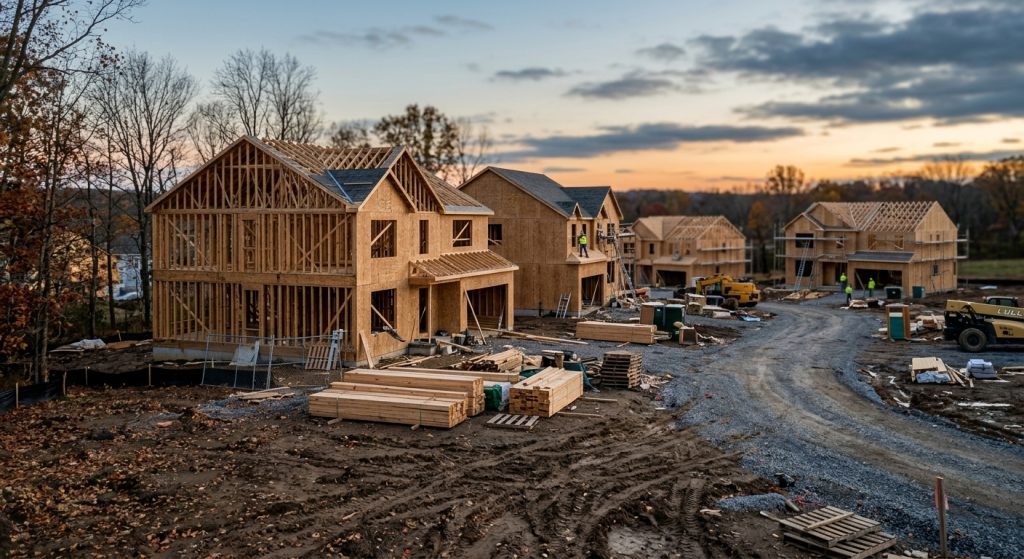
Mortgage rates above 7% are now visible in every corner of the Federal Reserve’s network of business contacts. The central bank’s latest Beige Book, released Nov. 25, 2026, said that “residential real estate activity weakened as affordability challenges suppressed demand,” construction “declined amid higher borrowing costs and elevated construction costs,” and commercial real estate was mixed. Data center projects were the most consistent source of strength in the construction reports.
The Beige Book collects anecdotal reports from businesses, lenders, brokers and builders in each of the 12 Federal Reserve districts. This edition was compiled by the Federal Reserve Bank of Atlanta from information gathered on or before Nov. 16, and it will be in front of policymakers when the Federal Open Market Committee meets Dec. 8-9. It is a summary of what contacts told the Reserve Banks, not a statement of Fed officials’ views.
Housing: lock-in, cash buyers and price cuts
Nearly every district described weaker housing demand, but the reasons differed by region.
The Dallas Fed was the most blunt. “The District housing market continued to struggle,” its report said, adding that “sales slowed noticeably due to mortgage rates eclipsing 7 percent.” Builders’ margins in the district were under pressure “from high costs, discounting, and rate buydowns,” housing starts dipped, and contacts reported layoffs.
The Cleveland Fed quoted a contact calling elevated rates a “wet blanket” on new and existing home sales. Demand for entry-level and mid-priced homes was especially soft there, while luxury homebuilding held up. That split ran through several reports. In the Philadelphia district, builders said a modest decline in sales left them anticipating fewer houses to build in 2027 and likely layoffs, yet contacts noted that “well-off baby boomers frequently pay cash.” A Minnesota luxury builder told the Minneapolis Fed, “All of our clients are paying cash for their project.”
The Atlanta Fed said inventory was elevated in Atlanta, Miami, Nashville and New Orleans, and contacts reported price declines in Savannah, Atlanta and Orlando. Builders there kept offering incentives and in some cases cut prices, and a larger share of affluent buyers used adjustable-rate mortgages and bigger down payments to lower monthly payments. The Chicago Fed reported that homebuilders “again lowered prices,” time on market grew, and home prices and rents slipped. In the St. Louis district, home sales fell from a year earlier in major metros while inventories kept rising.
Supply-starved markets were the exception. The New York Fed said housing activity was little changed because “persistently low inventory continued to limit sales and push prices higher,” and it described lock-in as “a key constraint on moving” as rates rose again. In the Boston district, September closed sales fell modestly from a year earlier, but single-family sales rose modestly in Massachusetts and Connecticut, and inventory, though up, stayed historically low.
The reports arrive alongside the October jump in new home sales and the climb in mortgage rates to the 7.2% range as inflation rose.
Rentals: strong in New York, concessions in the Sun Belt and West
Renters face very different conditions depending on the city. The New York Fed said rents in New York City “stood near record highs,” that rental inventory “fell considerably” in Manhattan and Brooklyn, and that rising mortgage rates were keeping would-be buyers in the rental market. In the Dallas district, apartment demand was healthy and year-over-year rent declines moderated, but concessions were still widespread, and San Antonio was the softest major market. San Francisco Fed contacts reported flat to falling multifamily rents, concessions, an excess of units in parts of the Mountain West and a Nevada contact who saw multifamily selling prices fall. The Kansas City Fed’s contacts expected rents for homes to rise modestly around the new year because existing supply had been absorbed and new supply was expected to drop sharply.
Commercial real estate: top-tier office firms up, financing is the pinch
Manhattan’s office market stood out. The New York Fed said vacancy fell further and asking rents rose “to record highs.” The Atlanta and Richmond districts also reported low or falling vacancies in Class A space, and the Dallas and St. Louis reports said office leasing was concentrated in higher-quality buildings. The Chicago Fed said demand for office space, “especially at the lower end, decreased.”
Capital was the recurring complaint. Richmond contacts did not see the normal seasonal uptick in 1031 exchanges, and they flagged higher-rate refinancing as “a large concern” for multifamily owners. The San Francisco Fed said financing was difficult to obtain and that commercial owners reported trouble refinancing debt. The Dallas Fed said higher rates had led to “a repricing of assets and wider cap rates.” In Boston, reports on credit availability for commercial real estate were mixed.
Construction: data centers carry the load
Outside data centers, nonresidential building looked weak. The Philadelphia Fed said “other than data center construction,” nonresidential activity was declining, and that a large apartment-focused commercial contractor had announced it would wind down existing projects and stop future operations. Cleveland and San Francisco contacts said growth was concentrated in data center, infrastructure and industrial projects. Data centers also showed up as a cost pressure. A North Carolina builder told the Richmond Fed that trade workers were traveling out of state to work on data center projects for higher wages, and a broker said uncertainty over data center demand was spilling over to lower-quality industrial space in northern Virginia that had been planned for conversion.
Read together, the districts describe a housing market split by buyer type more than by region. Cash-rich and high-end buyers are still moving, while entry-level and mid-priced demand stalls under 7% rates. That is our reading of the reports, not a conclusion the Fed draws. The Beige Book’s national summary said most districts expected “slight to moderate growth” ahead, and for real estate the next test is whether the FOMC’s December decision moves rates in either direction. Directors at four Reserve Banks had already pushed for a higher discount rate.