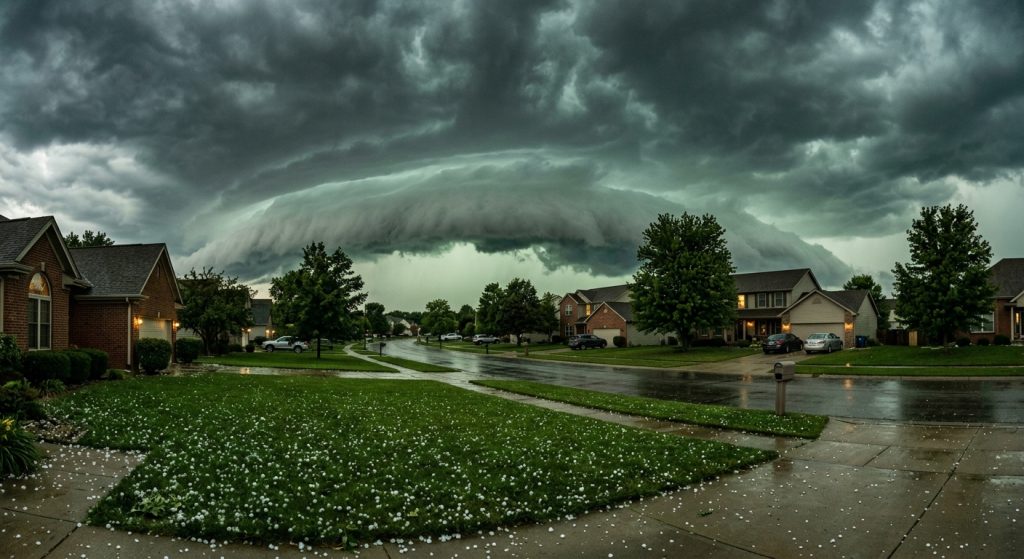
Severe thunderstorms — not hurricanes — have become the costliest natural peril for property insurers worldwide, according to a new analysis from climate risk modeler First Street. Hail, damaging straight-line winds and tornadoes generated roughly $82 billion in global economic losses in 2025 alone, and cumulative insured losses from these storms have now overtaken tropical cyclones for the first time on record.
The finding comes from First Street’s “Global Severe Convective Storm Risk: Pricing Economic Exposure to a Rising Peril,” the firm’s 19th national risk assessment, published in July 2026. First Street defines severe convective storms (SCS) as the combination of hail, severe thunderstorm wind and tornadoes, and says the category accounted for nearly one-third of all natural catastrophe losses worldwide last year — more than any other single peril. Of the $82 billion in 2025 losses, First Street attributes $68 billion to the United States, where outbreaks clustered across the Great Plains, Texas and the Midwest, with a further $7 billion tied to European summer storms, citing loss-event data from reinsurance broker Aon.
The report puts the shift in historical context: since 2000, inflation-adjusted SCS losses have climbed roughly 6.8% a year, more than double the 2.7% annual growth rate for all weather-related catastrophe losses combined. Cumulative global insured losses from severe convective storms have reached $794 billion over the past 25 years, according to First Street’s analysis of Aon data — and 2025 marked the year those insured losses surpassed tropical cyclones for the first time, making SCS the costliest insured peril of the 21st century.
First Street’s figures are drawn from a hazard model that combines observed hail, wind and tornado reports with atmospheric reanalysis data and climate projections, mapped at 6-kilometer resolution under a moderate-emissions climate scenario. The firm says nearly half of global GDP is already exposed to frequent hail risk of at least one inch in diameter, and roughly two-thirds is exposed to frequent damaging thunderstorm winds of 65 mph or greater.
Geographically, First Street identifies the Americas — and the U.S. in particular — as the region with the largest current concentration of SCS exposure, with more than 11% of regional GDP exposed to annualized hail risk today, the highest share of any region globally. Texas holds what First Street calls the single largest concentration of hail-exposed GDP in the world. At the county level, Harris County, Texas (Houston) ranks as the largest single locality by GDP exposed to moderate hail risk — an estimated $127.4 billion annually — followed by Cook County, Illinois (Chicago) at $115.8 billion, Dallas County at $85.8 billion, and Tarrant County (Fort Worth) and Bexar County (San Antonio) rounding out the top five. First Street projects Europe as the fastest-growing hail-risk region and Asia-Pacific as the fastest-growing wind-exposure region over the next 30 years, while U.S. exposure remains the largest in absolute terms today.
The market consequences are already visible. First Street’s report says that as insurers reprice SCS risk through higher premiums, larger deductibles, tighter underwriting terms and reduced coverage availability, more of the financial burden is shifting onto homeowners, lenders and property investors. CBS News, reporting separately on the First Street findings, quoted the firm’s chief economist, Jeremy Porter, saying that combining large concentrations of insured real estate with rising storm frequency is “where those numbers balloon.” Coverage of the broader reinsurance market — including Aon’s own first-half 2026 catastrophe data, cited in First Street’s report — has similarly flagged severe convective storms as this year’s leading driver of global insured catastrophe losses.
For homeowners and buyers in hail- and wind-prone corridors of the Plains, Midwest and Southeast, that repricing is showing up directly in the cost and availability of coverage — a dynamic RealtyWire has previously covered as insurers pull back from higher-risk markets. It adds to the broader set of climate-linked risk factors that buyers are increasingly weighing before closing on a home, and it underscores how coverage gaps between standard homeowners policies and perils like flood insurance can leave owners exposed when a specific hazard escalates. More coverage of insurance-market shifts affecting housing is available on RealtyWire’s housing market page.
What it means: First Street’s core figures — the $82 billion 2025 global loss estimate, the $68 billion U.S. share, the $794 billion cumulative insured-loss figure, and the county-level hail-exposure rankings — are the firm’s own modeled and reported data, sourced in part from Aon’s catastrophe database. First Street’s framing of severe convective storms as an underpriced “secondary peril” now demanding portfolio-level underwriting attention is the firm’s stated interpretation. RealtyWire’s own read: this is as much a housing-affordability story as a weather story. As underwriters apply the same rigor to thunderstorm risk long reserved for hurricanes, homeowners in hail-alley metros — not just coastal ones — should expect more of the repricing, tighter terms and non-renewal pressure already reshaping coverage in Florida and California to extend further into the country’s interior.