
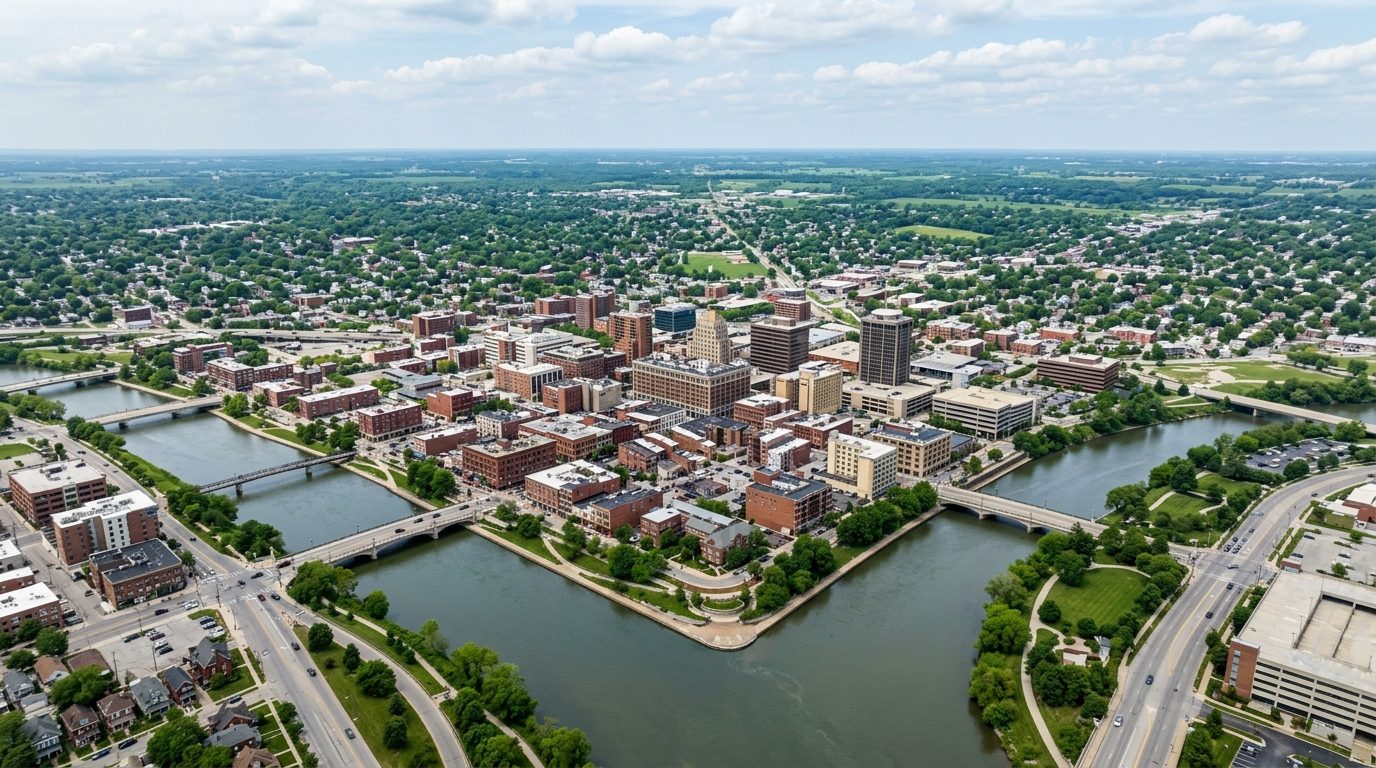
Current real estate market data, news and analysis for the Dayton-Kettering-Beavercreek, OH metropolitan area — 826,554 residents across Greene, Miami and Montgomery counties.
Data as of May 2026. Sources: Redfin Data Center, U.S. Census Bureau.
Latest Dayton Real Estate News
Dayton Real Estate Market Overview
The Dayton-Kettering-Beavercreek metro sits in southwest Ohio’s Miami Valley, across Montgomery, Greene, and Miami counties along the Great Miami, Mad, and Stillwater rivers. Downtown Dayton anchors the region at the confluence of those waterways, with Kettering and Oakwood forming close-in suburbs to the south, Beavercreek and Fairborn extending east toward Wright-Patterson Air Force Base, and Troy and Piqua serving as smaller cities up the Great Miami River corridor to the north. The terrain is flat to gently rolling glacial till plain, suited to grid-pattern streetcar neighborhoods in the urban core and subdivision growth spreading outward since the mid-twentieth century. Housing stock reflects that layered history: early-1900s frame and brick homes in Dayton’s older neighborhoods, brick bungalows and Cape Cods from the postwar boom in Kettering and Oakwood, and ranch and split-level construction across Beavercreek, Centerville, and Huber Heights. Newer subdivisions continue filling in around Beavercreek and Clearcreek Township, while small towns such as Yellow Springs and Cedarville retain historic cores surrounded by farmland.
Price tiers track school district reputation, lot size, and proximity to employment more than any single factor. Oakwood, a small, landlocked, tree-lined enclave bordered by Dayton and Kettering, commands a consistent premium tied to its walkable business district, century-old architecture, and long-standing schools. Pockets of Washington Township, Beavercreek Township, and Clearcreek Township carry similar premiums where custom-built homes sit on larger private lots near golf courses and newer schools. Centerville and much of Kettering draw buyers seeking established neighborhoods close to retail and hospital employment. Older sections of Dayton, Trotwood, and parts of West Carrollton sit lower on the spectrum, reflecting smaller lots and housing stock that saw less reinvestment during the manufacturing-era decline. Areas along the downtown riverfront and revitalized historic districts occupy a middle tier, gaining value as adaptive reuse continues.
The regional economy has diversified well beyond its manufacturing roots, though that legacy still shapes the built environment. Wright-Patterson Air Force Base, straddling Greene and Montgomery counties near Fairborn, is the region’s largest employer, combining active-duty personnel, civilian federal workers, and defense contractors tied to the Air Force Research Laboratory. Health care is the other dominant sector, led by Premier Health and Kettering Health, both multi-hospital systems with campuses across the metro, alongside Dayton Children’s Hospital. Insurance and information-services firms including CareSource and LexisNexis Risk Solutions are headquartered in Dayton, as is automotive retail-technology company Reynolds and Reynolds. Higher education anchors including the University of Dayton, Wright State University, and Sinclair Community College add further employment.
Buyers should verify a handful of locally specific factors before purchasing. Much of the urban core sits in the historic floodplain of the Great Miami and Mad rivers, a risk the Miami Conservancy District’s levee system has managed since the 1913 flood prompted its creation, but flood-zone status and flood insurance needs still require individual confirmation. Ohio’s patchwork of municipal and school-district income taxes means a short house-hunting radius can span several different local tax rates, so buyers should check the specific municipality and school district tied to any address. Areas near Wright-Patterson can carry aircraft noise worth reviewing beforehand. Public transit is limited to the regional bus network, making a car largely necessary outside the city core. Winters bring lake-effect snow, and spring and summer bring severe storms with tornado risk, worth discussing with an insurance agent.
Cities and Towns in the Dayton Metro Area
Notable Communities and Neighborhoods
Dayton Real Estate Market FAQ
How is the Dayton-Kettering-Beavercreek metro organized geographically?
The metro is centered on the city of Dayton at the confluence of the Great Miami, Mad, and Stillwater rivers, and spans Montgomery, Greene, and Miami counties. Close-in suburbs like Kettering, Oakwood, Moraine, and West Carrollton ring the city to the south and west, Beavercreek and Fairborn extend east toward Wright-Patterson Air Force Base, and smaller cities such as Troy and Piqua sit farther north along the Great Miami River corridor. Outlying towns like Yellow Springs, Cedarville, and Germantown remain more rural in character.
Which areas in the Dayton metro tend to be pricier, and why?
Oakwood carries a consistent premium because of its walkable village center, historic architecture, and long-established schools, while pockets of Washington Township, Beavercreek Township, and Clearcreek Township command similar premiums for larger lots, newer custom construction, and proximity to golf courses. Established, well-maintained neighborhoods in Centerville and Kettering also price higher than comparable homes in areas that saw less reinvestment during the region’s manufacturing-era population shifts, largely because of school district reputation and housing stock condition rather than any single geographic factor.
What should buyers verify locally before purchasing in this metro?
Buyers should confirm the exact municipality and school district tied to an address, since Ohio’s local income taxes and school levies vary block by block in some areas. Flood-zone status and levee certification are worth checking directly with floodplain maps given the region’s river-valley setting, and homes near Wright-Patterson Air Force Base should be checked against aircraft noise contours. It is also worth confirming whether a property relies on municipal or township services, since infrastructure and response times can differ outside incorporated cities.
What is the main region-specific risk buyers should understand?
Flooding tied to the Great Miami and Mad rivers is the defining historical risk, dating to the 1913 flood that led to construction of the Miami Conservancy District’s levee and dry-dam system, which still protects much of the urban core today. Standard homeowners insurance does not cover flood damage, so properties in or near mapped floodplains typically require separate flood coverage. The region also sees severe spring and summer thunderstorms with occasional tornadoes, which buyers should factor into insurance planning regardless of flood exposure.
Nearby Markets