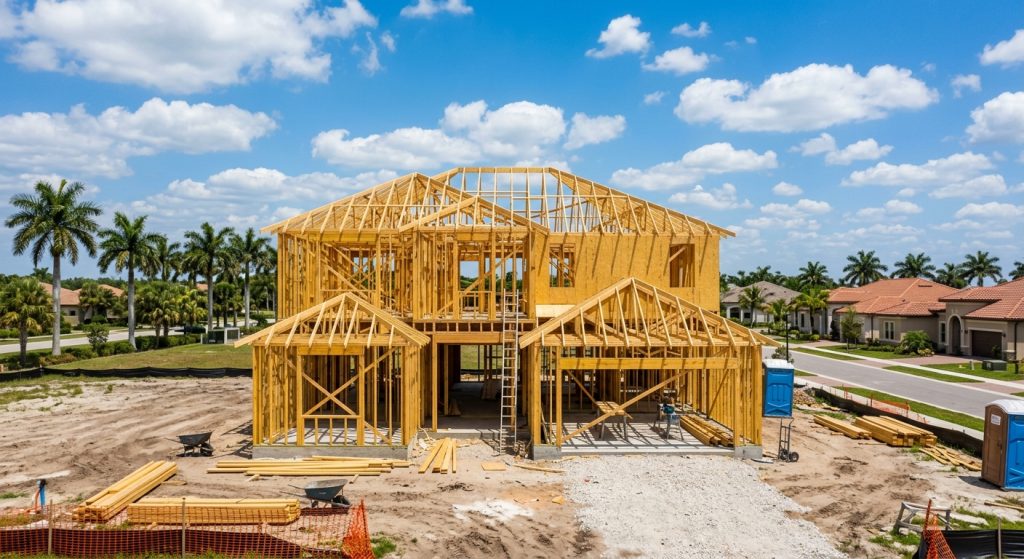
Florida issued 51,444 new residential building permits through the second quarter of 2026, down 7% from the same period a year earlier, according to a July 30 Florida Realtors article citing the HBW Building Activity Trend Report, compiled by DeBary-based building permit data firm HBW. The decline follows a 4% drop in permit activity in 2025, marking a second consecutive year of statewide softening.
The slowdown was not uniform across the state. Northwest Florida was the only region to post growth, with permits rising 11% year over year to 7,093. West Florida remained the state’s busiest region by volume despite a 14% decline to 12,489 permits. Southwest Florida permits fell 7% to 10,988, Northeast Florida fell 4% to 8,766, and Central Florida posted the steepest regional decline, down 17% to 7,039 permits. Southeast Florida was essentially flat, edging up 1%.
County-level data showed even sharper divergence. Lee County, which includes Fort Myers and was hit hard by Hurricane Ian’s aftermath in recent years, saw permits fall 30% to 3,333, while Polk County dropped 18% to 3,224. Manatee County was the standout performer among larger counties, with permits up 39% to 3,179, while Marion County held roughly flat at 2,921 permits, which HBW’s report characterized as a sign of stabilization rather than continued decline. Smaller counties posting notable growth included Walton County, up 41%; Palm Beach County, up 10%; Lake County, up 7%; and Bay County, up 5%.
One bright spot cut across regions: permits for higher-value homes priced at $500,000 and above remained comparatively strong statewide, with West Florida leading that segment at 1,762 permits, suggesting builders are finding steadier demand at the top of the market even as overall volume softens. HBW summarized the statewide picture as “cooling, but still active; declining, but not distressed; shifting, but not stalling.”
The permit slowdown adds to a mixed picture of Florida’s housing market this year. Existing-home sales in Naples and statewide have recently shown year-over-year gains, even as new construction activity has pulled back — a divergence that can reflect builders working through existing inventory and adjusting pace to demand, rather than a market in broad distress. At the same time, Florida has led the nation in foreclosure filings for the first half of 2026, another data point pointing to uneven conditions beneath the state’s still-growing population and relocation-driven housing demand.
What it means: The permit figures come from HBW’s building-activity data as reported by Florida Realtors, a Class 2 primary source for this analysis rather than a government dataset, though building-permit counts are generally considered a reliable leading indicator of construction activity. The county-level divergence — with some markets like Manatee posting sharp growth while others like Lee and Polk decline — reflects local supply, insurance-cost and demand dynamics that a statewide permit total alone cannot fully explain.