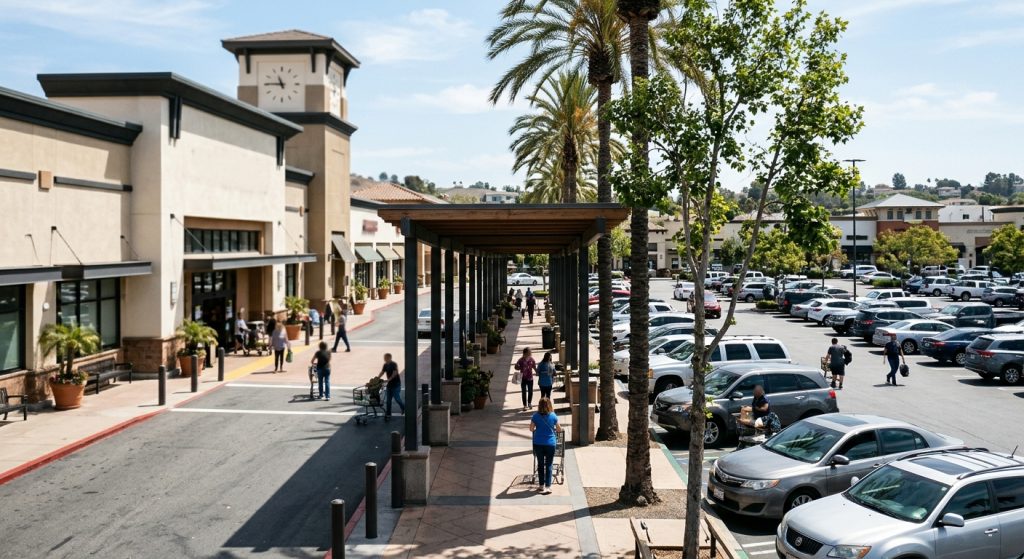
Canada’s Public Sector Pension Investment Board and Nuveen Real Estate have assembled US$790 million of grocery-anchored shopping centers across eight states, and on Oct. 21, 2026, they disclosed the joint venture that owns them. The partnership has already closed on 19 properties totaling 3 million square feet and says it plans to keep buying.
The announcement from PSP Investments and Nuveen adds two more large institutions to the list of investors betting that open-air, necessity-based retail, the strip and community centers built around a supermarket, is the most dependable corner of the retail property market.
What the PSP-Nuveen venture owns
The portfolio spans Virginia, Arizona, Florida, Minnesota, Texas, California, Colorado and Washington. The partners named two single-asset purchases:
- The Shoppes of Lorton Valley, a 110,000-square-foot neighborhood center in Lorton, Va., a Washington, D.C., suburb, anchored by Giant.
- Las Tiendas Village, a 188,000-square-foot community center in Chandler, Ariz., in the Phoenix metro, anchored by Sprouts.
Most of the square footage came through two portfolio deals. The first is six open-air centers totaling about 801,000 square feet in the Fort Lauderdale, San Diego, Orange County, Dallas-Fort Worth, Minneapolis and Los Angeles markets. The second is an 11-property portfolio of about 1.9 million square feet across California, Colorado and Washington. The release did not disclose individual prices, sellers, cap rates or how the $790 million is split between equity and debt.
According to the partners, the strategy targets centers anchored by “market or category dominant grocers, necessity-based retailers, and essential services,” in metro areas with population growth, rising household incomes and high barriers to new construction, where well-capitalized retailers are looking to expand. Every asset in the two portfolios sits at a high-traffic intersection or along a major corridor, the companies said.
Why a pension fund wants supermarket centers
PSP’s comments frame the deal as part of a broader pruning of its U.S. retail holdings. “We have been reshaping our U.S. retail exposure around a much tighter definition of the sector: open-air centers anchored by grocers and daily-needs tenants, which aims to deliver a steady, inflation-linked income for our portfolio,” said Julien Roy-Décary, managing director of real estate investments for the Americas at PSP Investments.
Roy-Décary said Nuveen “brings the sourcing reach and operating depth this kind of portfolio demands, and what we own today is exactly the retail exposure our strategy calls for.”
Brian Wallick, retail portfolio manager at Nuveen Real Estate, pointed to the category’s record through downturns. “Necessity-based retail has demonstrated remarkable resilience through various cycles, underpinned by consistent consumer demand for essential goods and services,” he said, adding that pairing Nuveen with PSP’s “long-term capital” is designed to deliver “both durable income and long-term value creation.”
PSP has been active on several fronts this fall. Earlier this month, BDT & MSD agreed to buy Sunrise Senior Living from PSP Investments, and the pension investor has partnered on large U.S. deals in other sectors. The fund reported $320.6 billion of net assets under management as of March 31, 2026. Nuveen Real Estate, owned by TIAA, manages $135 billion.
A crowded trade in grocery-anchored retail
The PSP-Nuveen venture joins a run of capital moving into the same niche. In recent months, Phillips Edison moved $377.5 million of shopping centers into its Northwestern Mutual venture, and Brixmor and Everview agreed to buy Slate Grocery REIT for $2.34 billion.
On our reading, the appeal for long-horizon investors is the one both executives describe: rent from tenants selling daily necessities, which PSP explicitly ties to inflation-linked income. The flip side of so many large buyers chasing the same kind of center is competition for deals, and the venture’s use of two bulk portfolio purchases, rather than one-off acquisitions, is one way to put $790 million to work across eight states.
The release describes the $790 million as the venture’s “initial” portfolio and says the partners plan “continued growth,” without giving a target size or timeline.
For more coverage of retail and other commercial property sectors, see RealtyWire’s commercial real estate section.