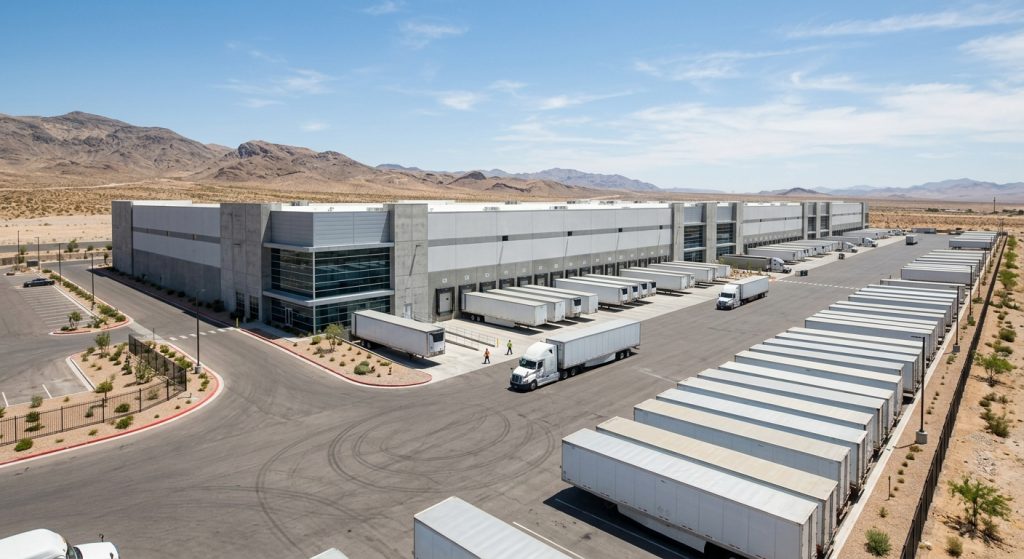
Vacancy in the Phoenix, Ariz. industrial market kept falling in the second quarter, dropping to 8.7% as tenants continued to absorb space faster than developers could deliver it, according to Colliers’ second-quarter 2026 Phoenix industrial market report. The decline shows the metro’s industrial sector still tightening even as construction starts have cooled from their pandemic-era peak.
Colliers reported that Phoenix-area industrial vacancy fell 50 basis points from the first quarter and 220 basis points from a year earlier. Net absorption reached 4.29 million square feet in the second quarter alone, pushing year-to-date absorption to 9.1 million square feet — about 1.9 million square feet ahead of the first half of 2025, the firm said.
Phoenix industrial market vacancy keeps tightening as construction slows
The vacancy declines were not uniform across the metro. Colliers said the Northwest submarket cluster posted the sharpest year-over-year improvement, with vacancy falling 800 basis points to 8.1% from 16.1% a year earlier. The Southeast Valley cluster, which includes Mesa and Chandler, remained the highest-vacancy submarket in the region at 11.6% even after a 120-basis-point quarterly decline, with 14.8 million square feet of direct vacant space still on the market, according to the report.
Leasing activity skewed toward the West Valley in the second quarter, with the five largest lease transactions of the quarter located along the Loop 303 corridor, Colliers said.
Construction pipeline holds near 15.5 million square feet
Colliers put the metro’s under-construction industrial pipeline at 15.5 million square feet as of the end of the second quarter, and said builder confidence is expected to hold up or improve through the rest of the year. Rental rates were largely stable in the quarter, with Colliers noting that supply constraints have kept headline asking rents firm even as some landlords offer more flexible lease incentives to close deals.
Investment sales activity slowed from the first quarter but still outpaced the first half of 2025 by $112 million, according to the report. The Southeast Valley accounted for 45% of industrial investment sales activity in the first half of the year, making it the most active submarket for capital deployment even as it continues to carry the region’s highest vacancy rate.
The Phoenix data tracks with broader national patterns of uneven industrial performance, where some metros are seeing rising vacancy as new supply outpaces demand, while developers in other markets continue to bring large speculative industrial projects online. RealtyWire covers these trends as part of its ongoing commercial real estate coverage.
What it means
Verified facts: Colliers’ own research, published on its website, shows Phoenix industrial vacancy at 8.7% in the second quarter of 2026, down from the prior quarter and from a year earlier, with 4.29 million square feet of net absorption in the quarter and 15.5 million square feet under construction. Submarket-level detail, such as the Northwest cluster’s vacancy drop and the Southeast Valley’s share of investment sales, comes directly from Colliers’ reported figures. RealtyWire’s analysis: continued absorption gains alongside a shrinking construction pipeline suggest the Phoenix industrial market is moving toward tighter conditions after several years of heavy new supply, though the persistently elevated vacancy in the Southeast Valley shows that tightening has not been even across the metro.