Hut 8 Corp. said it has fully leased its 1-gigawatt Beacon Point data center campus in Nueces County, Texas, after signing a second 15-year lease that the company values at $9.8 billion. The deal brings the campus’s total contracted value to $19.6 billion and comes as AI companies race to lock up power-ready data center capacity years in advance.
The Nasdaq- and Toronto Stock Exchange-listed company, which began as a bitcoin miner before pivoting into AI infrastructure, announced the lease on July 20 in a press release distributed through PR Newswire. The filing said an existing tenant at Beacon Point signed a 352-megawatt IT lease that doubles that customer’s contracted capacity at the site to 704 megawatts, filling out the full 1,000-megawatt campus.
What Hut 8 disclosed about the lease
According to the release, the new agreement is a 15-year, triple-net lease with a 3% annual base rent escalator and a base-term contract value of $9.8 billion, matching the value the company assigned to the first 352-megawatt lease at the campus when it was announced in May. Hut 8 said the tenant carries a high investment-grade credit rating, but the company did not name the tenant in either announcement.
Three five-year renewal options attached to the leases could lift the campus’s total contract value to as much as $50.2 billion if the tenant exercises all of them, Hut 8 said. That figure represents a hypothetical maximum tied to options that have not been exercised, not a guaranteed sum.
Hut 8 said its companywide contracted AI data center capacity now totals 949 megawatts, backed by 1,330 megawatts of utility capacity, for an aggregate base-term contract value of $26.6 billion across its portfolio. The company said it expects average annual net operating income of more than $1.75 billion once its contracted capacity is fully operational, and that 100% of that capacity is leased to or backstopped by investment-grade counterparties. Those are company-reported projections, not audited results.
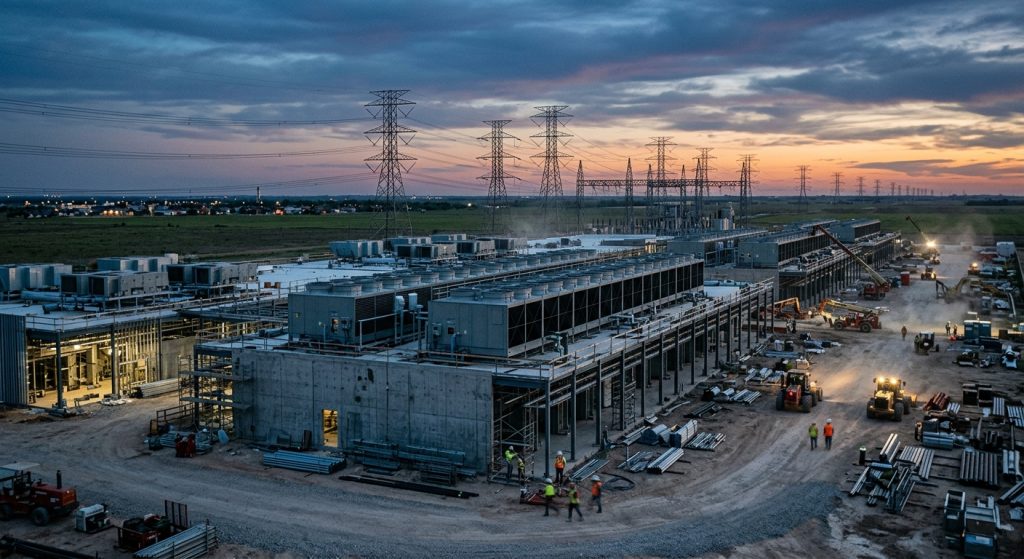
Site preparation for the second phase is underway, with initial energization targeted for the first quarter of 2027 and the first Phase 2 data hall expected to open in the second quarter of 2028, the company said. Hut 8 shares rose sharply in the days following the announcement, according to trading data.
Hut 8 CEO Asher Genoot said in the release that “the real test of our power-first approach is what our partners are willing to commit against it,” a characterization of the company’s strategy rather than an independently verified claim.
Why it matters
Beacon Point is one of several gigawatt-scale campuses that data center developers have brought to market this year as hyperscalers and AI labs compete for power capacity, a bottleneck that has become as important to AI expansion as chip supply. Hut 8’s disclosure that the entire 1-gigawatt campus is now under long-term lease, before the second phase has been built, underscores how far in advance large tenants are now contracting for future capacity.
The dollar figures attached to the leases — $9.8 billion per phase, $19.6 billion for the campus, and a potential $50.2 billion including renewal options — are Hut 8’s own accounting of contracted revenue over the life of the leases. They are not cash received upfront, and the renewal-option figure assumes future decisions by a tenant Hut 8 has not identified.
Other developers have pursued similar strategies. A separate 2-gigawatt data center project in Texas and OpenAI’s $20 billion data center buildout in Georgia reflect the same pattern of AI tenants committing to power-heavy sites well before delivery.
What it means: It is verified fact, from Hut 8’s own SEC-adjacent press release, that the company signed a second 352-megawatt, 15-year lease at Beacon Point and now considers the 1-gigawatt campus fully commercialized. The $9.8 billion and $19.6 billion figures are Hut 8’s stated base-term contract values, not independently audited numbers, and the identity of the tenant remains undisclosed. The $50.2 billion figure is a hypothetical ceiling contingent on renewal options that have not been exercised. RealtyWire’s analysis is that the deal signals continued aggressive forward-leasing of power capacity by AI tenants, though the actual economics depend on whether the named-but-undisclosed counterparty performs on a 15-year commitment.