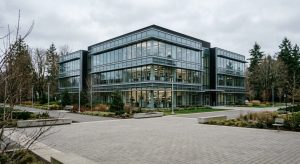
Piedmont Office Realty Trust raised its full-year 2026 earnings guidance for the second consecutive quarter after posting better-than-expected second-quarter results, the Atlanta-based office REIT announced July 28.
Core funds from operations (FFO), the REIT industry’s standard earnings measure, came in at $0.38 per diluted share for the quarter, ahead of Wall Street consensus by a penny. The company raised its full-year 2026 Core FFO guidance to a range of $1.50 to $1.55 per diluted share, up from its prior range of $1.49 to $1.54 — an increase equating to earnings growth of more than 8% for the year at the midpoint.
Piedmont also lifted its full-year 2026 same-store net operating income (NOI) guidance to a range of 5% to 8% on both a cash and GAAP basis, a meaningful step up that points to accelerating rent growth across the company’s existing portfolio rather than gains driven primarily by new acquisitions.
The company signed roughly 670,000 square feet of leases through the first half of 2026, part of an ongoing effort to fill its roughly 16 million-square-foot portfolio of Class A office properties concentrated in Sunbelt markets including Atlanta, Dallas, Orlando and Minneapolis. Piedmont has leaned on what it calls a "hospitality-driven approach," converting select buildings into what it brands "Piedmont PLACEs" — properties retrofitted with amenity-heavy common areas, dining and conferencing space designed to draw tenants back to the office.
The back-to-back guidance raises come as the broader office sector remains bifurcated: well-located, amenitized Class A buildings in growth markets have generally outperformed older or poorly located product, a trend reflected in improving office vacancy data in Sunbelt metros like Phoenix, where vacancy has fallen for three consecutive quarters. Piedmont’s Sunbelt-heavy footprint has positioned it to benefit from that flight-to-quality dynamic more than office landlords concentrated in slower-recovering coastal gateway markets.
Piedmont held a conference call and webcast on July 29 to discuss the results in greater detail, with a replay available through mid-August via the company’s investor relations site.
What it means: A second consecutive guidance raise, paired with same-store NOI guidance climbing to as much as 8%, signals that Piedmont’s leasing momentum is broad-based rather than a single large deal skewing the numbers. The office sector overall remains well below pre-pandemic occupancy levels nationally, so Piedmont’s results are best read as confirmation that Sunbelt Class A space specifically continues to recover faster than the national average — not as evidence the broader office downturn has ended. Investors should watch whether the company’s leasing pace holds through the back half of the year, when the tougher year-over-year comparisons from 2026’s stronger start will test whether the growth is sustainable or front-loaded.