
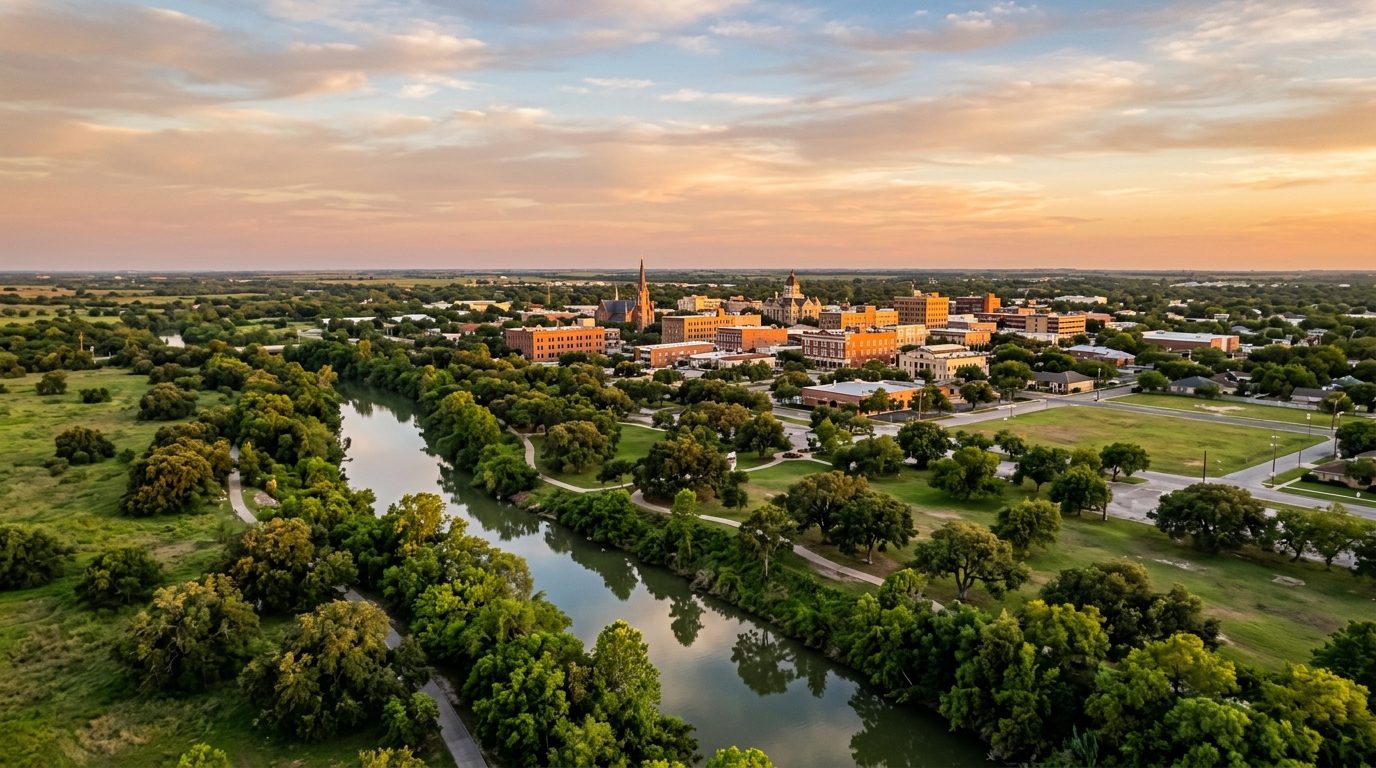
Current real estate market data, news and analysis for the Victoria, TX metropolitan area — 99,864 residents across Goliad and Victoria counties.
Data as of May 2026. Sources: Redfin Data Center, U.S. Census Bureau.
Latest Victoria Real Estate News
Coverage of this market is coming soon. Browse all housing market news.
Victoria Real Estate Market Overview
The Victoria metro area sits at the transition between the South Texas plains and the Gulf Coast prairie, in the Coastal Bend region between San Antonio, Corpus Christi, and Houston. The city of Victoria straddles the Guadalupe River, which continues southeast toward San Antonio Bay, while Goliad, seat of neighboring Goliad County, sits along the San Antonio River to the southwest. The terrain is flat to gently rolling coastal prairie, historically ranch and farm land, with mesquite, live oak, and pecan groves along the river bottoms. Housing stock reflects a long settlement history rather than a single building boom: downtown Victoria retains a core of early twentieth-century homes, including Victorian and bungalow-era houses near the original townsite, while surrounding rings carry mid-century ranch homes and newer single-story subdivisions toward its edges. Goliad’s housing is smaller in scale and more rural, mixing historic town-square structures with acreage and manufactured homes, which are generally more common in unincorporated parts of both counties than within Victoria’s city limits.
Within the metro, price tiers generally track proximity to the river corridor, established tree cover, and lot size rather than any single dominant driver. Older, centrally located neighborhoods near downtown Victoria and Riverside Park draw interest for their mature landscaping, walkability, and historic character, supporting higher relative values despite the age of the housing stock. Newer subdivisions on the city’s north and west sides, with larger modern floor plans, occupy the upper end of the new-construction market. More modest, older neighborhoods near the industrial corridor and rail lines, and manufactured-home areas on the city’s fringes, tend toward the lower end. Outside Victoria proper, unincorporated Victoria County and all of Goliad County trend toward lower density and lower price points, reflecting larger-acreage rural and agricultural land uses; Goliad itself, despite its historical prominence, has a small, slower-moving housing market.
The area’s economy rests on heavy industry, agriculture, healthcare, and education. Victoria’s industrial base includes petrochemical and plastics manufacturing along the Guadalupe River and Victoria Barge Canal, with facilities operated by Invista and Formosa Plastics, alongside manufacturers such as Caterpillar and Dow’s nearby Seadrift operations. The Port of Victoria connects these industries to the Gulf Intracoastal Waterway. Healthcare is anchored by DeTar Healthcare System’s hospitals and by Citizens Medical Center, both significant local employers. Cattle ranching and row-crop farming remain important across the surrounding counties, and higher education is represented by Victoria College and the University of Houston-Victoria. Goliad’s economy is smaller and oriented toward ranching, agriculture, and heritage tourism tied to its historic sites.
Buyers should weigh several regional factors. The area lies within reach of Gulf hurricanes and tropical storms, and portions of Victoria near the Guadalupe and San Antonio Rivers carry established floodplain designations, so flood insurance and elevation certificates are worth confirming property by property. Texas has no state income tax, and local government relies on property taxes assessed at the county level; homestead exemptions and agricultural-use valuations can affect tax bills on larger parcels. The metro has no fixed-rail transit, and daily life is oriented around personal vehicles, with the city of Victoria running a small local bus service. Development outside city limits is governed by county rules rather than municipal zoning, so buyers considering unincorporated land should verify subdivision covenants, septic and well permitting, and any extraterritorial jurisdiction rules before purchasing.
Cities and Towns in the Victoria Metro Area
Notable Communities and Neighborhoods
Victoria Real Estate Market FAQ
How is the Victoria, Texas metro area organized geographically?
The metro covers Victoria County and Goliad County in the Coastal Bend region of South Texas. The city of Victoria, the area’s population and economic center, sits along the Guadalupe River, while Goliad, the smaller historic county seat of Goliad County, lies along the San Antonio River to the southwest. The surrounding land is coastal prairie transitioning into the South Texas plains, historically used for ranching and farming.
Which parts of the metro tend to be pricier, and why?
Established, tree-lined neighborhoods near downtown Victoria and the riverfront parks tend to draw stronger interest for their mature landscaping, historic homes, and walkable settings. Newer subdivisions on the city’s outer edges with larger modern floor plans also sit toward the higher end of the new-construction market. Rural and unincorporated areas of both counties, along with Goliad itself, generally reflect lower density, larger acreage, and a more limited, slower-moving housing market.
What should buyers verify locally before purchasing in this area?
Buyers should confirm whether a property lies within a mapped floodplain along the Guadalupe or San Antonio Rivers, check county appraisal district records for property tax valuation and any agricultural exemptions, and, for land outside city limits, verify septic and well permitting, subdivision covenants, and county development rules rather than assuming municipal zoning applies.
What is the hurricane and flood insurance situation in the Victoria metro?
The area’s Gulf Coast proximity exposes it to hurricane and tropical storm activity, and parts of Victoria near its river corridors have documented flood histories and established floodplain designations. Buyers should check FEMA flood zone status for specific parcels, ask about elevation certificates where relevant, and factor flood and windstorm insurance costs into ownership budgets separately from standard homeowners coverage.
Nearby Markets