
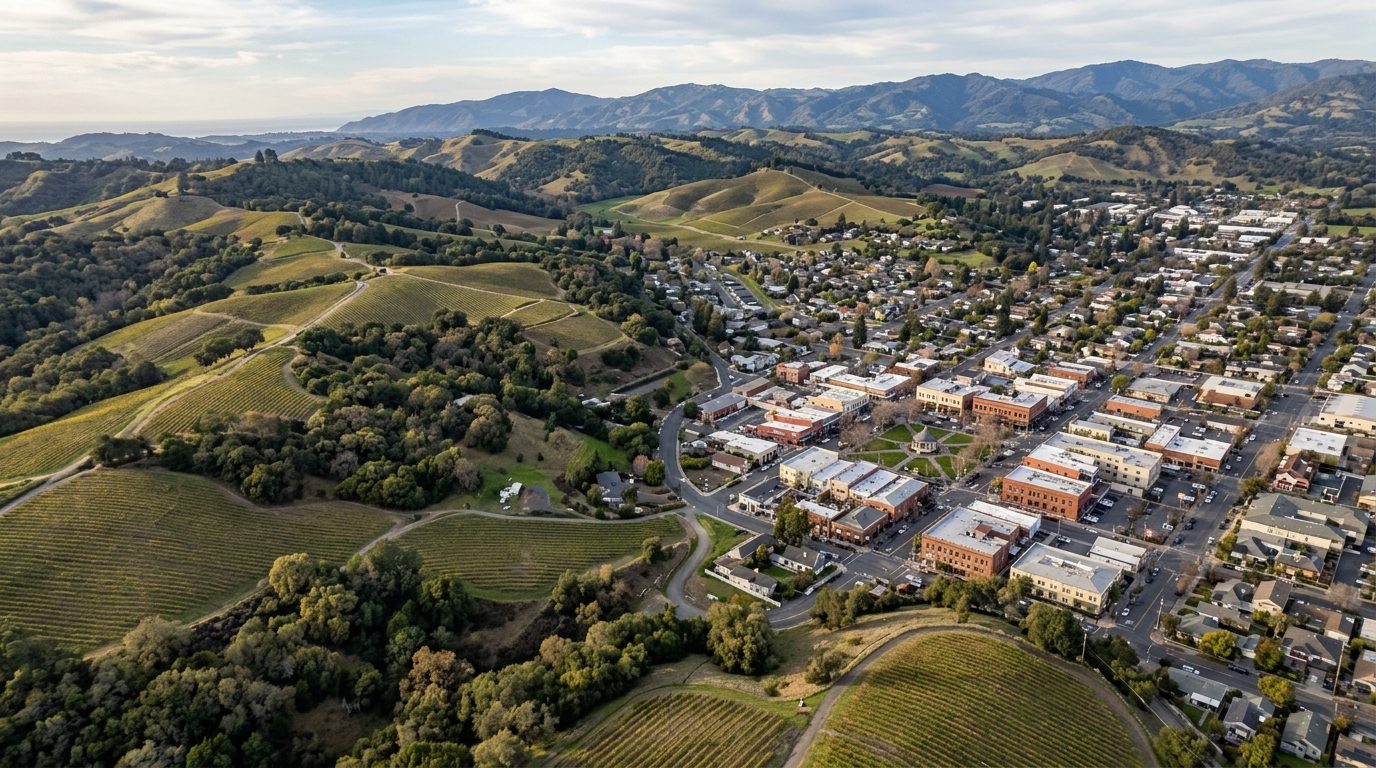
Current real estate market data, news and analysis for the Santa Rosa-Petaluma, CA metropolitan area — 486,444 residents across Sonoma county.
Data as of May 2026. Sources: Redfin Data Center, U.S. Census Bureau.
Latest Santa Rosa Real Estate News
Coverage of this market is coming soon. Browse all housing market news.
Santa Rosa Real Estate Market Overview
The Santa Rosa-Petaluma metro area occupies Sonoma County, a landscape of broad river valleys, oak-studded hillsides, and vineyard terraces stretching from the Mayacamas and Sonoma mountains in the east to cooler, fog-influenced hills near the Pacific coast in the west. Santa Rosa, the county seat, sits at the center of the Santa Rosa Plain, while Petaluma anchors the southern gateway along the Petaluma River near San Pablo Bay. Smaller towns including Healdsburg, Windsor, Cloverdale, and Sebastopol line the Russian River and Highway 101 corridor to the north, and Sonoma sits in its own valley to the southeast. Housing stock reflects this layered history: post-World War II ranch homes and mid-century subdivisions fill much of central Santa Rosa and Rohnert Park, older Victorian and Craftsman-era homes cluster in downtown Petaluma, Healdsburg, and Santa Rosa’s historic districts, and newer infill housing has filled in along urban edges in recent decades.
Pricing tiers track proximity to wine country amenities, commute distance toward the greater Bay Area, and school district reputation. Healdsburg, Sonoma, and the hillside and rural-residential pockets around Kenwood and Glen Ellen sit at the higher end, reflecting vineyard views, tourism-driven downtown cores, and larger parcels. Petaluma and Windsor occupy a middle tier, valued for walkable historic downtowns and a shorter drive toward Marin County. Santa Rosa spans a wide range, with hillside neighborhoods priced above flatland tracts closer to Highway 101. Rohnert Park and Cotati, built up around Sonoma State University and postwar suburban growth, along with Cloverdale at the county’s northern edge, tend to be more attainable, reflecting greater distance from the coast and fewer tourism amenities.
The economy blends agriculture, healthcare, technology, and tourism. Wine remains a defining industry, with wineries and grape-growing operations based throughout the county, including Jackson Family Wines, one of the area’s largest private employers. Healthcare is a major employment pillar, anchored by Kaiser Permanente’s Santa Rosa Medical Center, Providence Santa Rosa Memorial Hospital, and Sutter Santa Rosa Regional Hospital. Keysight Technologies, a test-and-measurement company with roots in Hewlett-Packard and Agilent Technologies, is headquartered in Santa Rosa, the largest technology employer to grow out of the county. Petaluma is home to Amy’s Kitchen, a large organic foods maker, reflecting the area’s food-processing base dating to Petaluma’s history as an egg and poultry hub. Tourism and Sonoma State University also support local employment.
Buyers should weigh several regional factors. Wildfire risk is significant: the 2017 Tubbs Fire destroyed thousands of homes in Santa Rosa neighborhoods including Coffey Park and Fountaingrove, and the 2019 Kincade Fire and 2020 Glass Fire caused further damage in the northern and eastern county, so buyers should check current fire-hazard-severity maps and any defensible-space requirements. Insurance availability and cost have become a real constraint in hillside and wildland-adjacent areas and should be confirmed before removing contingencies. Property taxes follow California’s Proposition 13 framework, tying assessed value to purchase price, so buyers should verify current assessments and any local bonds. Commuting toward Marin County and San Francisco is common from the southern metro, served by Highway 101 and the SMART commuter rail line linking Cloverdale, Santa Rosa, Rohnert Park, and Petaluma. Growth is shaped by agricultural preserve and urban growth boundary policies limiting sprawl into vineyard land, so buyers should independently verify zoning and well or septic status outside service areas.
Cities and Towns in the Santa Rosa Metro Area
Notable Communities and Neighborhoods
Santa Rosa Real Estate Market FAQ
How is the Santa Rosa-Petaluma metro area organized?
The metro covers Sonoma County and includes Santa Rosa as the county seat and largest city, along with Petaluma to the south near the Marin County line, Rohnert Park and Cotati around Sonoma State University, the wine-country towns of Healdsburg, Windsor, and Cloverdale along the Russian River corridor to the north, Sebastopol to the west, and the town of Sonoma in its own valley to the southeast. Each town has a distinct downtown core and character, ranging from historic agricultural centers to wine-tourism destinations.
Which parts of the metro tend to be more expensive, and why?
Healdsburg, the town of Sonoma, and rural-residential and hillside areas near wine country generally sit at the higher end, reflecting vineyard proximity, tourism-oriented downtowns, and larger lot sizes. Petaluma and Windsor occupy a middle tier tied to their historic downtowns and shorter commute distance toward Marin County and San Francisco. Areas farther from the coast and wine-tourism corridors, including parts of Rohnert Park, Cotati, and Cloverdale, tend to be more attainable.
What should buyers verify before purchasing in this metro?
Buyers should independently confirm a property’s fire-hazard-severity zone designation and any defensible-space or home-hardening requirements, check current homeowners insurance availability and terms rather than assuming a prior policy transfers, verify the assessed value and property tax basis under California’s Prop 13 rules along with any local bonds or special assessments, and confirm water and sewer service, or well and septic status, for properties outside city limits. Zoning and general plan designations are also worth checking directly with the relevant city or county planning department.
Is wildfire a serious concern for homebuyers in this area?
Yes. Sonoma County has experienced multiple major wildfires in recent years, including the 2017 Tubbs Fire, which destroyed large residential areas of Santa Rosa, the 2019 Kincade Fire in the northern county, and the 2020 Glass Fire in the eastern hills. Wildfire risk varies significantly by location, particularly in hillside and wildland-urban interface areas, and has made property insurance harder to obtain and more expensive in some neighborhoods. Buyers should check current fire-hazard maps and evacuation zone information and confirm insurability before committing to a purchase.
Nearby Markets