
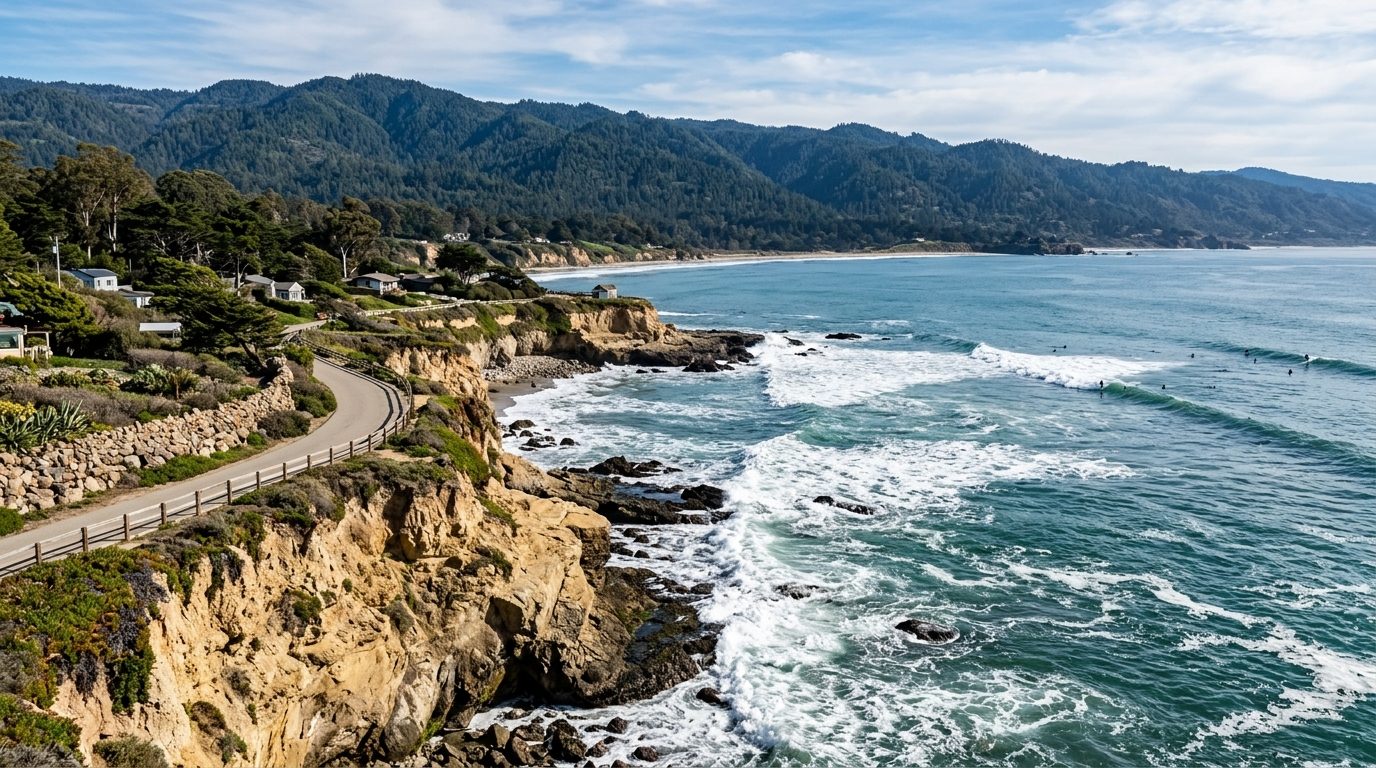
Current real estate market data, news and analysis for the Santa Cruz-Watsonville, CA metropolitan area — 258,852 residents across Santa Cruz county.
Data as of May 2026. Sources: Redfin Data Center, U.S. Census Bureau.
Latest Santa Cruz Real Estate News
Santa Cruz Real Estate Market Overview
Santa Cruz-Watsonville lies on the northern curve of Monterey Bay, bounded inland by the forested Santa Cruz Mountains and outward by sandstone bluffs and sandy beaches, terrain shifting quickly from coastal flats to steep, redwood-covered canyons and a mild coastal climate giving way to cooler, foggier hills. Santa Cruz mixes older Victorian and Craftsman homes near downtown with mid-century ranch houses on the Westside and in Live Oak, plus small cottages near the shoreline. Capitola centers on a compact village core with older bungalows and hillside homes above Soquel Creek. Scotts Valley, in a mountain valley along Highway 17, is more suburban, with newer subdivisions and larger lots. Watsonville and the Pajaro Valley retain a rural, agricultural character, with older downtown blocks and farmland mixed with newer tracts.
Homes closest to the ocean and to walkable commercial districts sit at the higher end of the market. Pleasure Point and Seabright in Santa Cruz, the bluffs along West Cliff Drive, and the village core of Capitola draw a premium for beach access, ocean views, and proximity to surf breaks. The Westside of Santa Cruz, close to downtown and the Municipal Wharf, also carries a premium for walkability and its mix of dining and shopping, as do neighborhoods near UC Santa Cruz tied to steady university demand. Moving inland and south, prices generally ease: the flatter Live Oak area, Scotts Valley over the mountain grade, and most of Watsonville and the Pajaro Valley sit at more accessible price points, reflecting distance from the coastline and an agricultural surrounding landscape. Unincorporated mountain communities vary widely, trading proximity for privacy.
The metro’s economy centers on education, healthcare, agriculture, and tourism. UC Santa Cruz, a research university set in redwood forest above the city, is among the area’s largest employers and a driver of housing demand near campus and downtown. Dominican Hospital serves the Santa Cruz area, while Watsonville Community Hospital anchors healthcare farther south. Agriculture remains central to the Pajaro Valley around Watsonville, home to Driscoll’s, a major berry marketer, along with Martinelli’s cider and Graniterock, businesses long based in the area. Tourism tied to the Santa Cruz Beach Boardwalk and the Municipal Wharf supports hospitality and retail jobs along the coast. Many residents also commute over Highway 17 to Silicon Valley jobs, linking housing demand here to broader South Bay employment even though the local economy itself is not tech-centered.
Several local factors shape ownership here. The San Andreas Fault runs through the county, and the region carries seismic risk that affects insurance underwriting and retrofit expectations. Wildfire risk is concentrated in the forested Santa Cruz Mountains, where past fires have burned through mountain communities and prompted stricter defensible-space rules. Along the shoreline, coastal bluff erosion affects properties near West Cliff Drive, and low-lying land near the Pajaro River carries flood exposure, including past levee trouble near Watsonville. Because California assesses property tax on purchase price under Proposition 13, buyers should confirm a property’s assessed basis, which can diverge sharply from a neighbor’s. Coastal development is further shaped by California Coastal Commission jurisdiction, which can restrict remodels or new construction near the shoreline. Buyers should verify whether a property relies on a private well or septic system, common in unincorporated areas, and confirm flood and fire hazard designations before assuming approval.
Cities and Towns in the Santa Cruz Metro Area
Notable Communities and Neighborhoods
Santa Cruz Real Estate Market FAQ
How is the Santa Cruz-Watsonville market area organized?
The metro consists of Santa Cruz County in its entirety, anchored by the incorporated cities of Santa Cruz, Capitola, Scotts Valley, and Watsonville. Much of the county’s housing stock, however, sits in unincorporated communities outside city limits, including coastal towns like Soquel, Aptos, and La Selva Beach and mountain communities like Felton, Ben Lomond, and Boulder Creek, all governed at the county rather than city level.
Which parts of the metro tend to be pricier, and why?
Areas directly on or within walking distance of the coastline, such as Pleasure Point, Seabright, the Westside of Santa Cruz, and Capitola Village, carry a premium tied to beach access and ocean views. Neighborhoods near downtown Santa Cruz and UC Santa Cruz also see elevated demand from walkability and proximity to the university. Inland and southern areas around Live Oak, Scotts Valley, and the Pajaro Valley near Watsonville tend to be more accessible, reflecting greater distance from the shoreline and a more agricultural surrounding landscape.
What should buyers verify locally before purchasing in this metro?
Buyers should confirm whether a property is on public water and sewer or relies on a private well and septic system, common in unincorporated parts of the county and the Santa Cruz Mountains. It is also worth checking flood zone status near creeks and the Pajaro River, fire hazard severity zone designation for hillside and mountain properties, and whether any remodel or addition would fall under California Coastal Commission review, which applies to much of the shoreline and can affect permitting timelines.
What is the main natural hazard consideration for homeowners here?
Seismic risk is a central consideration, since the San Andreas Fault runs through Santa Cruz County and the surrounding region is subject to earthquake shaking. Older homes may need retrofitting to meet current seismic standards, and standard homeowners insurance typically excludes earthquake damage, so separate earthquake coverage is a common consideration. Wildfire risk in the forested Santa Cruz Mountains and coastal bluff erosion along exposed stretches of shoreline are additional hazards specific to parts of the metro.
Nearby Markets