
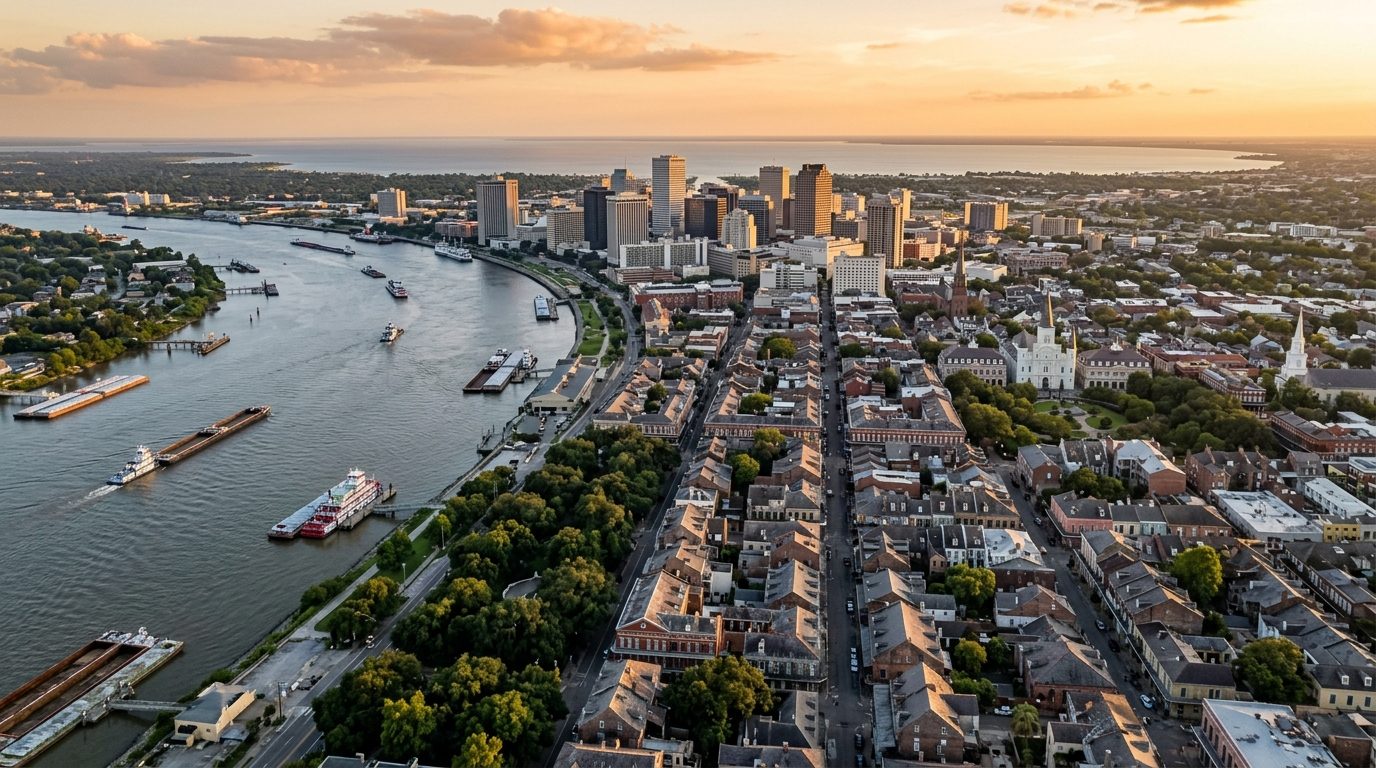
Current real estate market data, news and analysis for the New Orleans-Metairie, LA metropolitan area — 970,849 residents across 7 counties in Louisiana.
Data as of May 2026. Sources: Redfin Data Center, U.S. Census Bureau.
Latest New Orleans Real Estate News
New Orleans Real Estate Market Overview
The New Orleans metro occupies a low-lying delta bowl between Lake Pontchartrain to the north and the Mississippi River, whose curving path through the city gives New Orleans its "Crescent City" shape. Much of Orleans and Jefferson parishes sits at or below sea level, protected by an extensive levee, floodwall, and pump-station system that was substantially rebuilt after Hurricane Katrina. Elevation changes sharply over short distances: the highest, earliest-settled ground runs along the natural river levee, while low-lying areas closer to the lake sit well below grade. The climate is humid subtropical with an active hurricane season running from early summer into late fall. Housing stock is architecturally distinctive, from French Quarter Creole townhouses and courtyards to citywide shotgun houses and Creole cottages, many raised on piers rather than built on slab foundations, since a high water table makes basements essentially nonexistent. Suburban Jefferson Parish sits west of the city, a separate West Bank community lies across the river, and more rural, industrial river parishes and delta parishes extend further out.
Higher ground along the natural river levee — including the city’s historic riverside neighborhoods and an established suburb just west of the city line — carries the lowest flood risk and, generally, the strongest demand, helped by protected historic architecture and walkable streets. Lower-lying, lake-adjacent neighborhoods face a higher flood-insurance burden and tend to be more affordable, as do neighborhoods hit hardest by Hurricane Katrina that have rebuilt more gradually in the years since. The river parishes further from the urban core mix affordable rural and riverfront housing with proximity to industrial corridors that can weigh on desirability in some spots.
The Port of New Orleans, a major deepwater and container port on the lower Mississippi, anchors a broader logistics and shipping economy. Healthcare and higher education are major employers, led by a large regional hospital system and two universities in the city. Tourism, hospitality, and the convention business built around the French Quarter and downtown’s convention center form a core part of the private-sector economy, and energy and petrochemical operations remain a significant employer along the river parishes’ industrial corridor. A major energy utility is headquartered in the city as well.
Hurricane and flood risk shape nearly every part of the housing market here: FEMA flood zones vary block to block, and an elevation certificate documenting a structure’s finished-floor height relative to the base flood elevation is essential before buying. Louisiana’s private homeowners-insurance market has contracted significantly in recent years, pushing many owners — especially in the more exposed outlying parishes — toward the state’s insurer of last resort, so it’s worth getting a firm insurance quote before making an offer rather than assuming coverage will be affordable or even available. Property tax includes a homestead exemption for owner-occupants, administered separately by each parish’s assessor. Levee districts and parish drainage and pump systems are critical local infrastructure, and historic districts including the French Quarter and Garden District carry design-review rules that affect any exterior renovation. Transit includes buses, historic streetcar lines, and two river ferries, but a car is necessary for most of the metro.
Cities and Towns in the New Orleans Metro Area
Notable Communities and Neighborhoods
New Orleans Real Estate Market FAQ
How is the New Orleans metro housing market organized?
The market centers on the historic urban core along the natural river levee, with suburban Jefferson Parish to the west, a separate West Bank community across the Mississippi, and more rural, industrial river and delta parishes extending further out. Elevation changes sharply over short distances and shapes flood risk block by block.
Which parts of the New Orleans area tend to be more expensive?
Higher ground along the natural river levee, including the city’s historic riverside neighborhoods and an established suburb just west of the city, carries the lowest flood risk and generally the strongest demand. Lower-lying, lake-adjacent neighborhoods tend to be more affordable but carry a higher flood-insurance burden.
What should buyers verify before purchasing in the New Orleans metro?
Get an elevation certificate for any property to understand its finished-floor height relative to the base flood elevation, and get a firm homeowners and flood insurance quote before making an offer, since coverage availability and cost vary block to block. Check whether a property is within a historic district carrying design-review rules that affect renovations.
What should buyers know about hurricane and insurance risk in New Orleans?
Louisiana’s private homeowners-insurance market has contracted significantly, and many owners in more exposed parishes rely on the state’s insurer of last resort. It’s worth confirming insurance availability and cost for a specific property early in the buying process rather than assuming it will be straightforward.
Nearby Markets