
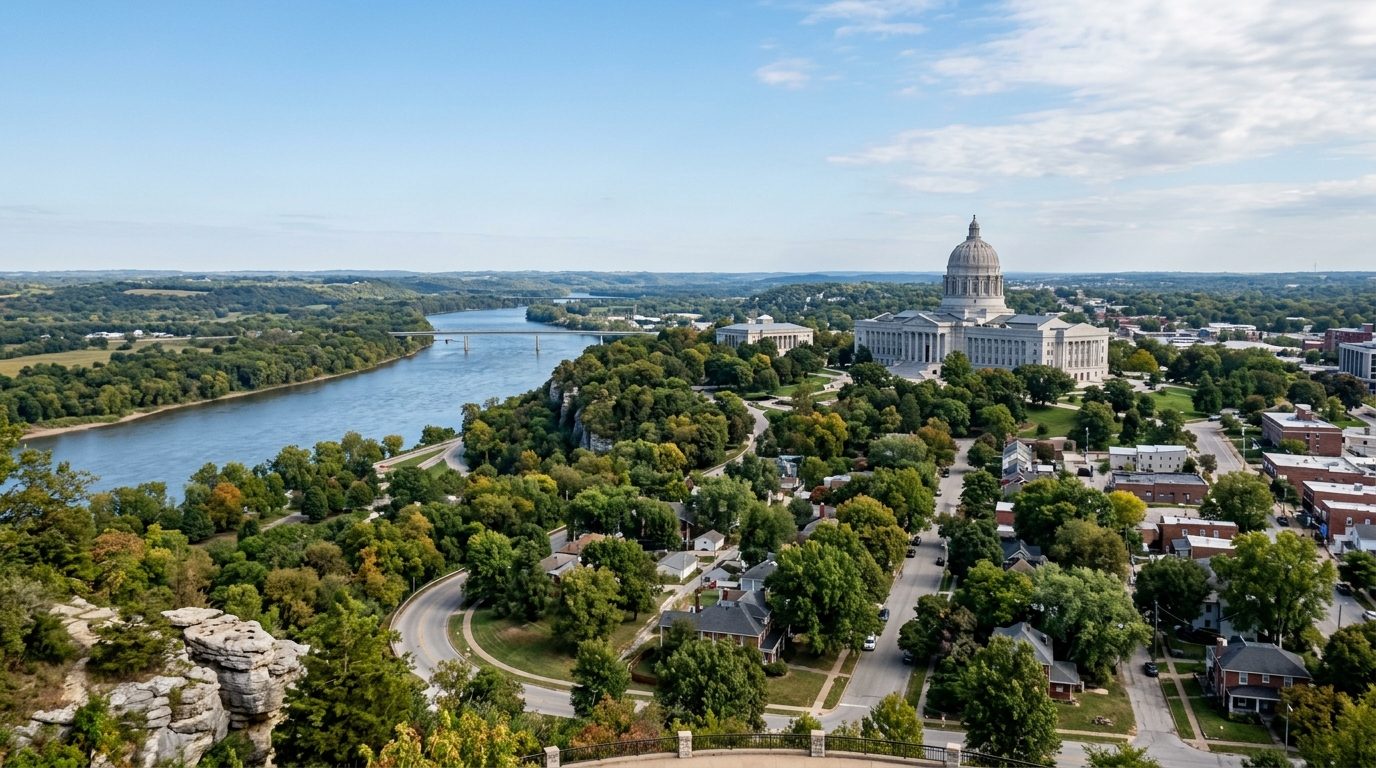
Current real estate market data, news and analysis for the Jefferson City, MO metropolitan area — 152,712 residents across Callaway, Cole, Moniteau and Osage counties.
Data as of May 2026. Sources: Redfin Data Center, U.S. Census Bureau.
Latest Jefferson City Real Estate News
Coverage of this market is coming soon. Browse all housing market news.
Jefferson City Real Estate Market Overview
Jefferson City sits astride the Missouri River near the center of the state, where the river cuts through limestone bluffs at the edge of the Ozark uplift. The core of the city rises from the riverbank in a series of terraces and ridges, with the State Capitol dome anchoring the skyline above the water. Streets in the older sections follow the contours of the bluffs rather than a strict grid, producing narrow lots, alleys, and hillside staircases. Housing stock nearest the river and the Capitol tends toward brick bungalows, foursquares, and other early-twentieth-century styles built when state government and river commerce anchored the local economy. Farther from downtown the terrain flattens into rolling farmland and wooded ridges that host ranch homes, split-levels, and newer subdivisions with curving streets typical of later suburban development.
Homes closest to the Capitol and the historic downtown core carry a mix of values: some buyers pay a premium for restored architecture and walkable proximity to state offices, while other blocks in the same area show deferred maintenance that keeps prices lower. Neighborhoods on the bluffs and ridgelines west and southwest of downtown, sitting above the floodplain and feeding into well-regarded school attendance zones, generally command higher prices because of their elevation, larger lots, and newer construction. Areas closer to the river itself, including low-lying sections north of the Missouri River and older river-adjacent settlements, sit toward the lower end of the range because of recurring flood exposure and older infrastructure. Outlying towns within commuting distance offer a wider spread of lot sizes and construction eras, with price differences tracking distance from the capital and school district reputation more than any single factor.
State government is the dominant force in the local economy, since Jefferson City is the seat of Missouri government and hosts the Capitol, executive agencies, and the General Assembly. Lincoln University, a public historically Black land-grant institution located in the city, adds higher-education employment and draws students and faculty into the housing market. Healthcare is anchored by Capital Region Medical Center and SSM Health St. Mary’s Hospital, both major regional providers. Manufacturing, distribution, and finance round out the base, with employers such as Scholastic’s distribution operations, ABB’s power transmission and distribution plant, and Unilever operating alongside homegrown financial institutions including Central Bancompany and Hawthorn Bancshares. In neighboring Callaway County, Fulton contributes its own institutional base, anchored by Westminster College, William Woods University, and Ameren’s Callaway nuclear power plant.
Because the city and several surrounding towns border the Missouri River, flood risk is a persistent consideration; low-lying blocks near the river and in river-adjacent communities have flooded in the past, and some riverside land has since reverted to parkland or open space rather than being rebuilt. Severe weather is also a factor, since the region lies within a corridor prone to tornadoes, and a damaging tornado once cut across the city itself, prompting rebuilding in several neighborhoods. Missouri’s overall property tax burden is generally moderate compared with other states, though rates vary by county, school district, and special taxing district. Outside incorporated city limits, land-use regulation across Cole, Callaway, Moniteau, and Osage counties tends to be limited, so rural and exurban parcels carry less zoning oversight than land inside town boundaries, and development tends to follow the highway corridors radiating outward from Jefferson City.
Cities and Towns in the Jefferson City Metro Area
Notable Communities and Neighborhoods
Jefferson City Real Estate Market FAQ
What makes the Jefferson City housing market different from other Missouri metros?
Its market is shaped heavily by state government employment, which draws a steady stream of public-sector workers, and by its layout along Missouri River bluffs, which creates significant variation in terrain, lot size, and flood exposure between neighborhoods.
Are homes near the Missouri River at risk of flooding?
Low-lying blocks close to the river and in older river-adjacent settlements have flooded in the past, so buyers considering property near the water typically want to understand its elevation and flood history before purchasing.
What industries support the local job market?
State government is the largest driver, supplemented by higher education through Lincoln University and the Fulton colleges, healthcare systems including Capital Region Medical Center and SSM Health St. Mary’s Hospital, and a mix of manufacturing, distribution, and banking employers.
Is the Jefferson City area prone to severe weather?
The region sits within a corridor where tornadoes and strong thunderstorms occur, and the capital itself has experienced a tornado strike directly through parts of the city, so storm shelters and wind-resistant construction are common considerations for local homeowners.
Nearby Markets