
Current real estate market data, news and analysis for the Hattiesburg, MS metropolitan area — 158,014 residents across Forrest, Lamar and Perry counties.
Sources: U.S. Census Bureau.
Latest Hattiesburg Real Estate News
Coverage of this market is coming soon. Browse all housing market news.
Hattiesburg Real Estate Market Overview
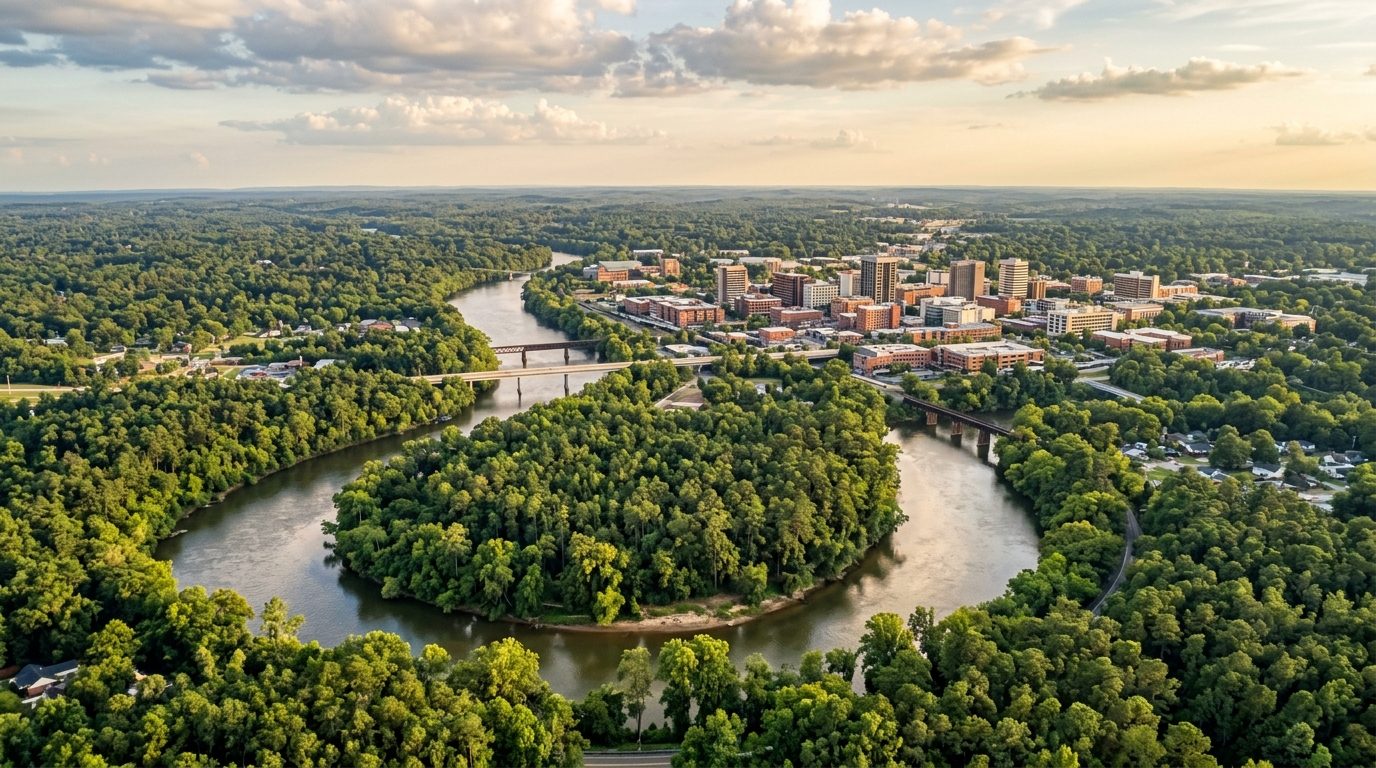
Hattiesburg sits at the confluence of the Leaf and Bouie rivers in the Piney Woods region of southeast Mississippi, a landscape of longleaf pine forest, gently rolling terrain, and scattered wetlands along the waterways that thread through Forrest, Lamar, and Perry counties. The metro’s housing stock reflects a long build-out: a compact historic core near downtown Hattiesburg with early-twentieth-century cottages, bungalows, and revival-style homes, ringed by mid-century brick ranch neighborhoods, and extending outward into newer subdivisions of traditional and craftsman-style homes on larger wooded lots. Development has generally pushed westward into Lamar County and eastward across the river into Petal, while Perry County to the south remains largely rural and forested.
Within the metro, price tiers track school-district reputation, newer construction, and proximity to Hattiesburg’s employment centers more than any single factor. Lamar County communities such as Oak Grove, Sumrall, and Purvis have drawn sustained suburban growth and tend to command higher prices, helped by newer schools, master-planned and golf-course communities, and easy highway access into Hattiesburg. Petal, across the Leaf River from downtown, carries similar appeal through its own school district and newer subdivisions. Closer to the urban core, older Hattiesburg neighborhoods offer historic character and walkable streets at comparatively lower price points that reflect their age, while outlying parts of Forrest County and rural Perry County, including Richton, New Augusta, and Beaumont, trade lower prices for larger lots, longer commutes, and fewer municipal services.
The metro’s economy centers on education, healthcare, military training, and forest-products manufacturing. The University of Southern Mississippi and William Carey University anchor Hattiesburg as a regional education hub, drawing students and staff from across south Mississippi, with Pearl River Community College and Jones College serving as additional higher-education anchors nearby. Forrest General Hospital, Merit Health Wesley, and Hattiesburg Clinic make Hattiesburg the medical center for a multi-county region, and the Camp Shelby Joint Forces Training Center, one of the largest state-owned training installations in the country, supports military and civilian jobs just south of the city. Manufacturing has deep roots here as well: Kohler Engines operates an engine plant in Hattiesburg, and Georgia-Pacific runs both a converting facility in Hattiesburg and the Leaf River Cellulose Mill near New Augusta in Perry County, linking the metro’s economy to the region’s long-standing timber industry.
Buyers should weigh a few region-specific factors before purchasing. The metro lies far enough inland to avoid direct coastal storm surge, but it still experiences hurricane remnants bringing heavy rain, high wind, and occasional tornado activity spun off from tropical systems, so wind and hail coverage terms are worth reviewing closely. Portions of Hattiesburg and other low-lying areas near the Leaf and Bouie rivers and their tributary creeks fall within mapped flood hazard areas, making a flood-zone check and elevation review worthwhile even outside the immediate riverfront. Mississippi’s property tax system includes a homestead exemption for owner-occupied homes, and land-use rules vary by jurisdiction. Some unincorporated areas of Forrest, Lamar, and Perry counties have limited zoning oversight compared with incorporated towns, so buyers should confirm covenants, easements, and utility access, municipal water and sewer versus well and septic, directly with the county or a title company before closing.
Cities and Towns in the Hattiesburg Metro Area
Notable Communities and Neighborhoods
Hattiesburg Real Estate Market FAQ
How is the Hattiesburg, MS real estate market organized geographically?
The Hattiesburg metro spans three counties: Forrest and Lamar, which form the urbanized core around Hattiesburg and Petal, and Perry, a more rural, heavily forested county to the southeast. Forrest County includes the city of Hattiesburg itself, Lamar County includes fast-growing suburbs like Oak Grove, Purvis, and Sumrall on the west side of the metro, and Perry County includes the smaller towns of Richton, New Augusta, and Beaumont. Most day-to-day housing activity concentrates in Hattiesburg, Petal, and the Lamar County suburbs, with Perry County offering a more rural, lower-density alternative.
Which areas of the Hattiesburg metro tend to be pricier, and why?
Suburban Lamar County, including Oak Grove, Sumrall, and Purvis, along with golf-course communities such as Canebrake and Timberton, tends to carry higher prices due to newer construction, larger lots, and school-district reputation. Petal, situated across the Leaf River from downtown Hattiesburg, sees similar demand for its own schools and newer subdivisions. Older, more centrally located Hattiesburg neighborhoods and the rural stretches of Forrest and Perry counties generally offer lower price points, reflecting older housing stock, distance from job centers, or fewer nearby amenities.
What should buyers verify locally before purchasing a home in the Hattiesburg area?
Buyers should confirm which school district and municipality a property falls in, since city, county, and school-district lines don’t always align across Forrest, Lamar, and Perry counties. It’s also worth checking whether a home is served by municipal water and sewer or relies on a private well and septic system, particularly in unincorporated or rural areas where county land-use oversight can be limited. For properties in or near a subdivision, buyers should review any homeowners association covenants, dues, and architectural restrictions directly with the HOA.
Is the Hattiesburg metro at risk from hurricanes or flooding?
Hattiesburg sits far enough inland to avoid direct storm surge, but it remains within reach of hurricane remnants that can bring heavy rainfall, high winds, and occasional tornadoes spun off from tropical systems. Separately, portions of Hattiesburg and other areas near the Leaf and Bouie rivers and their tributary creeks lie within mapped flood hazard zones. Buyers should check a specific property’s FEMA flood zone status and ask about wind, hail, and flood insurance coverage before closing, even for homes that aren’t directly on the riverfront.
Nearby Markets