
Current real estate market data, news and analysis for the Corvallis, OR metropolitan area — 97,728 residents across Benton county.
Data as of May 2026. Sources: Redfin Data Center, U.S. Census Bureau.
Latest Corvallis Real Estate News
Coverage of this market is coming soon. Browse all housing market news.
Corvallis Real Estate Market Overview
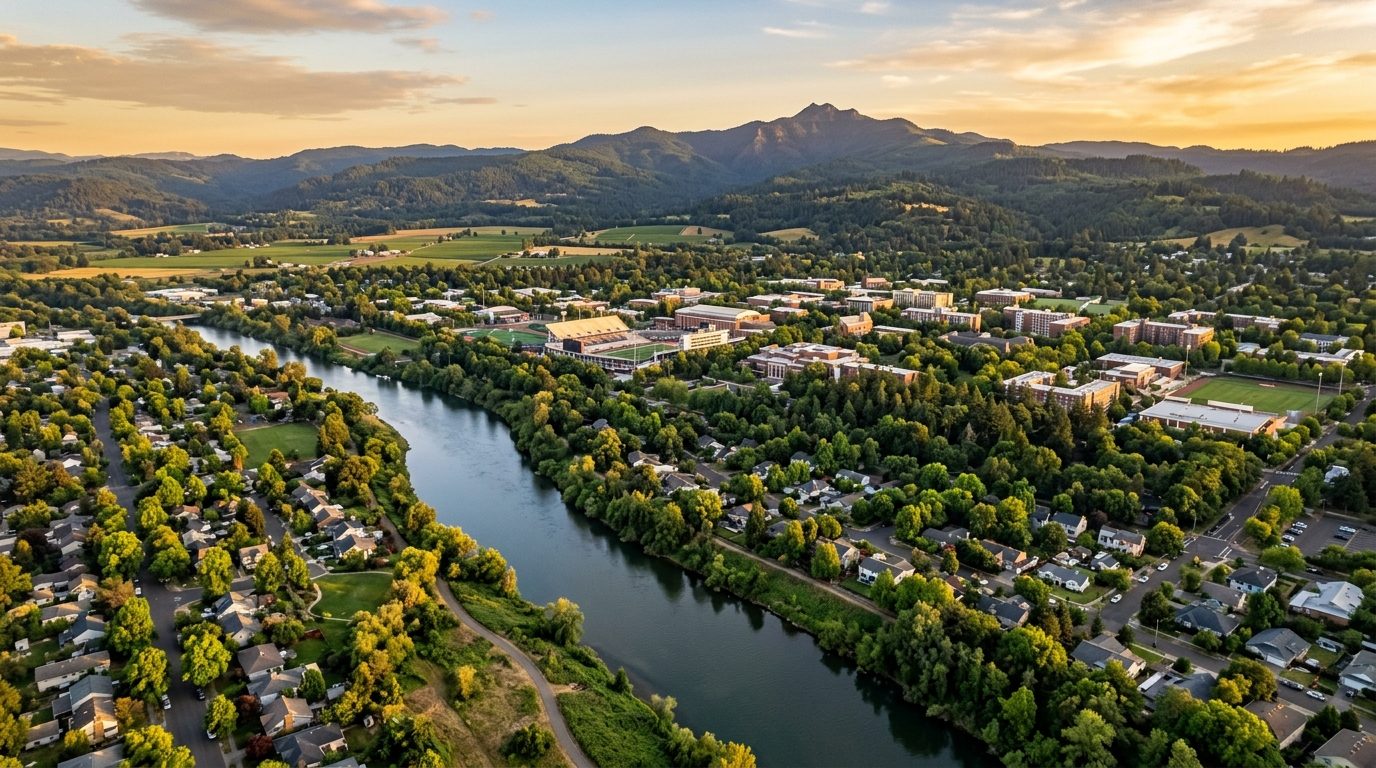
The Corvallis metro sits in the mid-Willamette Valley of western Oregon, along the Willamette River between the flat valley floor and the forested foothills of the Coast Range. Marys Peak, the tallest summit in the Coast Range, rises just west of the city and shapes long sightlines from many neighborhoods. Surrounding countryside is given over to grass seed farms and other row crops, giving the metro a working rural edge close to downtown. Housing stock reflects the city’s identity as a university town: a historic core of early twentieth-century bungalow and craftsman homes near campus and downtown, ringed by mid-century ranch and split-level subdivisions, hillside homes with valley or forest views, and newer construction at the edges. Philomath, Monroe, and Adair Village, the smaller surrounding towns, lean more rural and small-town, with acreage properties and manufactured homes contrasting with the denser, walkable core of Corvallis proper.
Price tiers track elevation, proximity to Oregon State University, and distance from the river. Hillside and west-side areas with valley or forest views and larger lots tend toward the higher end, reflecting both the view premium and distance from river-adjacent flood exposure. Areas close to campus and downtown mix investor-owned rental housing serving students with owner-occupied historic homes, with pricing driven more by walkability than lot size. Low-lying areas along the river and toward the valley floor, where drainage and seasonal high water recur, tend toward the more modest end. The outlying towns generally offer lower entry points, trading commute distance for more land and quieter surroundings.
The economy centers on Oregon State University, whose faculty, staff, and students make it the dominant employer in the region and the primary driver of housing demand near campus. Healthcare is the other anchor, led by Samaritan Health Services, a nonprofit hospital and clinic system headquartered in Corvallis that operates Good Samaritan Regional Medical Center. Technology manufacturing also has a long presence through Hewlett-Packard, which operates a research and development campus in Corvallis dating to the company’s early expansion outside California. Agriculture remains a substantial part of the base outside the city itself: the surrounding Willamette Valley is one of the world’s leading grass seed production regions, supporting seed conditioning plants and farm supply businesses across Benton County. Together, the university, the hospital system, the technology campus, and the farmland form a diversified, closely linked local economy.
Buyers should weigh several Oregon-specific factors. The state has no general sales tax, and property taxes follow voter-approved limitation measures tying assessed value growth to formulas independent of market value, so comparable homes can carry different tax bills, worth confirming with the county assessor. Oregon’s statewide land-use system requires cities to maintain an urban growth boundary, and Corvallis’s boundary limits how much land can be developed for housing, pushing construction toward infill rather than sprawl; check a property’s zoning and applicable area plan. Flooding and seasonal high water along the Willamette River affect low-lying sections of the metro, particularly south of downtown, so flood zone status is worth verifying locally. Wildfire smoke drifting in from forests elsewhere in the region during late summer is a recurring seasonal air-quality issue rather than a direct fire threat, though Coast Range foothill properties warrant closer scrutiny. Corvallis also runs a fare-free bus system and bicycle infrastructure, making car-free living practical near campus.
Cities and Towns in the Corvallis Metro Area
Notable Communities and Neighborhoods
Corvallis Real Estate Market FAQ
How is the Corvallis metro area organized geographically?
The metro is centered on the city of Corvallis, which sits along the Willamette River in the mid-Willamette Valley, with the Coast Range and Marys Peak rising to the west. Oregon State University’s campus sits near the center of the city, and neighborhoods radiate outward from downtown and campus toward hillside areas to the west and flatter agricultural land to the south and east. Smaller incorporated towns, including Philomath toward the Coast Range foothills, Adair Village to the north, and Monroe to the south, round out the metro and offer a more rural counterpoint to the university city at its core.
Which areas of the Corvallis metro tend to be pricier, and why?
Hillside and west-side neighborhoods with valley or forest views, larger lots, and quieter streets tend to sit toward the higher end of the market, both for the view premium and because they sit above the flood-prone valley floor. Areas immediately around campus and downtown carry their own premium tied to walkability, though much of that housing stock is investor-owned rental property serving students rather than owner-occupied homes. Low-lying areas along the Willamette River and outlying small towns farther from campus and job centers tend to be more affordable, reflecting drainage considerations, commute distance, or fewer in-town amenities.
What should buyers verify before purchasing in the Corvallis area?
Buyers should confirm a property’s zoning and any applicable neighborhood or area plan with the city or county, since Oregon’s land-use system and Corvallis’s urban growth boundary shape what can be built where. Flood zone status and drainage history are worth checking directly with local authorities, particularly for property near the Willamette River or in South Corvallis. Because Oregon’s property tax system ties assessed value to formulas independent of market value, buyers should also request the current assessment history from the county assessor rather than assume it tracks a home’s sale price. In the smaller outlying towns, confirming well and septic status versus municipal water and sewer service is also worthwhile.
How does Oregon’s urban growth boundary affect the Corvallis housing market?
Oregon’s statewide land-use planning law requires every city to maintain a mapped urban growth boundary separating land available for urban development from farmland and forest land outside it. Corvallis’s boundary is drawn tightly against the Willamette River, the Coast Range foothills, and surrounding farmland, which limits how much vacant land is available for new subdivisions and pushes much of the city’s growth toward infill, redevelopment, and periodic boundary expansions rather than open sprawl. For buyers, this means new construction concentrates in specific planned areas rather than spreading evenly across the metro, and it is one reason the character of Corvallis’s housing stock skews toward older, established neighborhoods relative to some faster-growing metros.
Nearby Markets