
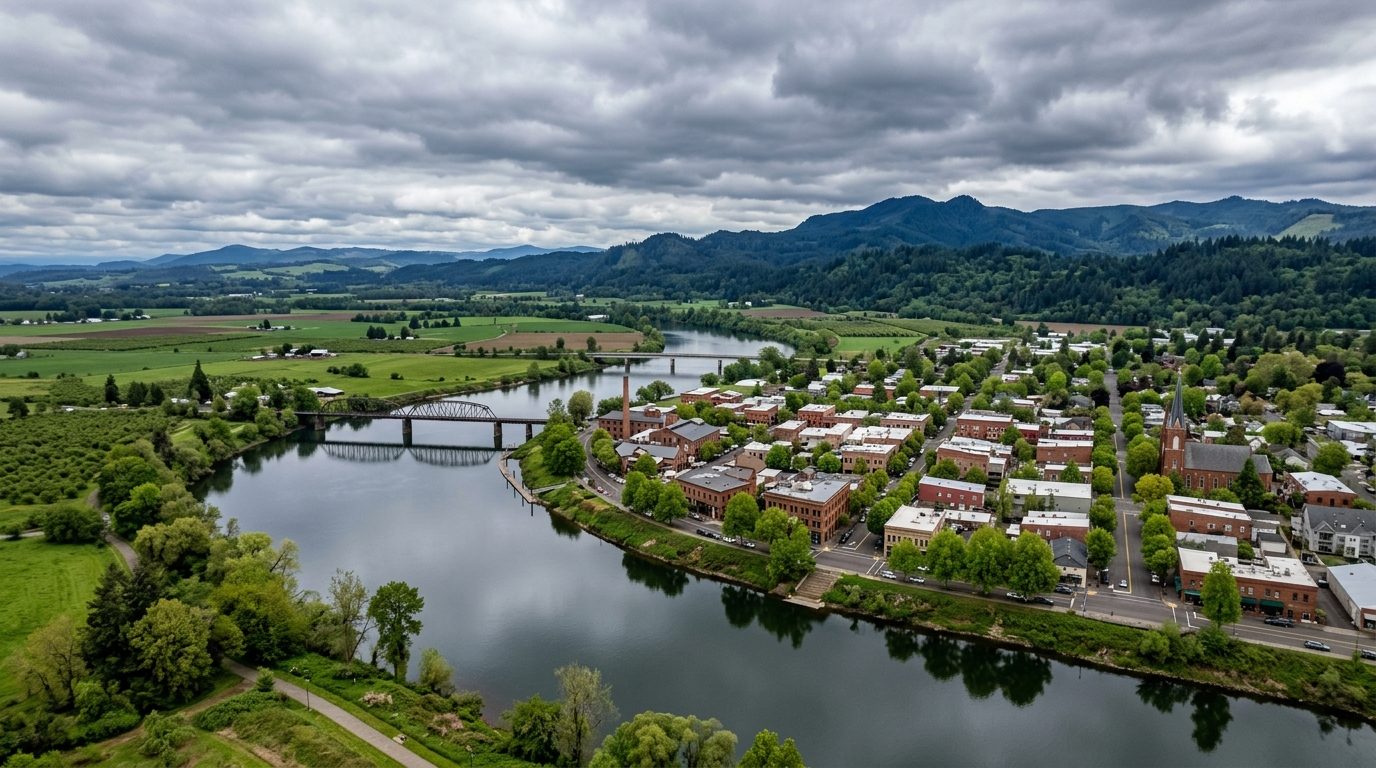
Current real estate market data, news and analysis for the Albany, OR metropolitan area — 132,843 residents across Linn county.
Data as of May 2026. Sources: Redfin Data Center, U.S. Census Bureau.
Latest Albany Real Estate News
Coverage of this market is coming soon. Browse all housing market news.
Albany Real Estate Market Overview
Albany, Oregon anchors Linn County at the confluence of the Willamette and Calapooia rivers in the mid-Willamette Valley, roughly midway between Portland and Eugene along Interstate 5. The metro extends beyond the city to smaller Linn County communities across the valley floor and eastern foothills, including Lebanon, Sweet Home, Brownsville, Harrisburg, Scio, Halsey, Tangent, Millersburg, Sodaville, Waterloo, Mill City, and Lyons, ranging from flat farmland planted in grass seed to timbered foothills. Housing stock reflects this layered history: downtown Albany retains a dense concentration of Victorian, Craftsman, and early twentieth-century homes within its historic districts, while surrounding neighborhoods and outlying towns are built out in mid-century ranch houses and newer suburban subdivisions on former farmland. Manufactured and site-built rural homes on acreage are common outside city limits, and farmland borders residential areas on most sides of Albany.
Price tiers within the metro track lot size, age of construction, and proximity to the rivers. North Albany, on higher ground north of the Willamette River, draws a premium for its larger lots, newer construction, and rural-edge feel while remaining close to downtown. The historic districts near the city core carry value tied to architectural character and walkable access to downtown and the Amtrak station, though homes there are older and require ongoing maintenance. More modest, older housing sits in flatter neighborhoods closer to the rivers and rail lines. Smaller outlying towns and Santiam Canyon communities such as Mill City and Lyons lean toward more affordable, smaller-footprint housing, reflecting distance from Albany’s employment base, fewer services, and, in the canyon towns, wildfire exposure following the 2020 Santiam Canyon fires.
The regional economy is anchored by specialty metals manufacturing, healthcare, education, and food processing. Millersburg, adjacent to Albany, is home to ATI Specialty Alloys & Components (formerly Wah Chang), a longtime producer of zirconium, titanium, and other rare metals used in aerospace, defense, and nuclear applications. OFD Foods, a major freeze-dried food manufacturer, is headquartered in Albany. Samaritan Health Services operates hospitals and clinics across the area, including Samaritan Albany General Hospital and Samaritan Lebanon Community Hospital, making healthcare a leading employer. Linn-Benton Community College serves as a regional education and workforce-training hub. In Lebanon, Entek International manufactures battery separator materials and a Lowe’s regional distribution center is a significant employer, while grass-seed and row-crop farming remain an economic mainstay valley-wide.
Several regional factors are worth verifying before buying. Portions of Albany and other river-adjacent communities sit within FEMA-designated floodplains along the Willamette, Calapooia, and Santiam rivers, so flood zone status and insurance requirements should be confirmed parcel by parcel. Santiam Canyon communities, including Mill City and Lyons, carry elevated wildfire exposure, and insurance availability can vary accordingly. Oregon’s property tax system, shaped by Measure 50, taxes most homes on an assessed value that grows more slowly than market value, so a low current tax bill does not predict the tax on a newly purchased or newly built home. Oregon’s statewide land use planning system requires cities to maintain urban growth boundaries, concentrating development inside city limits and limiting subdivision of outlying farmland; buyers looking at rural or edge-of-town parcels should check zoning, water rights, and septic or well status with Linn County. Amtrak Cascades and several small transit systems connect Albany to Salem, Eugene, and Portland, but most local travel depends on driving.
Cities and Towns in the Albany Metro Area
Notable Communities and Neighborhoods
Albany Real Estate Market FAQ
How is the Albany, Oregon housing market organized geographically?
The metro centers on the city of Albany at the confluence of the Willamette and Calapooia rivers and extends across Linn County to smaller communities like Lebanon, Sweet Home, Brownsville, and the Santiam Canyon towns of Mill City and Lyons. Each town functions as a fairly distinct submarket, with the city of Albany serving as the primary commercial and employment hub.
Which areas within the Albany metro tend to be pricier?
North Albany, situated on higher ground north of the Willamette River, tends to command a premium for its larger lots and newer construction. Albany’s historic districts near downtown also carry value tied to architectural character and walkability. Housing in smaller, more remote towns and the Santiam Canyon tends to be more modest, reflecting distance from the main employment base and fewer local services.
What should buyers verify locally before purchasing in this area?
Buyers should confirm FEMA flood zone status for any property near the Willamette, Calapooia, or Santiam rivers, since flood insurance requirements are determined parcel by parcel. For rural or edge-of-town parcels, buyers should also check zoning under Oregon’s urban growth boundary system, along with water rights and septic or well status, directly with Linn County. Because Oregon’s property tax system caps assessed value growth rather than taxing full market value, buyers should also ask how a purchase or new construction will affect the tax bill going forward.
What is the primary region-specific risk to be aware of in this metro?
Wildfire exposure is a notable risk in the eastern, foothill portions of the metro, particularly the Santiam Canyon communities of Mill City and Lyons, which were directly affected by the 2020 Santiam Canyon wildfires. Flood risk along the Willamette, Calapooia, and Santiam rivers is a second, geographically distinct consideration for properties closer to the valley floor and river corridors.
Nearby Markets