
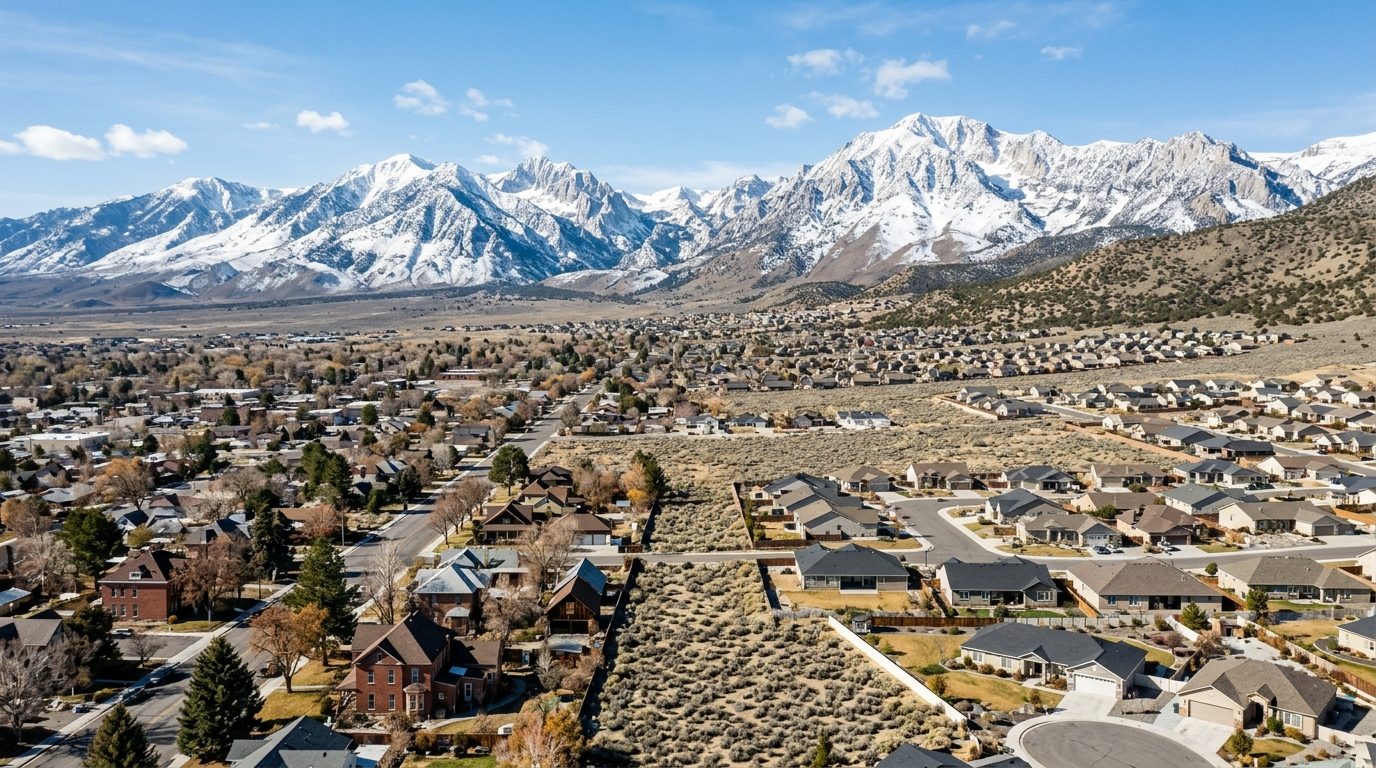
Current real estate market data, news and analysis for the Carson City, NV metropolitan area — 58,571 residents across Carson City county.
Data as of May 2026. Sources: Redfin Data Center, U.S. Census Bureau.
Latest Carson City Real Estate News
Coverage of this market is coming soon. Browse all housing market news.
Carson City Real Estate Market Overview
Carson City sits in Eagle Valley, a high desert basin pressed against the eastern face of the Sierra Nevada and the Carson Range, with the Pine Nut Mountains rising to the southeast and the Carson River crossing the valley’s southern edge. Lake Tahoe is a short drive west over the mountains, and Reno lies to the north, giving the capital a setting that mixes sagebrush valley floor with forested foothill terrain. Housing stock reflects that layered geography: a compact historic core of nineteenth-century Victorian, Craftsman, and Colonial Revival homes near downtown, ringed by mid-century and later suburban tracts on the valley floor, and newer subdivisions climbing into the foothills and southern edge of the city. Because Carson City functions as a single consolidated city-county, its housing spans this full range within one compact jurisdiction rather than being split across many incorporated suburbs.
Within that footprint, price tiers generally track elevation, lot size, and age of construction rather than distance from any single center. Foothill and western-edge neighborhoods that back up to the Carson Range tend to command more for their larger lots, mountain and valley views, and newer or custom construction. The historic downtown core carries a different kind of value tied to architectural pedigree and walkability rather than square footage, with a wide range of home conditions from restored landmarks to smaller original-era houses. Valley-floor neighborhoods built out in the mid-to-late twentieth century sit in a more moderate tier, while newer master-planned development on the city’s southern side offers contemporary construction at a range of price points depending on lot premiums and builder.
Carson City’s economy is anchored by its role as the seat of Nevada state government, which supports a large share of local employment through executive agencies, the Legislature, and related administrative offices. Healthcare is another major pillar, centered on Carson Tahoe Health’s regional hospital and outpatient network. A notable manufacturing sector, concentrated in aerospace and defense components, includes employers such as Click Bond and Chromalloy, making the city a significant light-industrial base for the region. Tourism tied to Lake Tahoe, the Sierra, and the city’s own historic and outdoor attractions supplements the employment base, along with retail and services that serve both residents and travelers passing through on U.S. 50 and U.S. 395.
Buyers should weigh several local factors that shape ownership here. Wildland-urban interface zones where foothill neighborhoods meet Sierra forest and high-desert brush carry wildfire exposure, and the city conducts seasonal prescribed burns and fuel-reduction work as part of its risk management; homes near these interface areas warrant a defensible-space and insurance-availability check. Nevada levies no state personal income tax, and property tax assessment follows the state’s cost-based system with statutory caps on annual increases for owner-occupied homes, both of which affect carrying costs relative to neighboring California markets. Public transit is a small local bus system, so most residents rely on personal vehicles. Development has generally proceeded from the historic valley floor outward into the foothills and south end of the city, and some western neighborhoods fall under historic-district design review that constrains exterior alterations. Buyers should independently verify flood-zone status near the Carson River, water and utility service (some outlying parcels rely on private wells or septic), HOA rules in planned communities, and current wildfire-insurance terms before purchasing.
Cities and Towns in the Carson City Metro Area
Notable Communities and Neighborhoods
Carson City Real Estate Market FAQ
How is the Carson City housing market organized geographically?
Carson City is a single consolidated city-county government, so its housing stock runs continuously from the historic downtown core out through mid-century valley-floor neighborhoods to newer subdivisions climbing into the western foothills and the city’s southern edge, rather than being divided among separate incorporated suburbs.
Which parts of Carson City tend to be more expensive?
Neighborhoods closest to the Sierra Nevada and Carson Range foothills, with larger lots, mountain or valley views, and newer or custom-built homes, generally sit at the higher end of the market, while established valley-floor neighborhoods and the historic downtown core cover a broader, more moderate range.
What should buyers verify locally before purchasing in Carson City?
Buyers should confirm whether a property sits within a historic design-review district, check flood-zone status near the Carson River, verify whether the home is served by city utilities or relies on a private well or septic system, review any HOA requirements in planned communities, and confirm current wildfire-insurance terms.
How significant is wildfire risk in the Carson City area?
Because Carson City’s western and foothill neighborhoods sit directly against Sierra Nevada forest and brush-covered high-desert terrain, they fall within designated wildland-urban interface zones; the city runs seasonal prescribed burns and fuel-reduction programs, and homes in these areas should be evaluated for defensible space and insurer wildfire underwriting.
Nearby Markets