
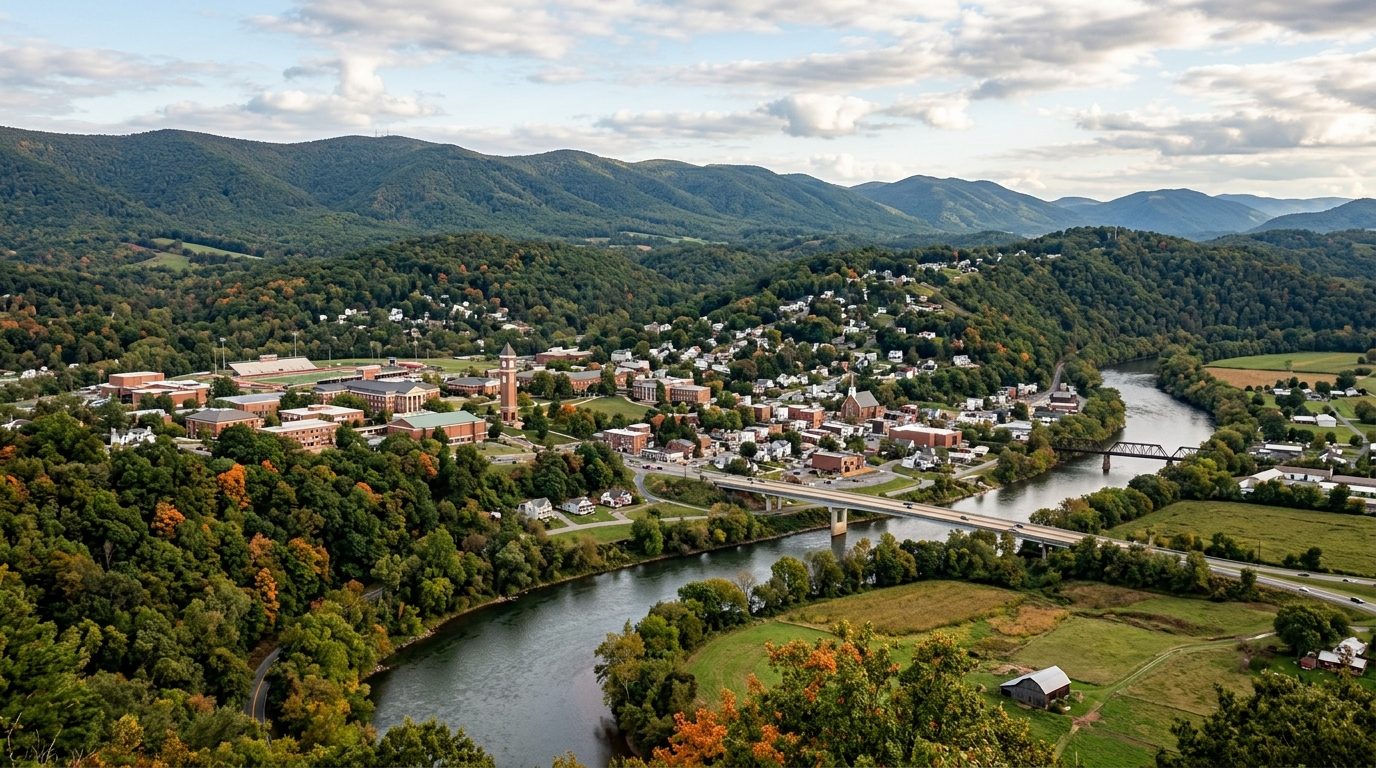
Current real estate market data, news and analysis for the Blacksburg-Christiansburg-Radford, VA metropolitan area — 181,616 residents across 5 counties in Virginia.
Data as of May 2026. Sources: Redfin Data Center, U.S. Census Bureau.
Latest Blacksburg Real Estate News
Coverage of this market is coming soon. Browse all housing market news.
Blacksburg Real Estate Market Overview
The Blacksburg-Christiansburg-Radford metro occupies Virginia’s New River Valley, a mountainous corner of southwestern Virginia where the Blue Ridge gives way to Appalachian ridge-and-valley terrain. The New River winds through Montgomery and Pulaski counties and the independent city of Radford, while Floyd and Giles counties add a rural, ridge-and-hollow character to the metro’s western and southern edges. Housing stock mirrors this layered history: brick and frame homes near historic downtown grids in Blacksburg, Christiansburg, and Radford; mid-century ranch houses in older in-town neighborhoods; dense student-oriented apartments and townhomes close to the Virginia Tech and Radford University campuses; and newer single-family subdivisions and planned communities spreading along the corridors between Blacksburg and Christiansburg. Rural parts of the metro, especially in Floyd and Giles counties, retain farmhouses, cabins, and larger-acreage parcels far from any subdivision grid.
Pricing tiers across the metro track proximity to the universities, walkability, and topography rather than any single dividing line. Areas within walking or biking distance of the Virginia Tech campus and downtown Blacksburg tend to command a premium because of access to campus, dining, and the Huckleberry Trail, and because buildable land close to campus is limited by the surrounding hills. Newer subdivisions on the outskirts of Blacksburg and Christiansburg, along with golf-course and lake-adjacent communities, also draw higher interest for their newer construction and amenities. More affordable options tend to sit farther from the universities, in Christiansburg’s older sections, in Pulaski County towns like Pulaski and Dublin, and in the more rural stretches of Floyd and Giles counties, where land is more plentiful but commute distances to campus and hospital jobs are longer.
The metro’s economy is anchored by higher education, health care, and manufacturing. Virginia Tech, based in Blacksburg, and Radford University are the region’s largest institutional employers and drive demand for both rental and owner-occupied housing. Health systems including Carilion New River Valley Medical Center and LewisGale Hospital Montgomery employ large clinical and administrative workforces. Manufacturing runs deep in the region: Volvo Trucks operates its New River Valley assembly plant in Dublin, one of the largest private employers in the area, while Corning, Hubbell Lighting, and Moog Components Group all maintain manufacturing operations in Montgomery County. The Radford Army Ammunition Plant, operated by BAE Systems, is another major regional employer spanning Montgomery and Pulaski counties. The Virginia Tech Corporate Research Center adds a cluster of technology, engineering, and autonomous-systems firms tied to university research.
Distinctive local factors shape ownership here. The region’s karst geology, most pronounced around Giles County and the New River corridor, makes sinkholes and groundwater flow patterns worth investigating before purchase, and buyers should check whether a property relies on a private well or septic system, common outside town limits. Flooding along the New River and its tributaries is a localized but real concern, so flood-zone status and flood insurance availability are worth confirming property by property. Because Blacksburg’s population is heavily student-driven, rental demand and turnover near campus can differ sharply from family-oriented neighborhoods a short drive away, and local zoning and short-term-rental rules vary by town, so buyers should verify use restrictions with the relevant county or town before closing.
Cities and Towns in the Blacksburg Metro Area
Notable Communities and Neighborhoods
Blacksburg Real Estate Market FAQ
How is the Blacksburg-Christiansburg-Radford housing market organized geographically?
The metro is built around several distinct town centers rather than one continuous suburb. Blacksburg surrounds Virginia Tech, Christiansburg sits at the crossroads along the Interstate 81 corridor, and Radford is a separate independent city built around Radford University and the New River. Pulaski, Dublin, and the more rural towns of Floyd and Giles counties round out the metro, each with its own character shaped by distance from the two universities and by the region’s mountain and river geography.
Which parts of the metro tend to be pricier, and which are more affordable?
Homes within walking or biking distance of the Virginia Tech campus and Blacksburg’s historic downtown tend to be in higher demand because of limited nearby land, walkability, and access to campus and trail amenities, and newer subdivisions and golf-course or lake-adjacent communities on the edges of Blacksburg and Christiansburg draw similar interest for their newer construction. More affordable options are generally found farther from the university cores, including older sections of Christiansburg, the towns of Pulaski and Dublin, and the more rural areas of Floyd and Giles counties, where land is more available but commutes to campus and hospital employment are longer.
What should buyers verify locally before purchasing in this metro?
Buyers should confirm whether a property uses a private well and septic system, common outside the towns, and have both inspected. Because parts of the region sit on karst geology, it is worth asking about any history of sinkholes or ground subsidence on or near the property. Flood-zone status should be checked for any property near the New River or its creeks, and buyers should also verify local zoning, HOA rules, and any short-term-rental restrictions with the relevant town or county, since these vary across Blacksburg, Christiansburg, Radford, and the surrounding counties.
What regional risk factors are specific to this part of Virginia?
The metro’s mountainous, karst-influenced terrain creates localized risks around sinkholes and groundwater movement, particularly near the New River and in Giles County. The region also experiences occasional flash flooding along rivers and creeks, which is worth checking against flood maps property by property. Economically, the area carries some concentration risk tied to its two universities and a handful of large manufacturing employers, so buyers should be aware that local rental and housing demand can be sensitive to enrollment trends and shifts in manufacturing employment.
Nearby Markets