
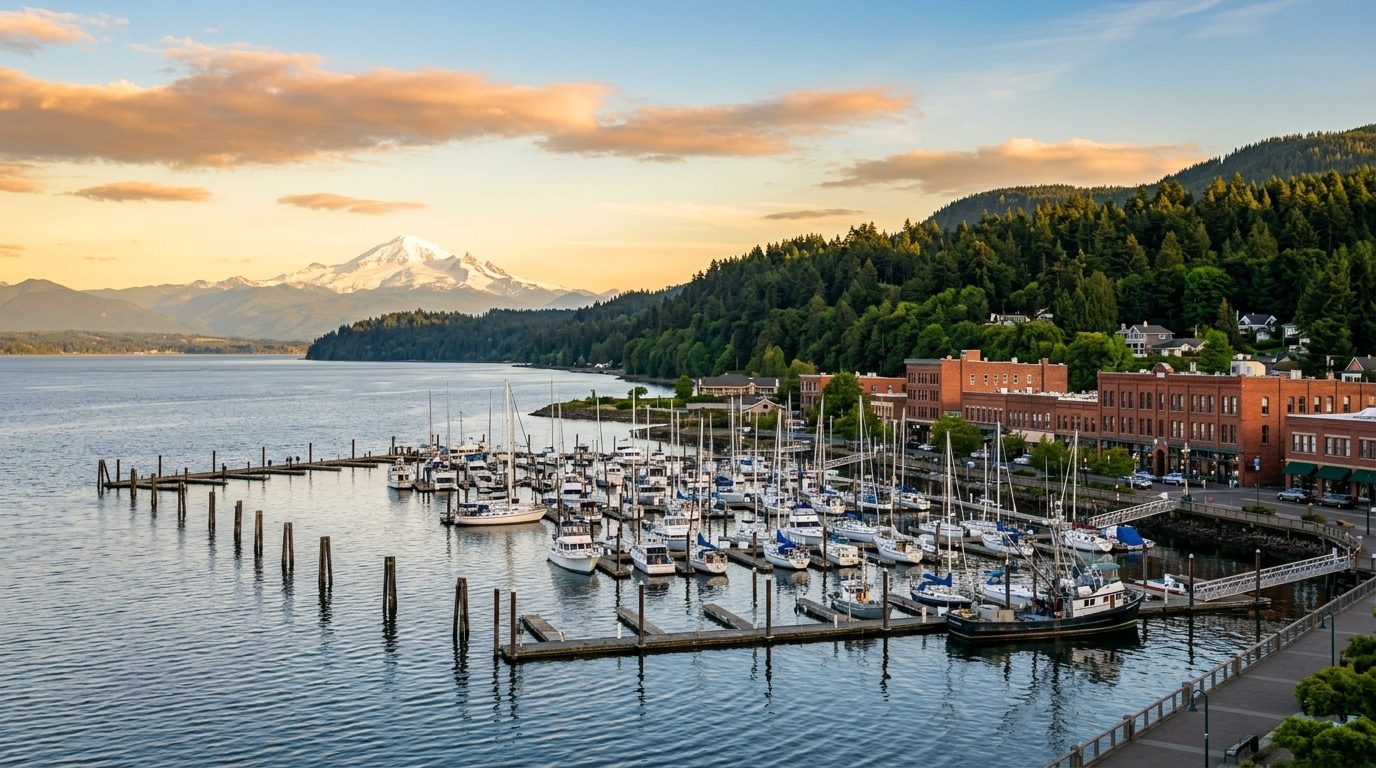
Current real estate market data, news and analysis for the Bellingham, WA metropolitan area — 236,392 residents across Whatcom county.
Data as of May 2026. Sources: Redfin Data Center, U.S. Census Bureau.
Latest Bellingham Real Estate News
Coverage of this market is coming soon. Browse all housing market news.
Bellingham Real Estate Market Overview
Bellingham sits on the shore of Bellingham Bay in the northwest corner of Washington state, close to the Canadian border, with Lake Whatcom forming its inland edge and the peaks of the North Cascades visible to the east. The terrain mixes shoreline bluffs, low hills, and creek ravines, giving many residential streets an irregular, view-oriented layout rather than a uniform grid. Housing stock in the older core ranges from early twentieth-century bungalows and Craftsman-style homes to postwar ramblers, while newer growth areas toward the county line contain contemporary single-family subdivisions, townhomes, and low-rise apartment or condominium buildings. Because the city is hemmed in by water, steep slopes, and adopted urban growth boundaries, recent development leans toward infill and denser housing types rather than outward sprawl.
Price tiers within the city track proximity to water, campus, and downtown more than lot size alone. Bluff and shoreline areas overlooking the bay command a premium for views and privacy, while the historic waterfront village anchoring the south end of the city draws buyers willing to pay for walkable streets, ferry access, and preserved architecture. Neighborhoods bordering the university are popular with both owners and investors due to steady rental demand, though that mix keeps prices below bluff-area levels. Homes along the lakeshore carry a similar water-proximity premium. More attainable pricing generally sits in the newer, flatter subdivisions toward the northern and eastern edges of the city, farther from downtown, the waterfront, and the university, where lot sizes tend to be larger relative to price but commute times into the core are longer.
The local economy centers on healthcare, higher education, marine trade, and industrial employment concentrated north of the city along the coastal corridor. A large regional hospital and medical network anchors healthcare, while the public university and two community and technical colleges are among the area’s largest employers. North of Bellingham, a cluster of petroleum refineries and an aerospace-component manufacturing plant provide a significant share of the county’s industrial jobs, and a grocery chain headquartered in the city, a software publisher, and the Port of Bellingham’s marine terminals round out the base of major private employers. A federally recognized tribal government headquartered in the county is also among the region’s larger employers, operating its own government, health, and business enterprises. Surrounding rural areas support dairy and berry farming tied to the broader county economy.
Buyers should account for a mild, wet marine climate with periodic summer wildfire smoke drifting in from the interior, and should check flood mapping for low-lying parcels near rivers and creeks outside the core, since the city itself sits mostly above tidal and river flood zones while nearby lowland areas do not. The region lies within reach of a major offshore earthquake fault system, worth discussing with an insurer regardless of parcel location. Washington has no state income tax, so property tax and voter-approved local levies carry more weight in household budgeting than in some other states. Growth management rules and a defined urban growth boundary shape where new development can occur, so buyers considering rural or edge-of-city parcels should confirm zoning, septic or well capacity, and water rights before purchasing. Cross-border proximity to Canada also supports a segment of local demand and short-term rental activity worth researching for a given neighborhood.
Cities and Towns in the Bellingham Metro Area
Notable Communities and Neighborhoods
Bellingham Real Estate Market FAQ
How is the Bellingham real estate market organized geographically?
The market splits roughly into a waterfront and bay-bluff tier close to downtown and the historic Fairhaven district, a university-adjacent tier with a strong rental mix, a lakeside tier along Lake Whatcom, and a set of newer, flatter subdivisions toward the northern and eastern edges of the city and into unincorporated Whatcom County. Each tier reflects distance from water, campus, and the compact downtown core rather than uniform citywide pricing.
Which Bellingham neighborhoods tend to be priciest and why?
Bluff and shoreline areas overlooking Bellingham Bay and the historic Fairhaven waterfront district generally command the highest prices, driven by water views, walkability, and limited buildable land. Lakefront pockets along Lake Whatcom carry a similar premium for water access. Areas farther from water, downtown, and the university tend to be more moderately priced.
What should buyers verify locally before purchasing in Bellingham?
Confirm whether a parcel falls inside city limits or unincorporated Whatcom County, since zoning, utility service, and permitting differ. For rural or edge-of-city properties, verify septic or well capacity and water rights. For any low-lying parcel near a creek, river, or the shoreline, check current flood zone mapping rather than relying on a neighborhood’s general reputation.
What is a region-specific risk buyers should understand?
The Pacific Northwest sits within reach of a major offshore subduction-zone earthquake fault, which is relevant to structural due diligence and insurance conversations regardless of a specific neighborhood. Buyers should also expect a wet marine climate with occasional summer wildfire smoke drifting in from inland areas, and should check drainage and flood mapping for any property near water.
Nearby Markets