
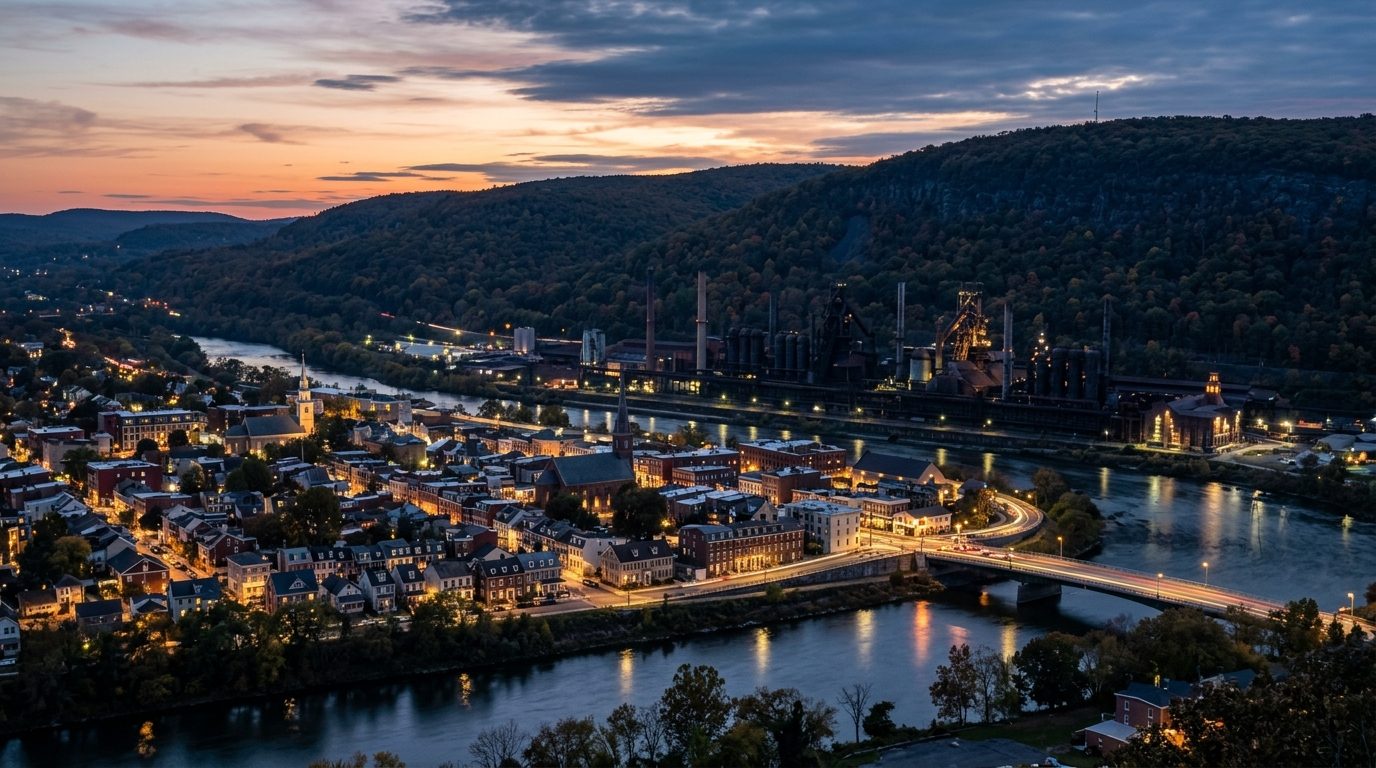
Current real estate market data, news and analysis for the Allentown-Bethlehem-Easton, PA-NJ metropolitan area — 887,615 residents across Carbon, PA, Lehigh, PA, Northampton, PA and Warren, NJ counties.
Data as of May 2026. Sources: Redfin Data Center, U.S. Census Bureau.
Latest Allentown Real Estate News
Allentown Real Estate Market Overview
The Lehigh Valley sits in a true river valley carved by the Lehigh River, bounded by Blue Mountain to the north and South Mountain to the south, roughly midway between Philadelphia and New York City. Its three core cities — Allentown, Bethlehem, and Easton — grew up around heavy industry, most notably Bethlehem Steel, once one of the world’s largest steelmakers before its shutdown; their urban cores retain dense stock of early-1900s rowhomes and twins built for that industrial workforce. Development further from the cities shifts to mid-century and newer suburban single-family homes, while Carbon County, anchored by the mountain town of Jim Thorpe in the southern Pocono foothills, carries a distinctly different, scenic, small-town character from the valley floor.
Fountain Hill and parts of west and south Bethlehem hold some of the region’s grandest housing, built by steel-industry executives a century ago, while College Hill in Easton, near Lafayette College, is similarly well-regarded for its Victorian housing stock. Upper Saucon Township and Center Valley, home to a well-known country club, form a newer, fast-growing, higher-end suburban tier known for strong schools. Allentown’s center city and the older rowhome blocks of South Bethlehem sit toward the more affordable end of the market, their housing stock and price points still shaped by the steel economy’s decline decades ago. Smaller towns like Emmaus, a walkable former Moravian village, and Nazareth retain distinct small-town identities of their own, while Jim Thorpe and the rest of Carbon County trade valley-floor convenience for mountain scenery and a slower pace.
Healthcare has become the region’s largest employment sector, led by two major hospital networks with a substantial combined regional footprint. Logistics and warehousing have grown enormously along the I-78 corridor, with major national distribution operations drawn by the valley’s location within a day’s truck drive of a huge share of the East Coast population. The former Bethlehem Steel site, roughly a fifth of Bethlehem’s land area, has been redeveloped for entertainment and mixed commercial use after significant environmental remediation, a notable local example of post-industrial reinvention.
Property taxes vary meaningfully by school district across Lehigh and Northampton counties, both of which rank among Pennsylvania’s higher-burden counties overall — worth checking district by district rather than assuming a uniform rate. Flooding is the region’s leading natural hazard, particularly in Easton at the confluence of the Lehigh, Delaware, and Bushkill, and along the Lehigh through Bethlehem, so flood history is worth checking regardless of official zone designation. Former industrial sites, including portions of the old Bethlehem Steel property, required significant soil and groundwater remediation before redevelopment, a legacy consideration for buyers looking at former industrial parcels anywhere in the valley. The region’s growing role as a warehouse and logistics hub has drawn organized resident opposition in several townships over truck traffic and congestion, worth researching for any property near active or proposed distribution facilities. Continued in-migration from the New York and Philadelphia metros, drawn by relative affordability, has kept housing demand and commuter-driven growth pressure elevated.
Cities and Towns in the Allentown Metro Area
Notable Communities and Neighborhoods
Allentown Real Estate Market FAQ
How is the Allentown-Bethlehem-Easton housing market organized?
It runs from the dense, historic rowhome cores of Allentown, Bethlehem, and Easton through newer, higher-end suburban townships like Upper Saucon, out to the small-town and mountain communities of Carbon County.
Which areas tend to be pricier and which more affordable?
Fountain Hill, College Hill, and newer suburban areas like Upper Saucon Township and Center Valley sit toward the higher end, while Allentown’s center city and the older rowhome blocks of South Bethlehem are generally more affordable.
What should buyers verify before purchasing here?
Check property tax rates by specific school district rather than county-wide averages, and for any former industrial parcel, confirm what environmental remediation, if any, was completed before redevelopment.
What regional risk factor is most important to understand?
Flooding is the valley’s leading natural hazard, particularly around Easton’s river confluence and along the Lehigh through Bethlehem, so local flood history matters more here than official zone maps alone.
Nearby Markets