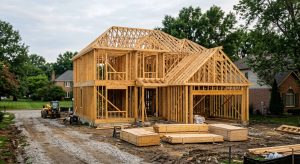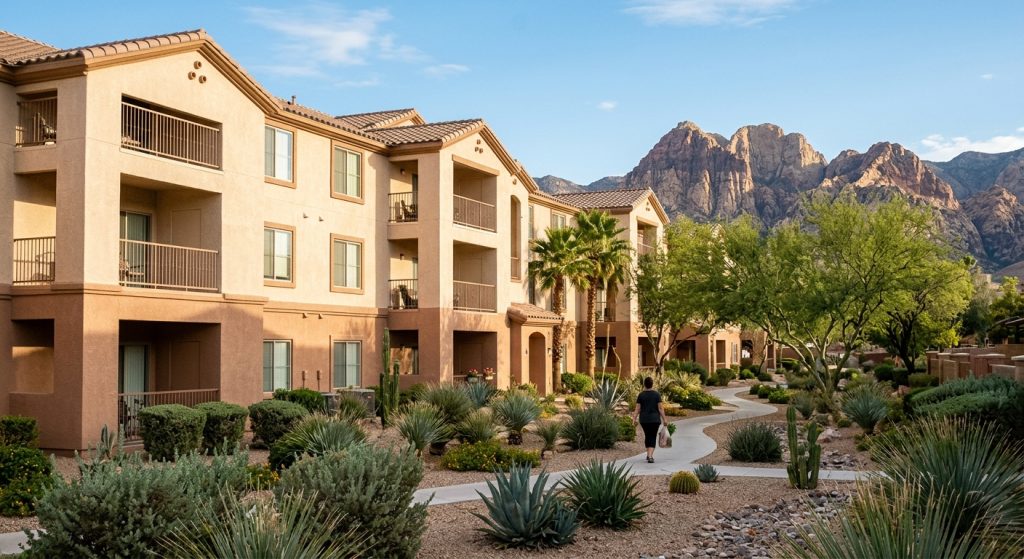
The Las Vegas Valley’s apartment construction pipeline has fallen to its lowest level in four years, according to a second-quarter market report from commercial real estate firm Marcus & Millichap. Only 3,400 multifamily units are expected to be added to the valley’s apartment stock in 2026 — the smallest annual addition since 2021 — a shift that signals a supply-side turning point in one of the country’s fastest-growing multifamily markets.
The pullback caps years of aggressive apartment building in Southern Nevada, where developers raced to keep pace with one of the nation’s strongest population and job-growth streaks through the pandemic era. That construction boom, financed by historically cheap capital, pushed thousands of new units into the market and helped reshape submarkets across the valley, from the northwest to Henderson.
More recently, Las Vegas multifamily fundamentals have been rebalancing. Absorption and new supply have been running closer together over the past year, according to other regional research, easing the imbalance that emerged after the pandemic-era building wave outpaced renter demand in some quarters.
The numbers
Marcus & Millichap’s second-quarter report attributes the slowdown to higher borrowing costs and tightened underwriting standards from lenders, conditions that have made new ground-up multifamily projects harder to finance across the country. In Las Vegas, that financing squeeze has translated directly into fewer units breaking ground and a construction pipeline that has thinned out year over year since the 2021-2022 peak.
Cameron Glinton, managing director and market leader for Marcus & Millichap in Las Vegas, characterized the shift as a stabilization rather than a downturn. “I would characterize the market as stabilizing rather than struggling as supply and demand fundamentals continue to rebalance,” Glinton said, according to the Las Vegas Review-Journal, which first reported on the firm’s findings.
The construction slowdown comes as landlords are still working through supply delivered in prior years. Rents in the valley have been declining for more than a year, and concessions — such as free months of rent and other move-in perks — are now attached to close to half of the units currently listed for lease, per the report. Despite the recent softening, Las Vegas rents remain well above pre-pandemic levels, having risen roughly 17% since 2019, a faster pace than many comparable Western metros.
What it means
Verified facts: Marcus & Millichap’s second-quarter report puts expected 2026 apartment deliveries in the Las Vegas Valley at 3,400 units, the lowest annual total since 2021. Rents have fallen for more than a year, and concessions are widespread across the existing rental stock.
Attributed interpretation: Marcus & Millichap frames the drop-off as a return toward pre-pandemic development norms rather than a sign of market distress, pointing to tighter lending conditions as the primary driver of fewer project starts.
RealtyWire analysis: A thinner construction pipeline typically takes one to two years to show up in landlord pricing power, since units already under construction or recently delivered still need to lease up. If absorption continues to track closer to new supply through the back half of 2026, as recent regional data suggest, the reduced pipeline could set the stage for concessions to fade and rent growth to firm up in 2027 — particularly in submarkets that saw the heaviest pandemic-era building. Investors and owners watching multifamily fundamentals nationally may see Las Vegas as an early test case for how quickly overbuilt Sun Belt-adjacent markets can work through excess supply once new starts dry up.
What to watch
- Whether vacancy rates begin to tighten meaningfully as the reduced 2026 delivery total works through the pipeline.
- Concession activity across the valley’s apartment listings, currently affecting close to half of available units, as an early signal of when landlord pricing power returns.
- Permit and groundbreaking activity in 2027, which will indicate whether the financing environment has eased enough for developers to restart new projects.
- Follow-up data from other regional multifamily research shops tracking the same absorption-versus-supply trend as the year progresses.
Marcus & Millichap’s full report was not made public in detail beyond the figures cited by the firm’s Las Vegas market leader; RealtyWire will continue tracking multifamily supply data as more 2026 delivery figures are confirmed.
Related coverage: Manhattan Apartment Rents Hit All-Time High in June 2026 · U.S. Hotel Construction Pipeline Grows to 5,975 Projects in Q2 2026, Lodging Econometrics Reports · Chicago Industrial Market Faces Rising Vacancy