Dallas-based Knightvest Capital has acquired a 1,027-unit apartment portfolio in Round Rock, Texas, part of the Austin metro area, in a bet that a reset in pricing is creating openings for value-add investors in one of the country’s most heavily built multifamily markets. The firm said it bought the three-community portfolio at a “completely reset basis” and a “significant discount to both recent trades and replacement cost,” according to an announcement released Tuesday.
The purchase price was not disclosed. The deal is the 20th investment for Knightvest’s Fund II, which the firm said was designed to target exactly this kind of asset.
The properties
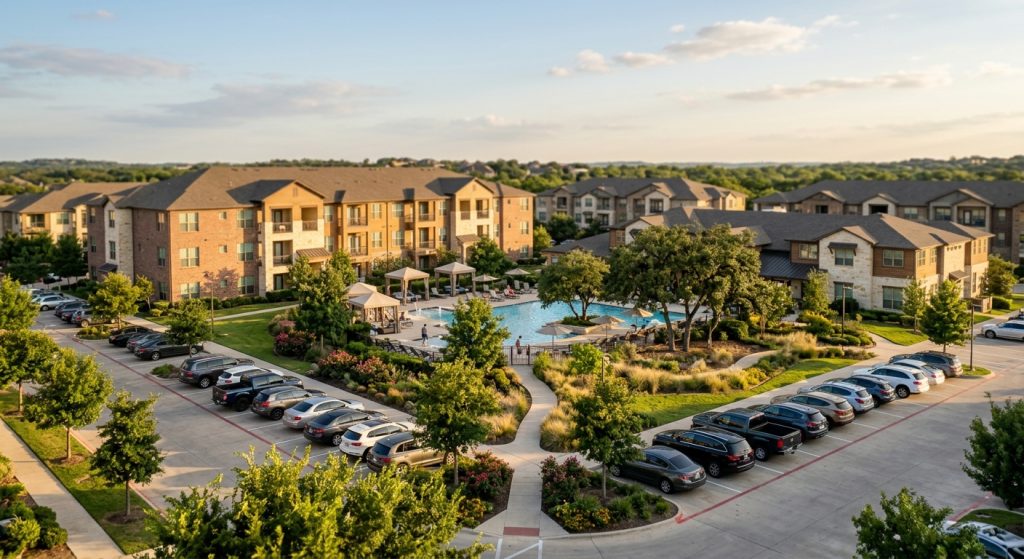
The portfolio, which Knightvest referred to as its Silicon Hills holdings, comprises Enclave at La Frontera, a 411-unit community built in 2004; Lakeside at La Frontera, a 366-unit community built in 2001; and Legends Lake Creek, a 250-unit community built in 2001. Enclave and Lakeside sit next to each other within the La Frontera master-planned, mixed-use development in Round Rock, while Legends Lake Creek is about six miles west in the Lakeline/Lake Creek submarket.
Knightvest plans to rename the three properties Brixton, Calder and Sutton, respectively, and to carry out a comprehensive renovation program. Planned work includes exterior improvements, upgraded common-area amenities and select interior updates with modern finishes and quartz countertops intended to help the early-2000s communities compete with newer construction.
Betting on a repriced market
“Fund II was purpose-built to identify assets like these — properties we can renovate to a like-new standard while maintaining a substantially lower basis than nearly all comparable vintage communities,” said David Moore, founder and chief executive of Knightvest.
The strategy leans on a dynamic that has taken hold across much of the Sun Belt. A wave of new apartment supply delivered over the past few years pushed up vacancies and pressured rents in fast-growing Texas markets, prompting some owners to sell at prices well below what they paid or what it would cost to build today. Value-add buyers like Knightvest aim to acquire those older communities cheaply, renovate them, and lift rents toward the level of newer product without bearing new-construction costs — a thesis that has drawn other large investors into Texas apartment portfolios in recent months.
Austin has been at the center of that supply surge. The metro absorbed heavy construction that weighed on rents and, in the for-sale market, contributed to some of the steepest home-price declines in the country. But recent data has pointed to stabilization, with multifamily rents nationally rising for a fifth straight month as the Sun Belt shows early signs of recovery.
A vertically integrated approach
Knightvest describes itself as a vertically integrated firm that handles acquisition, renovation and property management in-house, a structure it says lets it move quickly on repositioning older assets. The Austin-area purchase deepens its footprint in Central Texas, where it has been an active buyer, including recent acquisitions in the nearby San Antonio market.
What it means: The deal is a concrete example of capital moving back into Sun Belt multifamily on the theory that prices have fallen far enough to offset the near-term risks of elevated supply. For sellers, transactions at a “reset basis” underscore how much values have corrected from their peak; for buyers with renovation expertise and patient capital, that correction is the opportunity. Whether the bet pays off will depend on how quickly Austin’s apartment market absorbs its remaining new supply and whether rent growth resumes as construction slows.