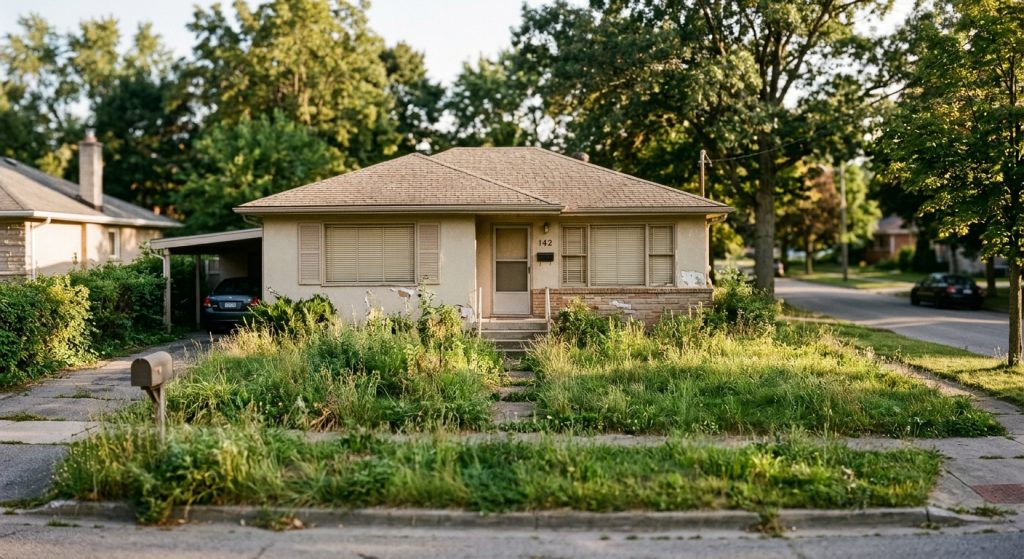
Completed foreclosure auctions rose 25% from a year earlier in the third quarter of 2026, the highest quarterly total since the first quarter of 2020, according to Auction.com’s Q3 2026 Auction Market Dispatch, published Oct. 22. The report, written by Daren Blomquist, Auction.com’s head of market economics, says the increase came mostly from loans insured by the Federal Housing Administration and from mortgages written in 2022 or later.
The online foreclosure marketplace said the third quarter was the seventh straight quarter in which auction volume rose from a year earlier. Completed auctions reached 70% of their first-quarter 2020 level and rose 6% from the second quarter. Scheduled foreclosure auctions, which show what is headed for sale, were up 15% from a year earlier at 71% of the pre-pandemic level. The report calls that a new post-pandemic high.
FHA loans are now above pre-pandemic levels
FHA-insured loans drove most of the increase. Their foreclosure auction volume rose 73% from a year earlier, the highest level since the first quarter of 2019. Auction.com said that for the first time in this cycle, FHA volume passed its own pre-pandemic baseline, at 117% of the first-quarter 2020 level. FHA loans made up 43% of all foreclosure auction volume, the largest share since the first quarter of 2015.
Loans backed by Fannie Mae and Freddie Mac grew more slowly, with auction volume up 30% from a year earlier.
Recent loans make up a growing share. Mortgages originated in 2022 or later accounted for 46% of completed foreclosure auctions in the quarter, and their volume rose 73% from a year ago. Auction.com describes these borrowers as “the first generation of borrowers who locked in at materially higher rates than their 2020 to 2021 counterparts.” Older loans continued to shrink as a share. Loans from 2005 to 2009, the years before the financial crisis, fell 22% to less than 9% of volume, and all loans originated before 2015 together made up 19% of activity.
The build is coming from a low base. ICE put the national mortgage delinquency rate at 3.53% in August, still below every pre-pandemic August on record, as RealtyWire reported in its coverage of ICE’s August data. ATTOM’s foreclosure filings data has also shown filings climbing this year. Auction.com’s numbers add detail on which loans are reaching the auction stage.
Where volume is rising
Thirty-one states posted annual increases in completed foreclosure auctions. These included Texas (up 54%), Florida (up 67%), California (up 80%), Ohio (up 12%) and Illinois (up 7%). The largest percentage increases were in Arkansas (113%), California (80%), South Carolina (76%), Nevada (76%) and Washington (69%).
Eighteen states reached or exceeded their first-quarter 2020 volume. Colorado stood out at 246% above its pre-pandemic baseline. It was followed by Connecticut (181% above), Utah (48%), Wyoming (47%) and Alaska (44%). Texas was 38% above its baseline, Arizona 31%, Louisiana 41% and California 9%. Texas alone accounted for 15% of national volume, followed by Florida at 8%, California at 6%, and Ohio and Illinois at 5% each.
Bank-owned (REO) properties, which return to lenders when they don’t sell at foreclosure auction, are also increasing. REO auction volume rose 18% from a year earlier and 7% from the second quarter, reaching the highest level since the third quarter of 2020, at 51% of the pre-pandemic level. About 54% of REO properties were vacant, almost unchanged from the prior quarter and the year before.
Buyers are getting slightly better prices
Investor demand has held up overall. The foreclosure auction sales rate, the share of properties that sold to third-party buyers, eased to 45.5%. That was down 5% from the second quarter but essentially flat from a year earlier and 8% above the first-quarter 2020 benchmark. Auction.com said the rate has been above that benchmark for seven straight quarters.
Buyers paid an average of 65.3% of estimated retail market value at foreclosure auction, down from 66.8% in the second quarter and up from 64.5% a year earlier. REO buyers paid 62.2%, down from 65.2% in the second quarter and 64.0% a year ago.
Lower pricing helped move FHA and bank-owned inventory. FHA pricing fell 3% from a year earlier, and the FHA sales rate rose 19%. REO reserve pricing, the minimum sellers will accept, slipped to 74.9% of estimated market value from 77.1% a year earlier, and the REO sales rate rose 29%.
Demand differed sharply by market. Of the 64 metros Auction.com tracks, 32 posted higher sales rates and 32 posted lower ones. The report says demand held up best in Sun Belt and Midwest markets with healthy job growth and stayed soft in the Great Lakes industrial corridor and several high-cost coastal markets. Among high-volume markets, sales rates rose in Houston (15%), Dallas (5%), Atlanta (18%), Chicago (3%) and Phoenix (16%). They fell in New York (10%), Detroit (27%), St. Louis (47%), Tampa (6%) and Riverside-San Bernardino, Calif. (34%).
More auctions are already scheduled
Auction.com expects volume to keep rising. “Scheduled foreclosure auction volume for the fourth quarter indicates both foreclosure auction volume and REO auction volume will continue to increase in that quarter,” the report says. Scheduled auctions are up 11% from a year earlier for October, 31% for November and 15% for December.
Two caveats apply. The figures come from Auction.com’s own marketplace, not a census of every foreclosure sale in the country. And the comparisons are against 2020 to 2022, when foreclosures were almost nonexistent because of pandemic moratoriums and forbearance. Even at a post-pandemic high, completed auctions were still below their early-2020 level. On our reading, the more useful signal for lenders and agents is the mix: FHA borrowers and buyers who purchased in the past four years are where distress is rising fastest. That matters most in states such as Colorado, Texas and Arizona, where auction volume is already above pre-pandemic levels. More on credit conditions is in RealtyWire’s mortgage coverage.