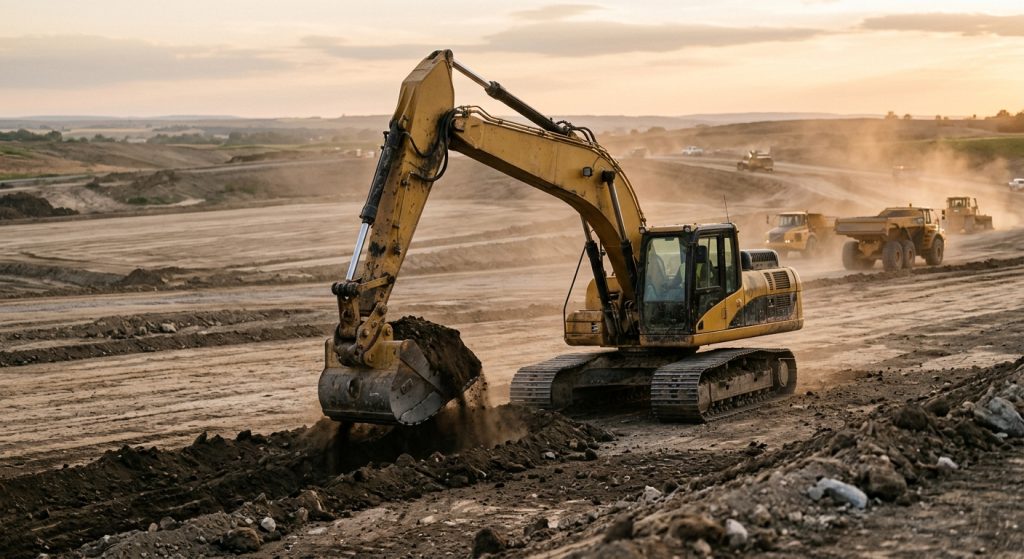
Bedrock Robotics, the San Francisco startup that retrofits excavators and other heavy equipment to run without an operator, has raised $600 million in Series C funding at a $4.1 billion post-money valuation, the company announced Oct. 26. The round is a large bet that autonomous machines will become a normal part of the earthwork that starts highways, housing subdivisions and data center campuses.
CapitalG and Emergence Capital co-led the financing. New investors US Innovative Technology Fund (USIT), Bessemer Venture Partners and Temasek joined existing backers 8VC, Georgian, Valor Equity Partners, Xora, Eclipse, Perry Creek Capital, NVIDIA and others. Bedrock said the round brings its total funding to nearly $1 billion.
From milestone to rollout
The raise follows what the company called a defining milestone for physical AI in mid-August 2026: fully autonomous excavators doing paid work on live commercial job sites. RealtyWire covered that milestone when the company first described the system working alongside crews and other equipment on active sites.
Bedrock said it is now moving into “its next phase of growth” — expanding deployments with more contractors and building the field, commercial and operational infrastructure needed to make autonomy “a dependable part of everyday construction work.”
“We have proven that fully autonomous excavators can perform real work of value alongside the crews and workflows already in place on job sites. The next challenge is delivering that capability to more contractors as a dependable part of how projects get built,” said Boris Sofman, Bedrock’s co-founder and CEO. He said the money will let the company “expand deployments, strengthen the field operations behind every machine, and work with more partners as they integrate intelligent systems into everyday work.”
Haydon signs on, and the map widens
The company’s newest named partner is Haydon, a Tempe, Ariz.-based general contractor that the release describes as 100% employee-owned and one of the largest in the Southwest. Haydon is deploying Bedrock’s system for fully autonomous earthwork on a remote site in Texas and plans to extend Bedrock-equipped machines across building and heavy civil work, including construction for advanced manufacturing, transportation, water and wastewater, data centers and healthcare facilities. As the partnership develops, Haydon will also test trench work and the automation of larger machine models.
“For us, the biggest win is a safer, more predictable job site,” said Katie Haydon, the firm’s CEO and chair. “As an employee-owned company, our people are at the heart of everything we do. Bedrock’s technology helps us work more efficiently and take on more of the work our communities need, without placing additional strain on our crews. Autonomous equipment could help our people accomplish more in a single shift, get them home safely, and allow them to spend more time with their families even during our busiest stretches.”
Bedrock also listed new customers that push it beyond its base in the West and Central South into the Midwest and South Atlantic: Wagner Construction in Minnesota, Smith Trucking Company in Florida, B&S Site Development in Virginia, Native Excavating in Colorado, Clarkson Construction in Missouri, C.W. Matthews in Georgia, and selected ArchKey Solutions projects in Arkansas. The company said it has more than doubled its total customer volume since 2025.
The labor argument
Bedrock pitches autonomy as a response to construction’s chronic worker shortage rather than a replacement for crews. Its announcement cites projections that employers will need to fill about 1.7 million skilled-trades openings each year through 2035, and survey figures showing 87% of construction firms have openings for hourly craft positions, with 88% saying those roles are as hard or harder to fill than a year ago.
Investors leaned on the same theme. “Construction sits at the foundation of nearly every major economic and industrial ambition in the United States. We cannot afford to take decades developing advanced robotics for this critical industry,” said Derek Zanutto, a general partner at CapitalG. Jake Saper, a general partner at Emergence Capital, said, “More than 20% of global GDP runs on industries that can’t hire the skilled labor they need, and construction is the sharpest example. That’s not a software problem, it’s a physical one.”
Bedrock also added two executives with backgrounds in driverless vehicles. Amy Jones Satrom joins as vice president of operations after deploying physical systems at Amazon, Nuro and Uber, and Lando Juarez becomes general counsel after serving as head of legal for Uber’s Autonomous Mobility & Delivery business. Founded in 2024, Bedrock is led by former Waymo engineers.
Why real estate should care
Site work is the first and often least predictable phase of a project: soil, weather and terrain vary from lot to lot, and excavation delays cascade into every trade that follows. On our reading, the size of this round — and the list of contractors willing to put the technology on paid jobs — signals that investors see the data center, manufacturing and infrastructure buildout as large enough to support a dedicated autonomy company for earthmoving. Whether autonomy meaningfully lowers site-work costs or timelines for developers is not yet established; Bedrock’s release makes claims about safety and predictability but does not publish productivity or cost data.
Bedrock is one of several construction-robotics companies drawing large checks this year, alongside SoftBank’s $200 million investment in Gravis Robotics and Buildots’ $130 million raise for construction AI. More coverage of the sector is in RealtyWire’s Technology & AI section.