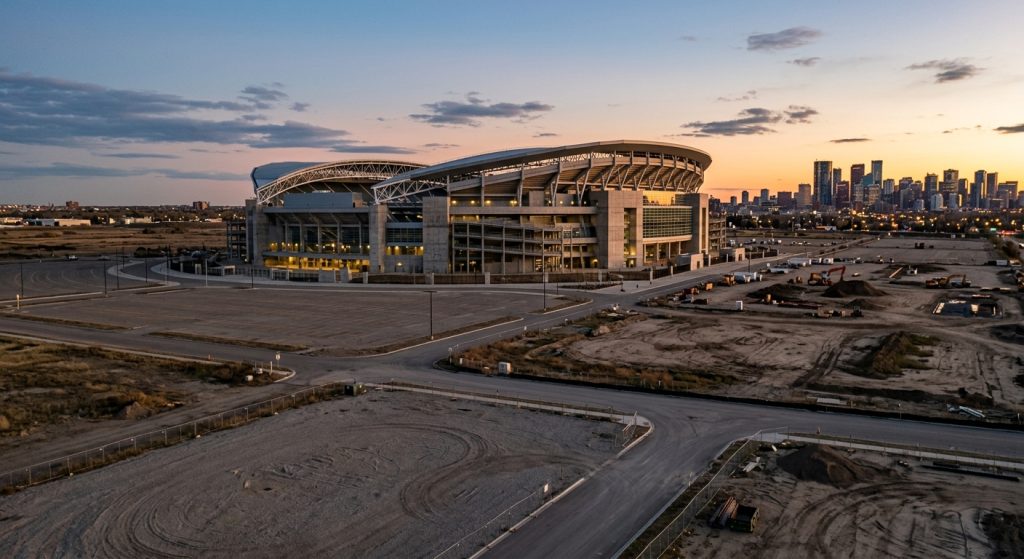
The Kansas City Chiefs and Hunt Midwest have formed a joint real estate venture that will act as master developer for two mixed-use districts in Kansas — one wrapped around the NFL club’s new stadium in Kansas City, Kan., and a second surrounding its future headquarters and training facility in Olathe, Kan.
The venture, named Two-Point Development, was announced by the team Monday afternoon. It pairs the franchise with the Hunt family’s Kansas City-based development company, both founded by Lamar Hunt, and gives a single entity control over the design and development of the land around two of the largest sports construction projects in the region’s history.
“This is a monumental day for our family as the Kansas City Chiefs and Hunt Midwest form a new business partnership,” Chiefs Chairman and CEO Clark Hunt said in the announcement. “Today we are so proud that his football franchise and his real estate company are joining forces to drive transformational real estate developments around the Chiefs future stadium and training facility.”
What the joint venture will control
According to the announcement, Two-Point Development will serve as master developer for both districts, overseeing the architects, engineers, land planners and general contractors on the projects. The company said the Wyandotte County district will combine entertainment, hospitality, retail, residential and public gathering space into what it described as a year-round destination rather than a game-day-only footprint.
In Olathe, the club’s future headquarters and practice facility is to be the centerpiece of a mixed-use environment the partners said would blend football operations, community space and entertainment. Populous, the Kansas City-based sports architecture firm, was previously named lead design architect for that facility and master planning architect for the surrounding development.
Hunt Midwest describes itself as a privately held developer with six decades of experience and more than $3 billion of completed projects across industrial, self-storage, residential, multifamily and senior living property. It is part of the Lamar Hunt family’s holdings, which also include the Chiefs, the Chicago Bulls and FC Dallas. The firm was on the other side of one of the Kansas City industrial market’s larger recent trades, selling a 1.5 million-square-foot distribution facility to Morgan Stanley Real Estate Investing for $158.5 million in August.
The team named Hunt Midwest Senior Vice President Aaron Schmidt as the contact for development opportunities.
A $4.5 billion program behind the districts
The districts sit on top of a much larger capital program. In a separate release on June 30, the Chiefs put total capital investment across the projects at $4.5 billion: roughly $3 billion for the stadium in Wyandotte County, $300 million for the Olathe headquarters and practice facility, and $1.2 billion in private ancillary development — the category Two-Point Development will now steer.
Those figures come from projections the club commissioned from Econsult Solutions in April. The same analysis estimated a one-time economic impact of $8.2 billion during construction, supporting 36,500 full-time-equivalent job-years and $2.7 billion in employee compensation, and ongoing annual impact of $1.5 billion once the facilities open, including 8,500 full-time-equivalent jobs. Econsult projected $106.4 million in state tax revenue during construction and $67 million annually from operations. Those are the club’s own commissioned estimates, not independently verified figures.
The stadium itself is planned as an enclosed, 70,000-seat building opening in 2031. The Chiefs selected Kansas City-based MANICA as lead design architect and HNTB as architect of record in July, with CAA ICON serving as owner’s representative. The move takes the franchise across the state line from Arrowhead Stadium in Kansas City, Mo.
The team said the stadium and training facility projects are being carried out with support from the State of Kansas, the Kansas Department of Commerce, the Unified Government of Wyandotte County and Kansas City, Kan., the City of Olathe and Johnson County.
What it means
Forming a dedicated development entity is the step that turns a stadium project into a real estate program. Rather than selling or ground-leasing the surrounding parcels to third-party developers, the Chiefs are keeping the land value inside a venture the family controls on both sides — the team supplies the attendance and programming, Hunt Midwest supplies the entitlement, construction and leasing machinery.
RealtyWire analysis: the structure resembles what other clubs have pursued around new venues, where ancillary development often outlasts and out-earns the stadium itself. The comparison worth watching is the Washington Commanders’ $3.8 billion stadium project on the former RFK site, where the surrounding acreage is likewise the long-term prize. What the Chiefs have not disclosed is the ownership split between the club and Hunt Midwest, a construction timeline for either district, or any tenant commitments — details that will determine how much of the $1.2 billion ancillary figure is real.
With the stadium targeted for 2031, the districts have a long runway. The near-term markers to watch are master plan filings with the Unified Government of Wyandotte County and the City of Olathe, and whether the venture begins acquiring or assembling land beyond the stadium and headquarters parcels.