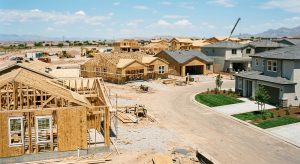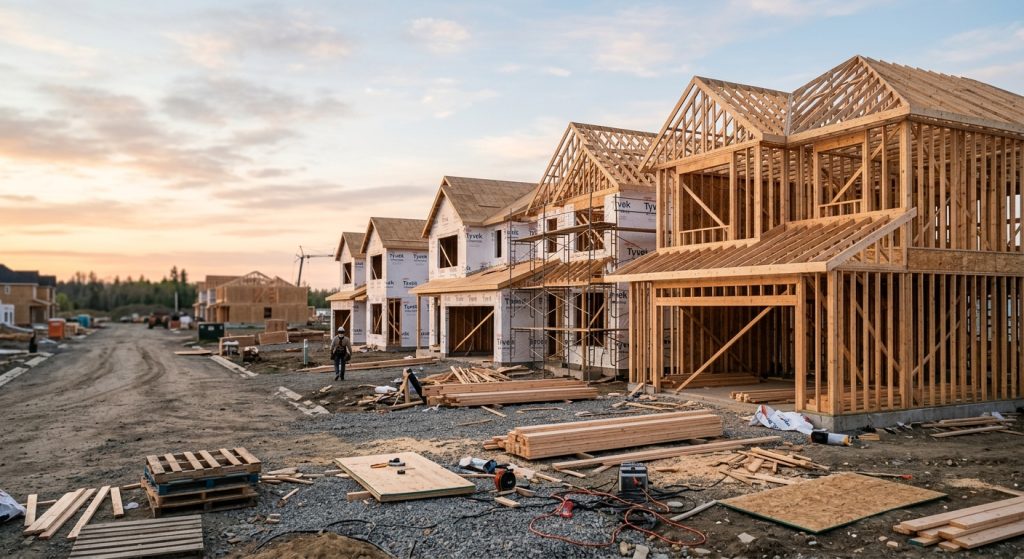
U.S. homebuilders broke ground on far fewer houses in July than in June, even as the number of building permits pulled for future construction rose, according to data released Tuesday by the U.S. Census Bureau and the U.S. Department of Housing and Urban Development.
Privately-owned housing starts fell to a seasonally adjusted annual rate of 1,239,000 units in July, down 12.4% from a revised June rate of 1,415,000 and down 13.5% from July 2025’s rate of 1,432,000, the Census Bureau’s monthly New Residential Construction report found. Single-family starts, the segment most closely tied to the traditional for-sale housing market, fell 9.9% month over month to a rate of 808,000 units and are down 15.7% from a year earlier. Starts of buildings with five or more units, a proxy for apartment construction, fell 15.6% from June to a rate of 421,000 units.
Building permits moved in the opposite direction. Privately-owned housing units authorized by permits rose 5.0% from a revised June rate of 1,374,000 to 1,443,000 in July, and were 3.1% above the July 2025 rate. Single-family authorizations climbed 2.5% month over month to 894,000, while permits for buildings of five or more units jumped to a rate of 490,000. Because permits typically precede ground-breaking by weeks or months, the increase suggests builders are lining up future projects even as they pull back on starting new ones today.
Housing completions also declined sharply, falling 9.1% from June to a seasonally adjusted annual rate of 1,212,000 units and down 16.8% from a year earlier. Single-family completions fell 5.8% month over month to 878,000 units. The total number of housing units under construction slipped 0.2% from June to 1,262,000, down 6.0% from July 2025; single-family units under construction fell 7.2% year over year to 579,000, according to the Census data.
In a same-day analysis of the report, the National Association of Home Builders’ Eye on Housing blog pointed to “economic uncertainty, rising construction costs, labor shortages and elevated financing expenses” as the forces weighing on builders. NAHB’s analysis found single-family starts are down 6.9% on a year-to-date basis, with the three-month moving average now at 865,000 units. Regionally, combined single-family and multifamily starts are up 11.7% year to date in the Northeast but down 3.0% in the South, 3.8% in the West and 4.5% in the Midwest; single-family starts specifically are lower in all four regions so far this year.
What it means: The divergence between falling starts and rising permits is the clearest signal in Tuesday’s report. Verified facts: starts, completions and the pace of construction activity all declined from June, while permit authorizations increased across both single-family and multifamily categories. NAHB’s attributed interpretation is that elevated financing costs and construction expenses are the primary drag on builders’ willingness to start new homes, even as some are still applying for permits to keep projects in the pipeline. RealtyWire’s analysis: a widening gap between permits and starts over consecutive months would be worth watching as a leading indicator of whether builders expect near-term demand to improve or are simply preserving optionality amid rate uncertainty.
The pullback in starts was broad-based by region. Seasonally adjusted annual starts activity fell in the South, to a rate of 645,000 units, down 4.9% from June and 16.2% from a year earlier, and in the West, to 257,000 units, down 21.6% month over month and 20.7% year over year. Starts in the Northeast rose 17.1% from June to 164,000 units but remained volatile on a small base, while the Midwest fell 27.1% month over month to 173,000 units. Single-family starts were down from a year earlier in every region, ranging from a 4.2% decline in the South to a 27.0% drop in the Midwest, underscoring how uneven the slowdown has been even as national headlines focus on the aggregate number.
The single-family slowdown compounds a permitting trend already flagged in RealtyWire’s coverage of June’s building permits data, which found multifamily permitting outpacing single-family activity through the first half of the year. It also comes as builders separately contend with land competition from data-center developers, a dynamic detailed in RealtyWire’s reporting on construction labor shifting toward nonresidential projects.
The Census Bureau’s August new residential construction report, covering the month during which the Federal Reserve’s next rate decisions will factor into builder financing costs, is scheduled for release Sept. 17.