Prices for residential building materials climbed further in July, with softwood lumber posting its sharpest monthly jump in more than a year, according to an analysis released Thursday by the National Association of Home Builders.
NAHB economist Jesse Wade, writing on the group’s Eye on Housing blog, found that prices for residential building materials excluding energy rose 0.4% in July and are up 5.0% from a year earlier — the fastest year-over-year pace since December 2022. The analysis is based on the Producer Price Index (PPI) released by the U.S. Bureau of Labor Statistics.
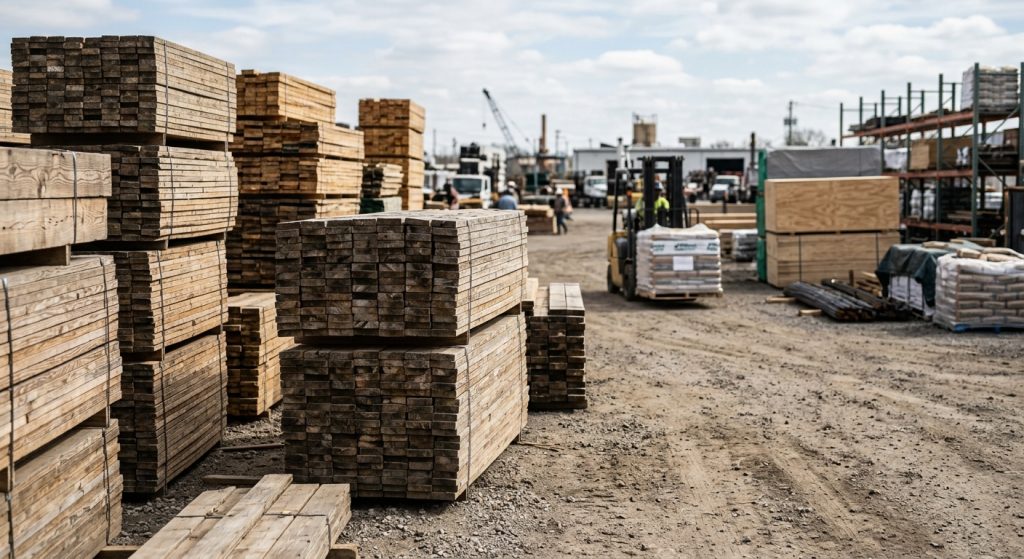
Softwood lumber prices, a closely watched input for single-family construction, jumped 7.4% in July alone and are up 17.3% over the past 12 months. Ready-mix concrete moved in the opposite direction, slipping 0.4% for the month, though it remains up 2.2% year-over-year.
The broader PPI for final demand — a measure of prices businesses receive for goods and services across the economy — was unchanged in July after falling 0.1% in June, and is up 4.7% from a year ago. Energy prices fell 2.4% in July but remain up a steep 33.1% year-over-year, reflecting the volatility that has characterized energy markets over the past year.
Services tied to construction and delivery also grew more expensive. Trade services — the markup charged by wholesalers and retailers — rose 7.0% year-over-year, while transportation and warehousing costs climbed 10.9%. Overall input services fell 0.3% in July but are up 6.2% over the past year.
What it means: The NAHB data is a verified reading of the government’s own producer-price series, filtered specifically for the materials and services that go into a house. The 5.0% annual increase in residential materials prices — the fastest since late 2022 — is a fact, not a forecast. What it means for buyers is RealtyWire analysis: sustained double-digit lumber inflation adds directly to the cost of framing a new home, and builders facing higher input costs typically pass at least some of that increase through to buyers or absorb it through thinner margins, particularly in a market where affordability is already stretched. The NAHB has separately flagged labor and land costs as additional pressure points for builders this year, so materials inflation is compounding rather than offsetting other cost increases.
The lumber price swing is notable because softwood lumber costs have been unusually volatile over the past several years, driven by mill capacity, tariff policy on Canadian lumber, and swings in housing demand. A single month’s 7.4% jump does not establish a new trend on its own, but it comes atop a 12-month gain of 17.3%, suggesting the pressure has been building rather than a one-off spike.
The building-material price data lands alongside other signs that construction costs remain a persistent drag on housing supply. NAHB has also reported that residential construction wage growth is cooling even as materials costs rise, a divergence that squeezes builders from multiple directions at once. Separately, the Turner Building Cost Index rose 5.15% in the second quarter, and builders have said data center developers are outbidding them for land in some markets — additional cost pressures layered on top of materials inflation.
NAHB tracks the PPI building-materials subset monthly as part of its broader push to document the cost side of the housing-affordability equation, alongside separate reports on labor, land and regulatory costs.
The PPI measures prices at the producer level — what manufacturers, wholesalers and service providers charge — rather than what a builder ultimately pays after distribution markups, so the NAHB analysis functions as a leading indicator for the input costs that eventually show up in a home’s sale price. Because lumber, concrete and other structural materials are typically bought and installed within weeks of a price change, swings in the PPI tend to move through to construction budgets faster than, say, land or labor costs, which are often locked in earlier in a project’s timeline.
The pressure is not limited to builders. A separate survey of real estate investors found nearly half cited tariff-driven material cost increases as a factor squeezing their projects this year, alongside financing costs and rising home prices. That combination of higher input costs and more cautious buyers is part of why sentiment gauges across the housing industry have stayed depressed relative to prior cycles.