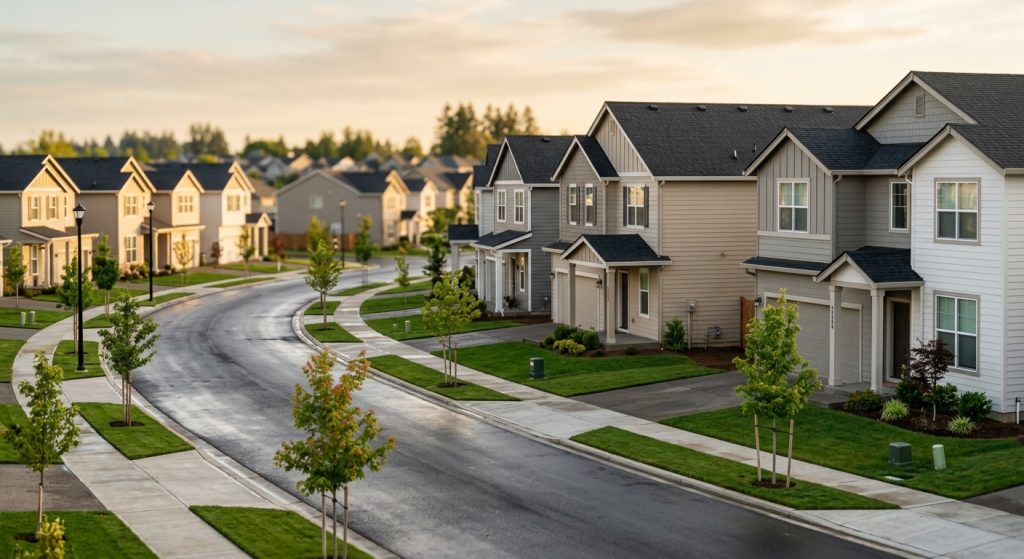
The Federal Housing Administration will now insure mortgages on rental communities made up of detached single-family houses, duplexes and triplexes — a build-to-rent product that HUD’s multifamily programs had excluded until now.
HUD announced the change on Oct. 14, and it takes effect immediately under Mortgagee Letter 2026-12, signed by Joseph M. Gormley, who is performing the duties of assistant secretary for housing and federal housing commissioner. Build-to-rent properties “will now be treated under the same terms and conditions as traditional multifamily rental developments,” the letter says, subject to a list of conditions it spells out over five pages.
“America needs more affordable housing,” Secretary Scott Turner said in the announcement. “We’re eliminating barriers to spur development, expand rental options, and improve housing affordability for hardworking American families.”
Why BTR was excluded
HUD’s Office of Multifamily Housing had limited its insured loans to developments with buildings containing four or more units — garden-style, mid-rise and high-rise apartments. Build-to-rent, which HUD once called “subdivisions for rent,” was excluded because its single-family design and subdivision layout raised questions about Fair Housing Act accessibility requirements and created valuation and underwriting problems, the letter says.
The letter cites Section 3 of Executive Order 14376, issued Jan. 20, 2026, and titled “Stopping Wall Street from Competing with Main Street Homebuyers,” which directs HUD to include “narrowly tailored exceptions for Build-to-Rent properties that are planned, permitted, financed and constructed as rental communities.” The order’s thrust is restricting Wall Street’s competition with individual homebuyers, which is why build-to-rent needed a carve-out from it; separately, Treasury’s first rule on a 350-home ownership ban reached the White House for review in early October.
What qualifies
Two programs are open to BTR: Section 221(d)(4), for new construction only, and Section 223(f), limited to acquisition or refinancing of properties whose certificate of occupancy is dated less than three years before the application.
A project must sit on a single cohesive contiguous site, be operated as one rental property, and contain five or more dwelling units. A single tax parcel is preferable but multiple contiguous parcels are acceptable. No privately owned parcels or houses may be interspersed, and HUD will not approve any sale of parcels or buildings, or any partial release of collateral, during the insured loan term — a provision that forecloses selling homes out of the community one at a time.
Sites mixing BTR with conventional apartment buildings are allowed if the lender works through the added underwriting and accessibility complications. Manufactured and modular construction are “generally acceptable,” the letter says, but complicate HUD’s practice of insuring advances for work installed on site, and must be vetted at the concept meeting. Gormley tied that to HUD’s parallel effort on factory-built housing: “Combined with other initiatives we are working on at HUD, including chassis removal in our manufactured housing programs, we are unshackling the market to deliver housing where it’s needed most.” HUD’s Next Generation Housing Action Plan proposed dropping the permanent-chassis requirement and extending its construction code to buildings of five units or more.
Properties must be professionally managed on terms comparable to other projects in the market, with an on-site management and leasing office and maintenance staff, or at minimum a locally staffed operation. Any homeowners association or master-plan governing regime must not impede HUD’s enforcement of program requirements or the borrower’s full management control, and lenders must disclose HOA involvement at the concept meeting.
The accessibility carve-out
On our reading, the most consequential technical point is accessibility. Detached houses, duplexes and triplexes do not meet the legal definition of a “covered multifamily dwelling,” so the letter exempts those building types from five Fair Housing Accessibility Guidelines design requirements: an accessible building entrance on an accessible route; an accessible route into and through the unit; reachable light switches, outlets and environmental controls; reinforced walls for grab bars; and usable kitchens and bathrooms. HUD says those features are “strongly encouraged” but not required.
The exemptions are narrow. Any building on the site with four or more units remains covered. Accessible routes, entries and other Fair Housing Act features are still required for common areas and site amenities, as at any multifamily property. Section 504 of the Rehabilitation Act applies where there is federal funding, the Americans with Disabilities Act applies to public accommodations, and where federal, state or local rules differ, the stricter one governs.
Underwriting terms lenders should expect
HUD built conservatism into the numbers. For new construction it will consider an absorption period of up to 24 months, recognizing that BTR communities lease up on a rolling basis while construction continues elsewhere on the site. The initial operating deficit escrow must be at least the greater of 3% of the loan amount or four months of debt service, with the lender independently sizing it under the Multifamily Accelerated Processing Guide using recent lease-up data from comparable BTR communities.
Vacancy assumptions are floored: market-rate projects must use the greater of 7% or the market rate for comparable properties, and affordable projects may go below 7% but never under 5%. HUD also tells lenders to expect higher operating expenses from low-density layouts, including grounds and road maintenance, and discourages relying only on expense data from conventional apartment projects. Replacement reserves should run higher as well, because more buildings mean more roofs, cladding and windows to replace.
On building codes, the letter draws a distinction it concedes causes confusion: a BTR property is a multifamily property, but an individual detached house on it is not a multifamily building. Where a code such as NFPA 101 requires sprinklers in new multifamily buildings, a detached rental house may be exempt depending on structure type and building separation. HUD says it will generally rely on the local building department’s interpretation.
The policy arrives as the sector cools. Single-family built-to-rent starts fell 16% over four quarters through the second quarter of 2026, by NAHB’s count. The Mortgagee Letter is effective until amended, superseded or rescinded, and HUD says the MAP Guide will be revised to incorporate it.