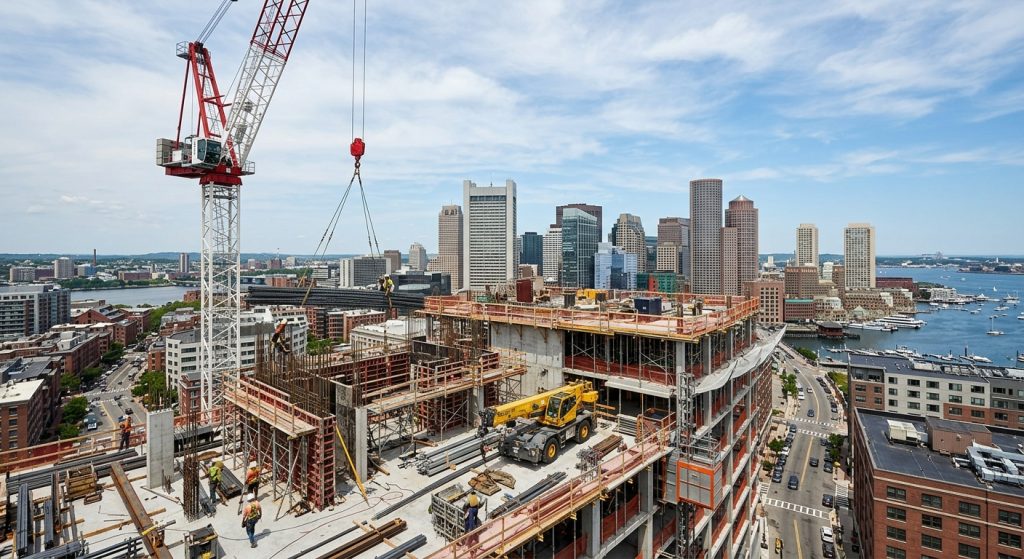
Wentworth Institute of Technology broke ground on a $200 million, 18-story residence hall in Boston that will be the largest capital project in the university’s history, the school announced in a release detailing construction progress on the tower.
According to Wentworth’s own announcement, the 202,000-square-foot First-Year Tower will rise on the school’s former West Parking Lot at Ruggles Street and house all 972 members of the incoming first-year class under one roof — the first time in the university’s history that its entire first-year residential cohort will live together. Site work and foundation activity are already underway, with a formal groundbreaking ceremony set for Sept. 17, 2026, and the building expected to open to students in August 2028.
Balfour Beatty Campus Solutions is developing the project, with BOND serving as construction manager, Perkins&Will as architect and BR+A Consulting Engineers handling engineering. The project is financed through a bond secured from MassDevelopment in July 2026.
The tower is designed as all-electric, with no on-site fossil fuel combustion, and is targeting Passive House certification, a rigorous energy-efficiency standard, with a high-performance building envelope intended to cut heating and cooling demand and continuously filtered air systems throughout. Each residential floor will include four centralized lounges, and the ground level will include dining and community space open to the broader campus, not just residents.
Wentworth President Mark Thompson said the tower represents “the clearest expression yet of the university we’re becoming,” framing it as a commitment to academic, social and personal support for first-year students. Vice President for Student Affairs Courtney McKenna said housing the full first-year class together is meant to enable more intentional community-building through orientation programs, living-learning cohorts and daily interaction. Matt Gruber, senior vice president of finance and administration, said the all-electric design controls long-term operating costs while aligning with student environmental priorities and the school’s engineering curriculum.
The residence hall anchors Wentworth’s 10-year Institutional Master Plan, announced in 2024, which calls for roughly 1,400 new beds across multiple projects and aims to raise the share of students living on campus to about 75%. The university said the project is also intended to ease rental-housing pressure in the surrounding Mission Hill, Roxbury and Fenway neighborhoods, and includes new pedestrian and cyclist infrastructure, including an extension of the People’s Pike pathway and new bikeshare stations funded by the university.
Wentworth said the project is also functioning as a teaching tool: 48 alumni are currently working on the project, current students are completing co-ops alongside the professional development team, and faculty across the university’s construction management, engineering and architecture programs are using the active job site as a classroom.
What it means: The project is part of a broader wave of purpose-built student housing investment nationally, as universities compete to guarantee more of their students on-campus housing rather than compete with residents for limited off-campus rental units — a dynamic also visible in university-adjacent developments like Varcity’s university-based retirement community at Purdue. For Boston specifically, adding nearly 1,000 beds to Wentworth’s own housing stock is a small but real release valve for a rental market where Mission Hill, Roxbury and Fenway have long absorbed overflow demand from the city’s dense concentration of colleges and universities.