U.S. industrial demand is on track to outpace new supply by late 2027, a shift that would mark a turning point for a warehouse and logistics market that has spent the past two years absorbing a wave of pandemic-era construction, according to a forecast CoStar Group published Aug. 5.
The commercial real estate data and analytics firm said national industrial vacancy remains in the mid-7% range entering the third quarter of 2026 and is expected to edge slightly higher into 2027 before beginning a steady decline — a modest improvement from CoStar’s prior forecast. Average annual rent growth for the 2026-27 period was revised upward to 1.9%.
Construction overhang still working through the pipeline
The near-term picture remains challenging for landlords. CoStar said industrial deliveries are expected to continue outpacing tenant demand through early 2027, keeping vacancy elevated and rent growth muted even as leasing activity holds up better than earlier expected. That stronger-than-anticipated recent demand is what prompted CoStar to revise its near-term net absorption estimate higher and trim its vacancy outlook slightly.
“While leasing activity remains healthy, elevated availability and a lingering supply overhang are expected to keep rent growth modest in the near term,” said Juan Arias, CoStar Group’s national director of industrial analytics. “By late 2027, slowing construction activity and improving demand should allow net absorption to exceed new supply, marking a turning point for market fundamentals.”
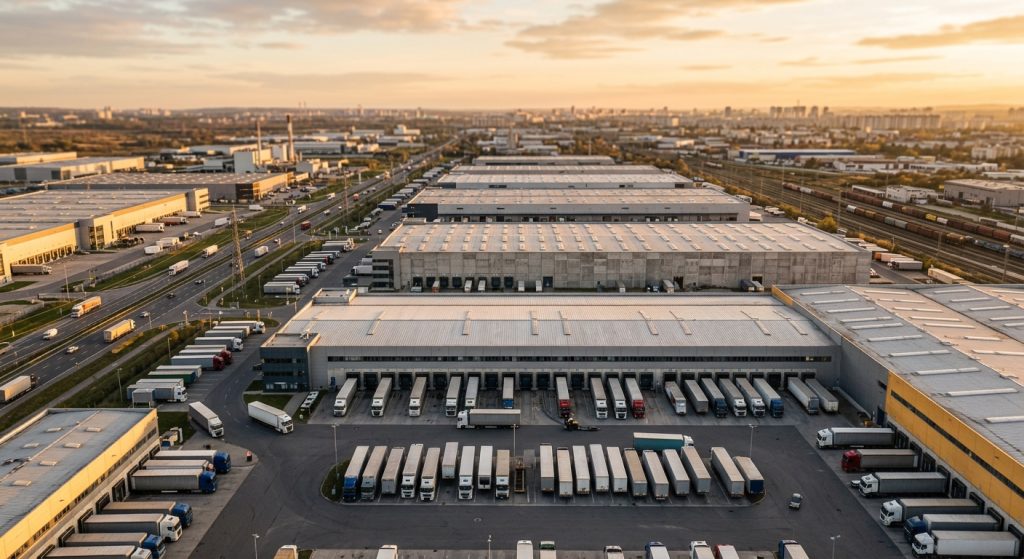
The forecast follows a multi-year building boom that added enormous amounts of warehouse and distribution space nationally as e-commerce growth and supply-chain reconfiguration drove developers to chase tenant demand. That construction wave has since cooled sharply as vacancy climbed from pandemic-era lows, leaving many markets — including Chicago, where industrial vacancy has been rising — working through a supply glut even as underlying leasing fundamentals hold up. Other markets, such as Phoenix, have already begun to see vacancy tick down as new construction slows.
Risks tilted to the downside
CoStar cautioned that its 2027 turning-point forecast is not guaranteed. “Risks to the forecast remain tilted to the downside,” Arias said. “Trade and tariff uncertainty, elevated operating costs, and subdued consumer spending on goods could weigh on tenant expansion plans and delay the recovery in demand. Under a weaker economic scenario, vacancy could rise above the current forecast and place additional pressure on rents.” He added that the opposite is also possible: “Easing inflation, stronger consumer confidence, and continued resilience in leasing activity could support faster absorption and an earlier recovery.”
CoStar, founded in 1986, said its websites drew an average of 118 million unique monthly visitors in the second quarter of 2026, a scale the company cites as evidence of its role as a primary source of commercial real estate data. In the same release, the firm reported that its separately tracked national apartment vacancy rate stood at 8.2% in the second quarter, down 26 basis points from the prior quarter and 14 basis points from a year earlier, while the national average apartment rent held roughly flat at $1,747 in July, up from $1,746 in June — a 0.03% monthly increase.
What it means
CoStar’s vacancy and rent figures are the company’s own proprietary market data, gathered from its national commercial real estate database — a Class 2 source that is authoritative for CoStar’s own research but represents one data provider’s methodology rather than a government count. The 2027 “turning point” is a forecast, not a certainty, and CoStar’s own risk language — citing trade policy, operating costs and consumer spending as swing factors — should be read as the company’s explicit hedge on the timeline.
What to watch: near-term industrial vacancy is still expected to rise before it falls, meaning landlords in oversupplied markets likely face another several quarters of soft rent growth and elevated concessions before the construction pipeline thins enough to shift leverage back toward owners.