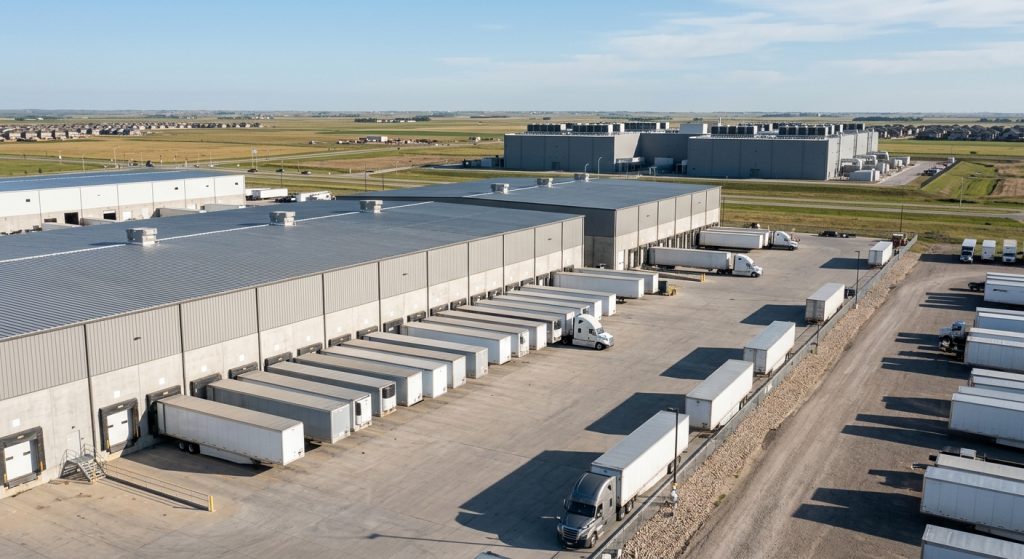
Data centers are now filling warehouses as well as power substations. Industrial leasing tied to building and running data centers reached 50 million square feet through the third quarter of 2026, according to a new Cushman & Wakefield analysis, “Data Centers: The Newest Logistics Demand Engine,” released Nov. 24, 2026. That is 113% more than the full-year 2025 total.
Total new industrial leasing nationally rose 21% over the same period, according to the firm. In the third quarter, data center-related users accounted for what Cushman & Wakefield called a record 14% of new industrial leasing among tenants of 50,000 square feet or more. The firm’s announcement also says the leasing through the third quarter exceeded 2024 and 2025 combined.
Data center industrial leasing: from 2% to 14% of the market
For most of the past four years, this was a small part of the warehouse market. Cushman & Wakefield’s numbers put data center-related users at just 2.0% to 2.5% of national leasing in 2022 and 2023. The share was roughly 5.0% in both 2024 and 2025. In 2026 they accounted for 11% of total new leasing year to date and 25% of the U.S. leases over 1 million square feet signed this year.
“Data center development is creating a physical supply chain that extends well beyond the campus itself,” said Jason Price, head of Americas logistics and industrial research at Cushman & Wakefield. “Servers, power and cooling equipment, construction materials and replacement parts all have to be manufactured, stored and distributed, and that is now showing up as a meaningful new source of industrial leasing.”
The report names three groups of tenants behind the demand:
- Third-party logistics providers (3PLs), as large data center users outsource the moving and distribution of critical parts and equipment.
- Construction and building suppliers, which need space to store materials for campuses under development.
- Manufacturers of servers, storage systems, racks, cabinets and other components, which are expanding distribution networks in key hubs.
The firm said manufacturers and suppliers of data center parts and components led the activity, along with construction suppliers. Construction and building suppliers made up 30% of year-to-date volume. Cushman & Wakefield argues that much of that demand will last, because campuses need ongoing maintenance and replacement parts after they are built.
The analysis ties the surge to the size of the build-out. The firm counts more than 47 gigawatts of operational data center capacity in the U.S. and another 36 gigawatts under construction. It says year-to-date U.S. imports of AI-related equipment, parts and components are up 62% from a year earlier, to $659 billion. Those goods pass through ports, warehouses and distribution networks before they reach data center users.
Logistics firms and hyperscalers sign big leases
Data center-related leasing by 3PLs reached nearly 11 million square feet year to date across 10 deals of more than 500,000 square feet. The report says long-term contracts announced earlier this year between hyperscalers and major 3PLs, including DHL and Kuehne + Nagel, supported that activity. It was strongest in Columbus, Ohio; Dallas-Fort Worth; and Phoenix.
Hyperscalers, the largest cloud and AI operators, also signed six leases of more than 500,000 square feet of their own to store and distribute equipment. Those were concentrated in Dallas-Fort Worth, Atlanta, Kansas City and Charlotte, N.C.
The markets where it matters most
The pattern is clearest where data center capacity is concentrated. Columbus, Phoenix, Atlanta and Dallas-Fort Worth each have more than 3,500 megawatts of operational or planned capacity, according to the report. Together they have produced more than 32 million square feet of data center-related industrial leasing in 2026.
In Phoenix, Columbus, Kansas City, Virginia and Dallas-Fort Worth, data center-related users account for 22% to 41% of year-to-date industrial leasing. Compared with 2025, such demand has grown more than 300% in Columbus, Northern California, the Carolinas, Kansas City and Austin-San Antonio.
The demand is also spreading beyond established hubs. Combined data center-related leasing in Austin-San Antonio, Kansas City, Reno, Nev., and West Texas is up 274% from last year, led by 2.2 million square feet in Kansas City. El Paso, Texas; Portland, Ore.; and Salt Lake City recorded notable demand of this kind for the first time in 2026, the firm said.
Developers have begun to respond. The industrial pipeline under construction is up from a year earlier in Columbus (190%), Atlanta (171%), Nashville (110%), Phoenix (92%) and Chicago (68%). Cushman & Wakefield notes that those pipelines are still well below their 2023-2024 highs.
What the firm tells occupiers and investors
The report warns that data center-related tenants often know where new campuses will be built before ground is broken, so they can lock up nearby space early. That makes them another source of competition for quality industrial buildings. “Occupiers with requirements in major data center hubs may want to evaluate their space needs and timelines earlier,” Price said. He added that with new supply “expected to remain modest in the near term,” occupiers can still secure well-located Class A facilities.
For investors, the firm expects advanced manufacturing and data center-related tenants to keep lifting absorption, the net amount of space taken up, nationwide into 2027. It argues that improving fundamentals in data center markets should support values and growth in net operating income.
That outlook comes from the firm’s own analysis, and it depends on data center construction continuing at its current pace. Some projects have run into local opposition. Loudoun County, Va., has paused board votes on data center applications, and in a separate analysis Cushman & Wakefield found data center construction costs up 21% per megawatt since 2024. On our reading, the warehouse demand is only as durable as the campus pipeline behind it. The report’s own case for durability rests on maintenance and replacement-parts demand from campuses that are already operating.
More industrial and office coverage is in our commercial real estate section.