Baltimore has released the full deal terms for redeveloping Harborplace, the aging pavilions on the Inner Harbor waterfront. The four agreements with developer MCB Real Estate go to the city’s Board of Estimates for a vote on Dec. 2. The package, announced Nov. 19 by Mayor Brandon M. Scott and the Baltimore Development Corporation (BDC), pairs a 25-year payment-in-lieu-of-taxes agreement with a 99-year ground lease, a profit-sharing clause and a community benefits agreement.
In a PILOT agreement, the developer pays a negotiated annual amount in place of ordinary property taxes. The arrangement has drawn the most scrutiny, and the city’s release spends much of its length defending it. City officials argue the subsidy is the only way to get a project built on a site that is losing value every year. Final approval now rests with the Board of Estimates, the city’s spending board.
The four Harborplace agreements
According to the city’s Harborplace redevelopment page, which posts all four documents:
- Ground lease. The city keeps ownership of the land and leases it to MCB for $50,000 a year for 99 years. MCB cannot begin construction on any phase until it shows, to the city’s satisfaction, that it has the money to finish that phase.
- PILOT agreement. MCB must pay a minimum of $543,000 a year, rising to $1.2 million a year within five years. The city puts the guaranteed total over the 25-year term at $35.36 million.
- Profit sharing. If the project outperforms profit expectations by 20%, the city receives a 20% share of those profits, according to the release.
- Community benefits agreement. These are legally binding commitments that are a condition of the PILOT. They include a $10 million community fund for downtown overseen by an advisory board, local hiring targets and a $5 million equity fund that would let Baltimore residents invest small amounts in the project.
The city also says MCB and the BDC will release annual audits of the project’s financial statements.
Why the city says the tax break is needed
The city’s argument rests on what happens if nothing is built. According to the release, the existing pavilions lose about $10 million in assessed value a year. Left alone, they would produce as little as $23,000 a year in property taxes, or $4.03 million in total through 2054. The guaranteed PILOT payments, the city says, are more than three times that.
According to the Harborplace page, a PILOT can be offered only if the developer shows the project would not be financially feasible without one. The city said that showing was made by a third-party analysis from MuniCap, a public-finance consulting firm. “Without this PILOT agreement, redevelopment will not happen,” the city’s FAQ states. It puts the forgone General Fund revenue in that case at roughly $31.33 million. It also cites more than $600 million in assessed value already lost across downtown.
The city also says it is not spending taxpayer money to build the project. It points to two precedents. One is the 25-year PILOT for the Baltimore Marriott Waterfront in Harbor East, which it says now produces $3 million a year in taxes. The other is The Wharf in Washington, D.C., which it says generated enough tax revenue to repay the city bonds that financed its infrastructure 15 years early.
“My main priority from day one of these negotiations has been getting a good deal for our residents,” Scott said in the release. “Over my lifetime, I’ve seen countless deals that advantaged private developers at Baltimore’s expense, and I was committed to doing things differently in this negotiation.”
Otis Rolley III, president and CEO of the BDC, said, “Harborplace is a major opportunity for Baltimore, and the PILOT is what makes redevelopment possible.”
What MCB plans to build
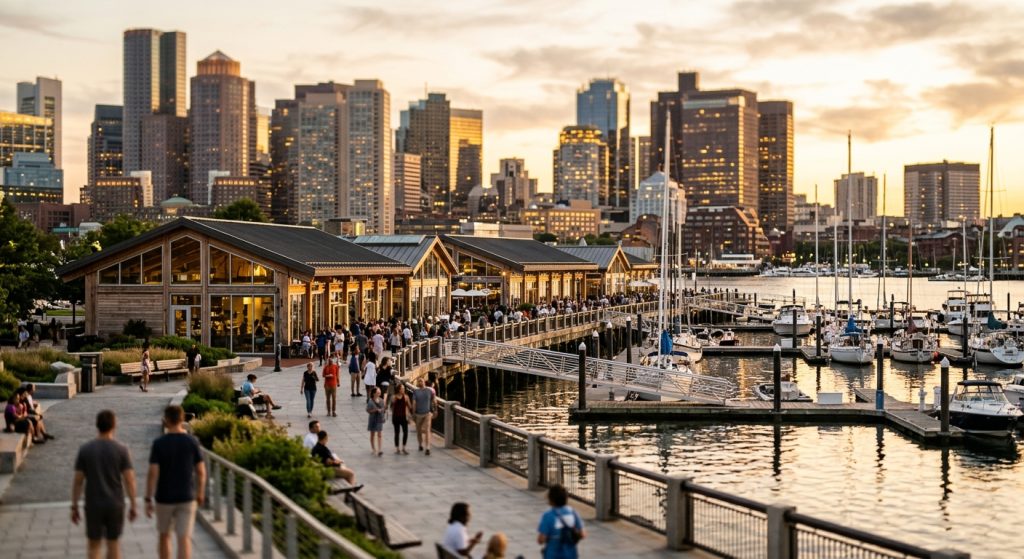
The city’s page lays out MCB’s plan: mixed-use residential, office and commercial buildings with retail and restaurants. The new buildings would cover less ground than the current pavilions, opening up 4.5 more acres of park and public space for a total of 18.7 acres.
- 303 Light St. is a pair of connected towers with retail, restaurant and community space on the first two floors and apartments and a hotel above. Ten percent of the residential units would be affordable at 50% and 60% of area median income.
- 201 E. Pratt St., known locally as “The Sail,” would have ground-floor retail and a market or food-hall concept, with commercial space on the upper floors.
- 203 E. Pratt St., between The Sail and the World Trade Center, would have ground-floor retail and offices above.
The plan also replaces the Inner Harbor’s entire seawall, which the city says has reached the end of its useful life, and raises it to account for rising sea levels. The city says the waterfront would get more than 500 new native trees, wetlands to filter nutrients from the harbor, and upper and lower promenades designed to handle flooding. The first phase begins with closing the Light Street spur next to McKeldin Plaza. That land becomes the Park at Freedom’s Port, which the city describes as a tribute to Baltimore’s first Black residents.
Timeline and jobs
The city expects infrastructure work and demolition of the pavilions to begin in 2027, with the first phase finished in 2031. It notes that the timeline “remains subject to financing, permitting, and construction progress.”
City projections put construction-period economic activity at about $2 billion, including $26.4 million in direct revenue to the city. They also project more than 8,500 construction jobs paying $648.6 million in labor income. Under the hiring terms, at least 35% of construction hours go to city residents, 40% of construction contracts go to disadvantaged and women-owned businesses, and 55% of new permanent hires must live in the city. Public maintenance workers in the development area will be covered by a collective bargaining agreement that includes AFSCME members. MCB is negotiating with UNITE HERE and the building trades over agreements for those workforces.
“When we first bid on this project to bring it out of receivership, our main goal at MCB was to deliver a project that enhanced our world-class waterfront,” said P. David Bramble, managing partner of MCB Real Estate. “While the announcement today is a critical step forward, we still have much work to do.”
What the Dec. 2 vote decides
The Board of Estimates vote decides whether the agreements take effect. It does not decide whether the towers get built. The financing condition in the ground lease means each phase moves only when MCB can show it has the capital to finish it. That matters for a project that will need financing for hotel, apartment, office and retail space.
On our reading, the city’s case depends on comparing the deal with a pavilion complex that keeps losing value, not with a fully taxed new development. That is the trade-off the board will be weighing. The structure resembles other public-private waterfront deals RealtyWire has covered, from the state-owned Fall River, Mass., site eyed for $1 billion of development to the hospital-anchored $1 billion redevelopment planned around Jersey City Medical Center. More development coverage is in our commercial real estate section.