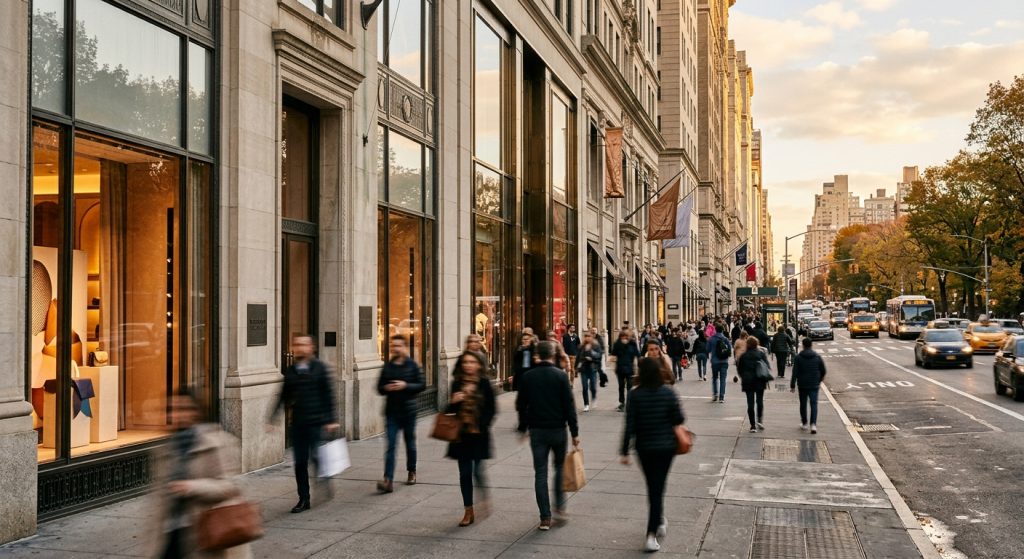
New York’s Upper Fifth Avenue is once again the most expensive retail street in the world. Average rents on the corridor rose 35% over the past year to $2,700 per square foot annually, lifting it from third place in 2025 back to first, according to Cushman & Wakefield’s annual Main Streets Across the World ranking, released Nov. 17, 2026. The firm said it is the first time Fifth Avenue has held the top spot since 2023.
The jump came after three years of flat rents on the strip, the full report says. London’s New Bond Street slipped to second at $2,230 per square foot and Milan’s Via Montenapoleone to third at $2,160, both with flat rent growth over the past year after large increases in prior years. A year ago, Cushman & Wakefield’s 2025 edition put New Bond Street at No. 1 for the first time, with Fifth Avenue third at an average of $2,000 per square foot.
U.S. retail rents outpace the world
The ranking covers headline rents on 147 top urban retail streets. Globally, rents rose an average of 3.0% year over year in local-currency terms, a second straight slowdown after 5.0% growth in 2024 and 4.3% in 2025. Nearly half of the streets (49%) posted increases, 32% held steady and 19% declined.
U.S. streets did better than the global average. Cushman & Wakefield says U.S. rents rose 5.8%, up from average growth of 2.5% in last year’s edition, with two Sun Belt corridors standing out: the Brickell Boulevard Corridor in Miami, where rents rose 43%, and South Congress in Austin, Texas, up 20%. The Americas and Asia Pacific each recorded 3.1% growth, and Europe 2.9%. Asia Pacific was the only region where growth accelerated.
The report also flags movement beyond the gateways. It says luxury brands are looking past New York, London, Paris and Tokyo to wealth centers such as Miami, Palm Beach and Austin, and that “waitlists, not availability, increasingly decide who secures a position” on the top streets. Among the decliners, Toronto’s Bloor Street fell five places after a 17% drop in rents.
Who is leasing the space
For the first time, the report tracked leasing on the 30 top streets. Retailers signed or opened more than 815,000 square feet across 153 deals over the past year, worth more than $647 million a year at average market rents, the firm said. More than 80% of that activity came from retailers new to their street, and international brands took about 90% of the space, with stores averaging 5,000 square feet, more than double the size of domestic retailers’ stores.
Large stores drove the totals. Stores above 10,000 square feet accounted for just 13% of deals but 47% of the space leased. Fashion remained the biggest category, with half of all deals and 57% of space taken, while health and beauty ranked second. The firm cites growing demand from K-beauty and J-beauty brands, alongside food and beverage and experiential concepts.
“The return of Fifth Avenue to the top of the rankings demonstrates how quickly rents can accelerate when strong retailer demand meets limited availability,” said Dr. Dominic Brown, Head of International Research, Global Think Tank at Cushman & Wakefield.
Alanna Loeffler, Senior Managing Director and Americas Retail Platform Lead, said that “today’s flagship store is more than a place to transact, it is a brand-building platform,” and that demand “continues to concentrate in a relatively small number of global retail destinations.”
The spending behind the rents
The report ties prime-street strength to a split consumer. It says the top 20% of U.S. households account for 60% of spending, which supports luxury demand while middle- and lower-income households come under pressure. It also notes that higher energy costs have pushed inflation back into focus and that central banks have turned cautious, with rate cuts not expected before the second half of 2027 at the earliest, in the firm’s view.
On our reading, the ranking reinforces a pattern visible across Manhattan commercial real estate this year: tight supply in the best locations is translating into pricing power for landlords, as it has in office space, where Vornado re-leased Manhattan offices at 26% higher cash rents in the third quarter and SL Green filled 245 Park Avenue. The same dynamic does not extend to the broader retail market, and the report’s own figures show nearly one in five tracked streets saw rents fall. More coverage is in our commercial real estate section.
Cushman & Wakefield said it expects competition for limited prime retail space to remain a defining feature of the market, with retailers increasingly folding artificial intelligence into customer engagement, inventory management and store operations.