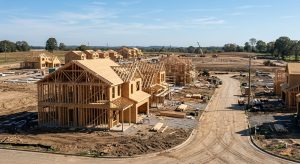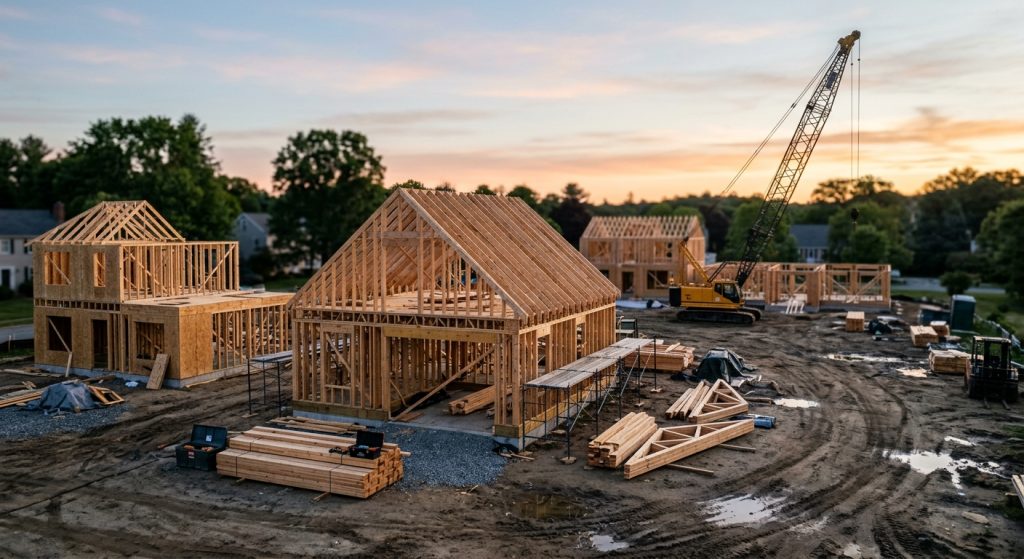
The Federal Reserve’s own tool for fighting inflation can work against the housing supply the country needs, Boston Fed President Susan M. Collins said Nov. 13. In opening remarks at the Federal Reserve Bank of Boston’s 70th Economic Conference, she said that “tighter policy in the near term can limit the expansion of the housing stock needed to ease housing market pressures.”
She defended that tightening in the same breath. Higher rates are “needed at times to ensure price stability,” Collins said, “with benefits for the housing market and economy as a whole over the longer run.” The remarks come two weeks after the Federal Open Market Committee held the federal funds rate at 3.75% to 4% on Oct. 28, with Governor Lisa D. Cook and Cleveland Fed President Beth M. Hammack dissenting in favor of a quarter-point hike. The committee’s next meeting is set for Dec. 8-9.
Collins on the housing market and Fed policy
Collins built the speech around four points about why a central bank would spend a day and a half on housing. The prepared text says the rise in house prices since the pandemic, “combined with the notable increase in mortgage rates since early 2022, has pushed homeownership beyond the reach of many Americans,” and that for some families recent developments “could delay, reduce, or eliminate the wealth-building associated with owning homes.”
Housing’s weight in the economy is larger than its share of output suggests, she argued. Although housing is a small part of GDP, Collins said it drove about 17% of GDP growth during the mid-2000s boom and about 41% of the output contraction in the bust that followed. Because new construction and buyers’ ability to purchase are so sensitive to interest rates, she said, monetary policy “can have an outsized influence on the housing sector,” and the tightening that began in 2022 sent mortgage rates up sharply and slowed new residential investment.
Collins was explicit that housing policy is not the Fed’s job. “Decisions on housing policies, zoning, and fiscal expenditures related to housing are definitively outside the Fed’s purview,” she said. What the regional banks can offer, in her account, is research. She also said she hears from New England employers about physicians, skilled mechanics, research scientists and hospitality workers who “backed out of job offers because of the limited availability and high cost of housing,” and, increasingly, about projects “slowing or stalling due to a lack of skilled construction workers.”
A construction sector getting less productive
The fact Collins said “stands out” on the supply side was construction productivity. While productivity has picked up across much of the economy, she said, the construction sector “produced about 40 percent less output from a given set of inputs in 2020 than it did in 1970,” and productivity has fallen further since the pandemic.
That figure comes from University of Chicago economist Chad Syverson, whose conference paper, “Productivity Growth in Construction: Still Strange and Awful,” updates his earlier work with Austan Goolsbee through 2025. The new data make the picture worse. Over 2020-25, the paper finds, construction’s labor productivity and total factor productivity fell at average annual rates of 2.6% and 2.7%, while both measures grew about 1.5% a year for the overall economy. Syverson writes that this 4-percentage-point annual gap is double the gap seen over 1970-2020.
The decline did not come from a lack of equipment. Syverson reports that construction’s capital stock grew at a 3.0% annual rate after 2020, double the 1.5% pace for the whole economy. Prices rose faster too: the construction output deflator climbed 6.9% a year over 2020-25, against 4.1% for the GDP price deflator.
Syverson also points to two newer shocks. Immigrants made up 26.3% of construction workers in 2024, according to an NAHB analysis of American Community Survey data that he cites, and he writes that “the current immigration crackdown has caused an inward shift in labor supply.” Second, the producer price index for construction inputs rose 49% between 2019 and 2026, compared with 41% for all commodities, with tariffs adding pressure after pandemic-era supply disruptions. He calls both “negative housing supply shifts.”
Federal data released the same morning showed that pressure has not eased. The Bureau of Labor Statistics’ October producer price index rose 0.3% for the month and 6.5% from a year earlier. In an analysis of the release, the National Association of Home Builders said prices of inputs to new residential construction rose 0.3% in October and were 10.4% higher than a year earlier, even as energy inputs fell 3.3% on the month. RealtyWire covered the September reading of the same series last month.
How big is the shortage?
Collins’s second theme was measurement, and she was blunt about the uncertainty. Estimates of the national housing shortage, she said, “range from several million units to none at all,” and “the shortage is not just about one number.” She noted that New England’s housing stock is among the oldest in the country; the median unit was built in 1964 in Rhode Island, 1965 in Massachusetts and 1968 in Connecticut, against 1982 nationally, according to Census data cited in the speech.
The session that followed her remarks took up that question directly. In a paper presented at the conference, Elena Patel of the Brookings Institution writes that published estimates of national housing underproduction run from 2.0 million to 5.5 million homes, and that choices within each component move an estimate by millions of homes, in one case by more than that entire 3.5 million spread. The most consequential assumption, she writes, is the period used to set a “normal” vacancy rate. Her own estimate links the rise in local rents between 2006 and 2024 to 2.5 million to 3.0 million households that did not form. She concludes that a national number “should not be read as a construction target.”
Collins also flagged a debate over how housing costs enter inflation. Shelter is the largest component of the Consumer Price Index, she said, and most Americans own their homes, yet the measures capture housing costs “largely through prices on rental properties.” Harvard economist Gabriel Chodorow-Reich is scheduled to present a paper on whether that should change when the conference resumes Nov. 14.
What it means for the housing outlook
Her prepared text contains no explicit signal about the Dec. 8-9 meeting. Taken together, though, her remarks and the research she highlighted describe a shortage that higher rates make harder to fix. On our reading, her argument is that tight policy carries a real cost for housing that she considers worth paying to get inflation down. She did not say the Fed would ease for housing’s sake.
“There is no ‘silver bullet’ that will solve the many challenges facing housing today,” Collins said. “It will take constructive collaboration among many parties.” For builders and buyers, the immediate variable is still the rate path. More on rates and prices is in our housing market coverage.