
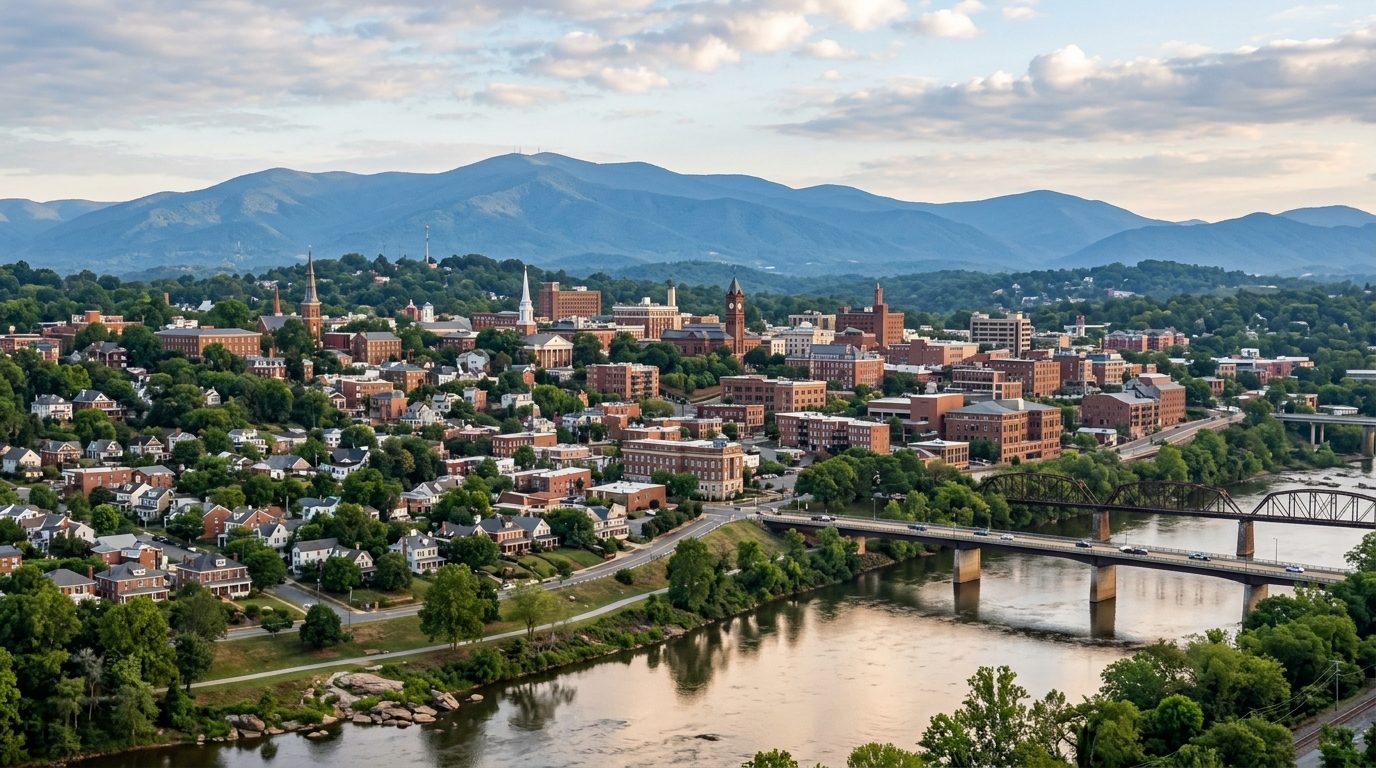
Current real estate market data, news and analysis for the Lynchburg, VA metropolitan area — 269,169 residents across 5 counties in Virginia.
Data as of May 2026. Sources: Redfin Data Center, U.S. Census Bureau.
Latest Lynchburg Real Estate News
Coverage of this market is coming soon. Browse all housing market news.
Lynchburg Real Estate Market Overview
The Lynchburg metro area sits where Virginia’s Piedmont meets the Blue Ridge foothills, a landscape of steep hills cut by the James River, which gives Lynchburg its old nickname, the City of Seven Hills. Downtown and the streetcar-era neighborhoods ringing it hold brick and frame Victorian, Queen Anne, and Colonial Revival houses from the city’s era of tobacco and rail prosperity, many on narrow, walkable, tree-lined streets. Closer-in suburbs filled out with brick ranch and Cape Cod homes in the postwar decades. Farther out, in Bedford, Campbell, and Amherst counties, newer subdivisions of traditional and craftsman-style houses sit on larger, wooded lots, while rural Appomattox County and the outer edges of Bedford and Campbell counties remain dominated by farmhouses, manufactured homes, and custom-built houses on open or forested acreage. Density falls away quickly outside the city limits and the handful of incorporated towns, giving way to pasture and timberland typical of this part of central Virginia.
Within the metro, price tiers tend to track school reputation, age of construction, and distance from employment centers rather than any single factor. The corridor stretching from Lynchburg’s edge into eastern Bedford County, around Forest and Wyndhurst, tends to sit toward the top of the market, favored for newer subdivisions, golf-course amenities, well-regarded schools, and a short commute into the city. Certain historic city neighborhoods that began as streetcar suburbs also command a premium for architecture and walkability. Older sections of the urban core nearer downtown and the riverfront industrial areas tend to be more affordable, reflecting smaller lots, aging infrastructure, and mixed commercial surroundings. Rural Appomattox County and the outer parts of Campbell and Amherst counties generally sit toward the lower end, a function of distance from job centers, older or owner-built housing, and reliance on private wells and septic systems rather than public utilities.
The regional economy rests on a handful of large, durable institutions rather than a broad industrial base. Liberty University, based in Lynchburg, is the metro’s largest employer, and its enrollment ripples through local housing and rental markets. Centra Health operates the region’s principal hospitals and clinics, anchoring healthcare employment. BWX Technologies, headquartered in Lynchburg, manufactures naval nuclear reactor components and pursues advanced nuclear technology work, a specialized manufacturing and defense-related presence. Randolph College adds a smaller liberal-arts institution within the city. In Appomattox County, heritage tourism tied to Appomattox Court House National Historical Park, site of the Confederate surrender ending the Civil War, supports lodging, dining, and retail around the town of Appomattox.
Terrain and water shape development throughout the metro. The hilly city core has pockets of floodplain along the James River and Blackwater Creek that constrain where building can occur, and slope stability matters on steeper lots. Property tax rates and land-use rules vary by locality, since the city and each surrounding county set independent rates and zoning ordinances, and Lynchburg’s historic districts carry design-review requirements for exterior changes. Public transit is largely confined to city bus service, so daily life across most of the metro assumes a car. Suburban growth has concentrated along corridors radiating from Lynchburg into Bedford and Campbell counties, while the more rural counties remain lightly developed. Buyers should independently verify flood-zone status, the condition and permitting of any well or septic system, and applicable historic-district or county zoning rules before purchasing.
Cities and Towns in the Lynchburg Metro Area
Notable Communities and Neighborhoods
Lynchburg Real Estate Market FAQ
How is the Lynchburg metro area organized geographically?
The metro centers on the independent city of Lynchburg, which sits along the James River at the edge of the Blue Ridge foothills and is not part of any county. Surrounding it are four counties with distinct characters: Bedford and Campbell counties hold the suburban growth areas closest to the city, including the towns of Bedford and Altavista, while Amherst County lies across the James River to the north and Appomattox County extends into more rural country to the southwest, anchored by the town of Appomattox. Smaller towns such as Brookneal and Pamplin City sit further out in largely agricultural areas. Commutes, school districts, tax rates, and zoning all shift at these city and county lines, so it matters which jurisdiction a given property sits in, not just which town name is attached to its mailing address.
Which parts of the metro tend to be pricier, and why?
Newer subdivisions on the Lynchburg-Bedford County line, particularly around Forest and the Wyndhurst area, tend to carry higher prices because of newer construction, golf-course and country-club amenities, larger lots, and access to county schools with strong reputations, all within a short drive of the city. Certain historic Lynchburg neighborhoods that were built as early streetcar suburbs also draw a premium for their architecture, mature tree canopy, and walkable layout. By contrast, older sections of the urban core, mill-village areas near downtown, and the more rural portions of Appomattox, Amherst, and outer Campbell counties tend to be more affordable, reflecting older housing stock, greater distance from employment centers, and, in rural areas, the added cost and complexity of private wells and septic systems.
What should buyers verify locally before purchasing in this area?
Outside the city and the larger towns, many properties rely on private wells and septic systems rather than public water and sewer, so buyers should confirm well yield and water quality along with septic permit records and drainfield condition through the local health department. On the area’s steeper, hillier lots, slope stability and drainage are worth an independent look, particularly for older homes or additions. Properties in Lynchburg’s historic districts are subject to design-review rules that govern exterior changes, so buyers should check with the city before assuming a renovation or addition will be approved. Flood-zone status near the James River, Blackwater Creek, and other waterways should also be confirmed directly with the locality or FEMA maps rather than assumed from a listing description.
What is a region-specific risk to be aware of in this market?
The area’s hilly, river-cut terrain means flood-prone areas exist along the James River and its tributary creeks even close to downtown Lynchburg, and steep lots elsewhere can raise questions about drainage and slope stability that a standard inspection may not fully address. The regional economy is also concentrated among a relatively small number of large employers, including a major university, a regional hospital system, and a nuclear-manufacturing company, so local housing demand can be more sensitive to developments at any one of those institutions than it would be in a more diversified metro economy.
Nearby Markets