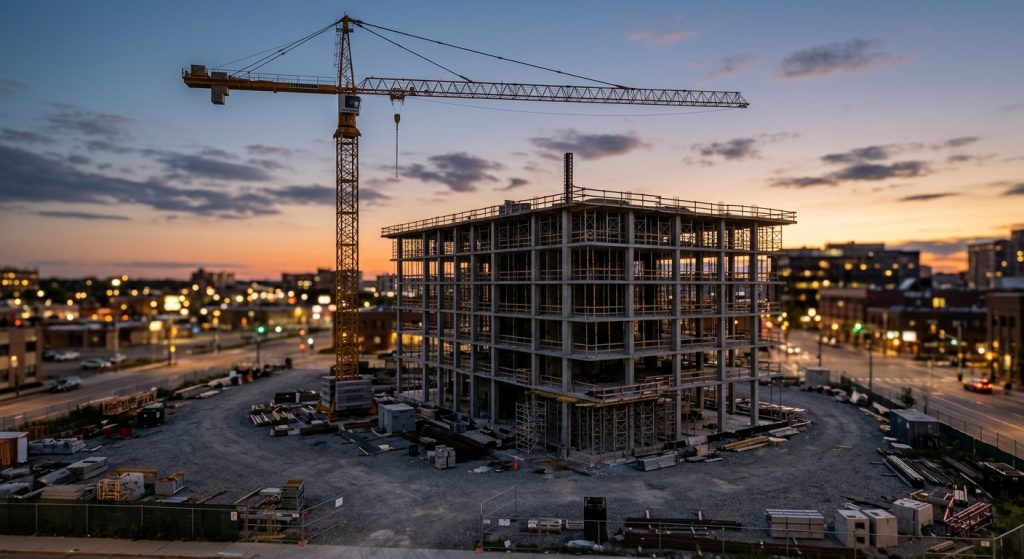
The construction industry’s pipeline of contracted work shrank sharply in October, and the split behind the drop was stark. Builders working on data centers added to their backlogs. Nearly everyone else lost ground.
Associated Builders and Contractors reported on Nov. 10 that its Construction Backlog Indicator fell to 8.1 months in October. That is down 0.6 months from September and 0.3 months from a year earlier. The indicator measures how many months of work contractors have under contract. It comes from a survey of ABC members conducted Oct. 20 to Nov. 3.
“Backlog fell sharply in October, returning to levels not consistently observed since last winter,” ABC Chief Economist Anirban Basu said.
Data center contractors versus everyone else
The trade group again split firms by whether they have data center work. Basu said the decline “was largely due to worsening prospects for the 88% of contractors not under contract to work on data centers.” That group’s backlog fell from 8.3 months in September to 7.6 months in October.
Contractors with data center work moved the other way, from 11.3 months to 11.5 months. Basu noted that most of them have more than $100 million in annual revenue.
That gap has been widening for months. In August, ABC found that about 1 in 6 contractors reported data center work. October’s reading shows how much of the industry’s resilience now rests on that one building type. It arrives the same week a single proposed data center campus in Sutton, Mass., was pitched to local officials at more than $16 billion.
Commercial work loses a month
ABC’s underlying data series shows where the losses were. Backlog in the commercial and institutional category fell from about 9.0 months in September to about 8.0 months in October. Infrastructure backlog fell to 8.7 months from 9.4, its lowest level since May 2025, ABC said.
Heavy industrial was the exception. Backlog there jumped from about 8.1 months to 10.1 months, a 15-month high.
Regionally, the data show the West dropping hardest, from about 8.1 months to 6.6 months. The Northeast slipped from 8.5 to 7.5, and the South stayed the deepest region at 10.1 months. The Middle States region was the only one to rise, from 6.7 to 7.8 months.
Firm size also mattered. Contractors with $100 million or more in annual revenue held the longest backlog, at 11.6 months, down only slightly from 11.8 in September. Those with $50 million to $100 million in revenue fell from 11.3 months to 9.2.
Margins hold up, for now
ABC’s Construction Confidence Index, which tracks contractors’ six-month outlook, gave a mixed reading. The sales gauge eased to 59.9 from 60.1, and staffing fell to 59.4 from 60.7. Profit margin expectations rose to 53.3 from 52.0. All three stayed above 50, the line that signals expected growth.
“Despite the decline in backlog and worsening sales and staffing expectations, contractor optimism regarding profit margins improved in October,” Basu said. “This is encouraging given recent increases in materials prices and borrowing costs.” He added that roughly 1 in 4 contractors still expect their margins to shrink over the next six months, a share similar to September’s survey.
The labor side is shifting too: October’s jobs report showed homebuilding employment down 16,400.
On our reading, the October survey is the clearest sign yet of a two-speed construction market. Large firms with hyperscale and industrial work have more than 11 months of contracted business. Contractors without that work, especially in commercial, institutional and infrastructure categories, are watching their pipelines thin. If that gap persists, developers of conventional commercial projects may find more contractors competing for their jobs. The survey does not measure bid pricing, so that remains an inference rather than something the data show.