
Current real estate market data, news and analysis for the Boulder, CO metropolitan area — 328,560 residents across Boulder county.
Data as of May 2026. Sources: Redfin Data Center, U.S. Census Bureau.
Latest Boulder Real Estate News
Coverage of this market is coming soon. Browse all housing market news.
Boulder Real Estate Market Overview
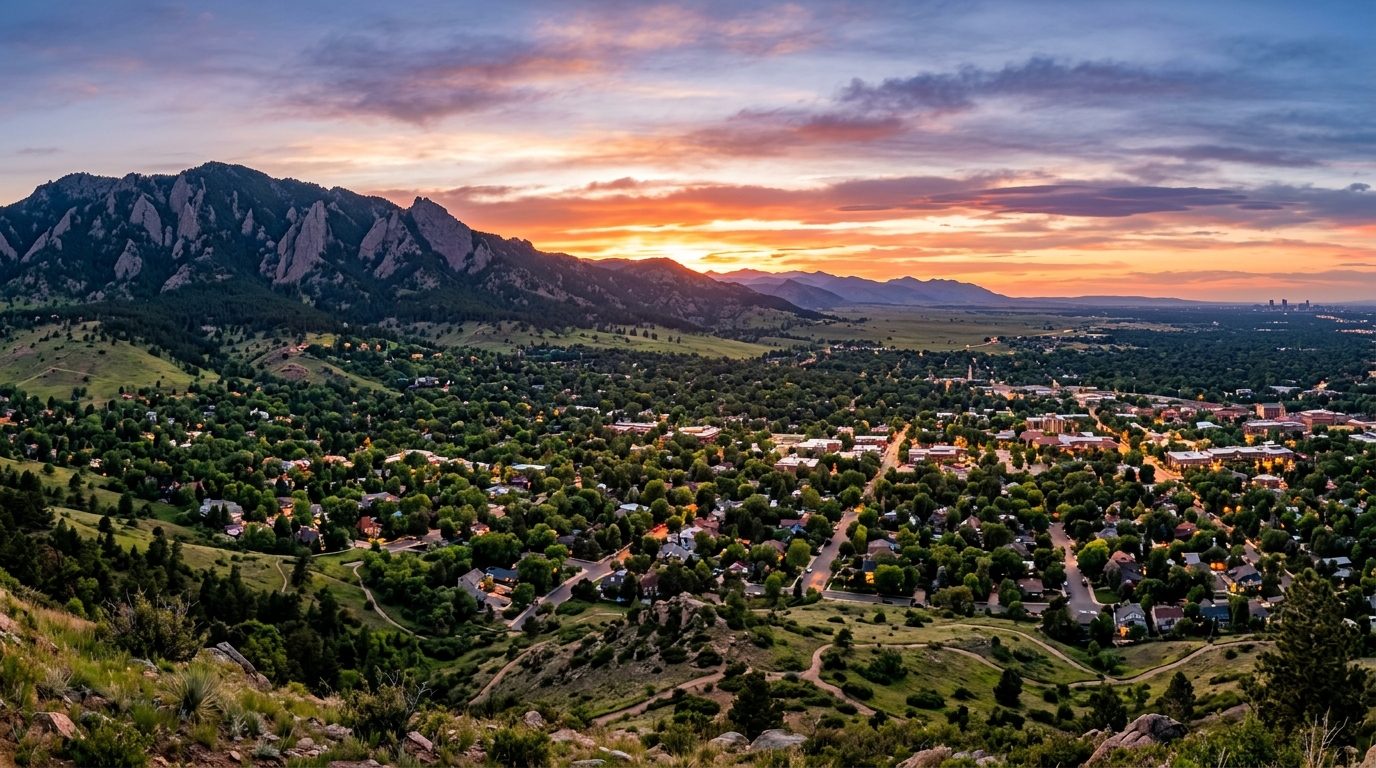
The Boulder metro sits directly against the Front Range, where the city of Boulder presses up against the Flatirons and a foothills greenbelt that the city has spent decades protecting from development. East of that greenbelt, the land flattens into high plains, and the metro’s other population centers — Longmont, Louisville, Lafayette, Superior, and unincorporated Gunbarrel and Niwot — spread out along that transition zone. Up Boulder Canyon and the Peak-to-Peak Highway, small mountain communities like Nederland, Ward, and Jamestown sit at higher elevation, more rural and considerably more isolated than the valley towns below. Boulder’s own housing stock skews older and denser near downtown and the university campus, while Longmont and the southeastern suburbs carry a mix of older small-town cores and large subdivisions built from the 1980s onward.
Homes near Boulder’s protected open space, the base of the Flatirons, and the university tend to be the most sought after and the hardest to come by, reflecting both scarcity and the city’s tightly managed growth boundary. Longmont and the plains-side edges of Boulder, being farther from the foothills and open space amenities, are generally viewed as more attainable, while Louisville, Lafayette, and Superior sit in between — newer construction and strong schools, but without direct mountain or greenbelt frontage. The small mountain towns above Boulder occupy their own category entirely: custom and older cabin-style homes on larger lots, with utilities and access that can differ meaningfully from the valley floor.
The University of Colorado Boulder anchors the local economy and, together with federal research institutions NOAA, NIST, and NCAR, gives the metro an unusually dense concentration of scientific employment. Aerospace has deep roots here too, from the former Ball Aerospace campus, now part of BAE Systems, to nearby Lockheed Martin operations, while Google, IBM, and Qualcomm maintain a substantial local tech presence. Local economic development groups also point to bioscience, cleantech, natural products, and quantum computing as growth clusters, giving the metro a research-and-technology identity that extends well beyond the university itself.
Boulder’s land-use rules are among the strictest in Colorado — height limits, an urban growth boundary, and a water-service line above which the city won’t extend utilities into the mountains — and buyers should understand how those constraints shape what can be built or added where. Wildfire risk is not theoretical here: a fast-moving winter fire in recent years destroyed homes across Superior, Louisville, and unincorporated Boulder County, and defensible-space and mitigation requirements have tightened since. Flooding is a parallel concern, particularly along creeks and in low-lying areas that were affected during a major regional flood event in the past, so a floodplain check is worth doing regardless of how far a property sits from the mountains. Commuters have bus rapid transit into Denver, but rail service north to Longmont remains unbuilt, so car dependence still shapes daily life for much of the metro.
Cities and Towns in the Boulder Metro Area
Notable Communities and Neighborhoods
Boulder Real Estate Market FAQ
How is the Boulder metro organized?
The city of Boulder sits against the foothills inside a protected greenbelt, plains-side suburbs like Longmont, Louisville, Lafayette, and Superior spread to the east and southeast, and small mountain towns like Nederland, Ward, and Jamestown sit up the canyons at higher elevation.
Which areas of the Boulder metro are typically pricier?
Homes near Boulder’s protected open space, the Flatirons, and the university are generally the most sought after, while Longmont and the plains-side edges of the metro tend to be more attainable.
What should buyers verify before purchasing in Boulder County?
Check floodplain status near any creek, review current wildfire mitigation and defensible-space requirements, and understand Boulder’s height limits and growth-boundary rules if building or adding on.
What is the most significant regional risk to understand?
Wildfire risk, underscored by a fast-moving winter fire in recent years that destroyed homes across Superior, Louisville, and unincorporated Boulder County, along with periodic flood risk along area creeks.
Nearby Markets