
Current real estate market data, news and analysis for the Gainesville, FL metropolitan area — 359,036 residents across Alachua, Gilchrist and Levy counties.
Data as of May 2026. Sources: Redfin Data Center, U.S. Census Bureau.
Latest Gainesville Real Estate News
Coverage of this market is coming soon. Browse all housing market news.
Gainesville Real Estate Market Overview
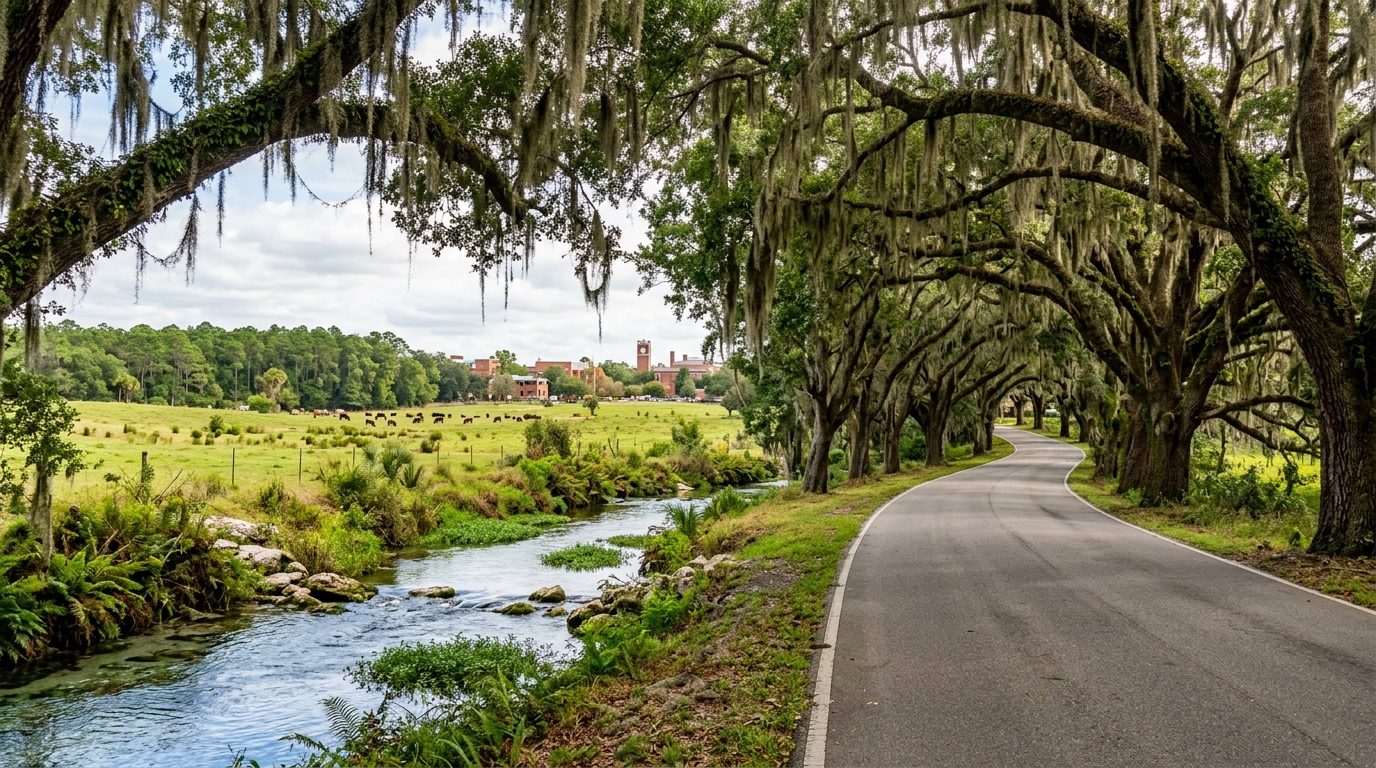
Gainesville sits inland in north-central Florida, roughly equidistant from the Gulf of Mexico and the Atlantic coast, on a low limestone plateau shaped by the Floridan Aquifer. The terrain here is defined by karst geology, sinkholes, underground springs, and the wetland basin of Paynes Prairie just south of downtown, rather than beaches or barrier islands. Rolling terrain, mature live oak canopy, and pine flatwoods give the region a wooded, shaded character uncommon in much of peninsular Florida. Housing stock reflects a long settlement history: early-1900s bungalows and colonial-revival homes cluster near the historic core, mid-century ranch houses fill older suburbs, and newer subdivisions with traditional and contemporary-style construction extend outward along the southwest and northwest corridors, while outlying county land supports larger rural parcels.
Southwest Gainesville, anchored by established communities such as Haile Plantation and newer development around the Town of Tioga and Jonesville, tends to sit at the higher end of the local market, reflecting newer construction, planned amenities, and proximity to well-regarded schools and the retail and office corridor along Interstate 75 and Archer Road. Areas closer to the University of Florida campus and downtown mix historic homes with student-oriented rentals, and values there vary block to block depending on age and renovation. Older neighborhoods in the eastern and northeastern parts of the city, along with more rural stretches of Alachua, Gilchrist, and Levy counties, tend to sit lower, reflecting older housing stock, larger unimproved lots, or greater distance from employment centers. The smaller outlying towns each have their own distinct markets shaped by tourism, agriculture, or springs recreation rather than the university economy.
The University of Florida anchors the regional economy, both as the area’s largest employer and as a source of research spinoffs and biotechnology ventures. UF Health, the university’s hospital and clinic system, is one of the largest employers in the state, and the independently operated HCA Florida North Florida Hospital and the Malcom Randall VA Medical Center add further healthcare employment. Santa Fe College, Alachua County Public Schools, and city and county government round out the public-sector base, while Gainesville Regional Utilities, the city-owned electric and water utility, is another significant local employer. Northeast of the city, Alachua’s Progress Corporate Park has grown into a biotechnology cluster built around the University of Florida’s Sid Martin Biotech incubator, with graduate companies including AxoGen and Ology Bioservices continuing to operate there.
Because Gainesville lies well inland with no coastal exposure, homeowners here are not subject to the storm-surge zones and coastal wind-mitigation rules that drive insurance costs along Florida’s coastlines, though a separate hurricane-wind deductible still applies statewide, and tropical systems can bring damaging wind and heavy rain well after landfall elsewhere. The region’s limestone karst foundation makes sinkhole activity a real, if localized, concern, and prospective buyers should ask about geotechnical history and sinkhole coverage before closing. Low-lying land near creeks and the Paynes Prairie basin can experience inland flooding, so checking flood zone status is worthwhile even away from any river or coast. Public transit is limited to the local bus system, so most residents drive. Buyers should confirm whether a property relies on public water and sewer or on well and septic, particularly in unincorporated county areas and smaller outlying towns, and should verify school zoning and any homeowners association rules before purchase.
Cities and Towns in the Gainesville Metro Area
Notable Communities and Neighborhoods
Gainesville Real Estate Market FAQ
How is the Gainesville, FL housing market organized geographically?
The market centers on the city of Gainesville and the University of Florida campus, with a historic core near downtown, established suburbs radiating outward, and a growth corridor to the southwest along Interstate 75 and Archer Road where much of the newer construction is concentrated. Beyond the city, Alachua County includes satellite towns such as Alachua, Newberry, High Springs, and Archer, while Gilchrist and Levy counties to the west and southwest are more rural and include small river and coastal communities like Trenton, Chiefland, Williston, and Cedar Key. Each of these outlying towns functions as a smaller, semi-independent market rather than a simple extension of the Gainesville core.
Which areas of Gainesville tend to be pricier, and why?
Southwest Gainesville, including established communities like Haile Plantation and newer growth around the Town of Tioga and Jonesville, tends to command higher prices, largely because of newer housing stock, planned community amenities, and proximity to well-regarded schools and the area’s main retail and office corridor. Neighborhoods immediately around the University of Florida and downtown carry a wide range of values depending on age and condition, with a strong overlay of student rental demand. Older neighborhoods farther from campus and more rural parts of the surrounding counties tend to sit toward the lower end, reflecting older construction, larger unimproved lots, or greater distance from major employers.
What should buyers verify locally before purchasing in this metro?
Because Alachua, Gilchrist, and Levy counties include both incorporated cities and large unincorporated areas, buyers should confirm whether a property is served by public water and sewer or relies on a private well and septic system, and should check which fire, school, and utility district applies. Given the region’s limestone geology, it is worth asking about any known sinkhole activity or geotechnical history for the specific parcel. Buyers should also confirm current flood zone status, review any homeowners association rules and fees for planned communities, and, in the smaller outlying towns, check zoning and land-use rules, since agricultural, residential, and commercial parcels can sit close together.
What is the region-specific risk buyers should understand in Gainesville?
Gainesville sits on karst terrain: the limestone bedrock underlying the region dissolves gradually and produces sinkholes, springs, and underground drainage, most visibly at features like the Devil’s Millhopper sinkhole and the Paynes Prairie basin. This geology means sinkhole activity, rather than storm surge, is the more distinctive structural risk here, and it can affect insurance and financing on individual properties even though the metro as a whole is well inland. Because the region is a college town built around a very large university, rental demand tied to the academic calendar is also a persistent feature of the local market, particularly in neighborhoods near campus.
Nearby Markets