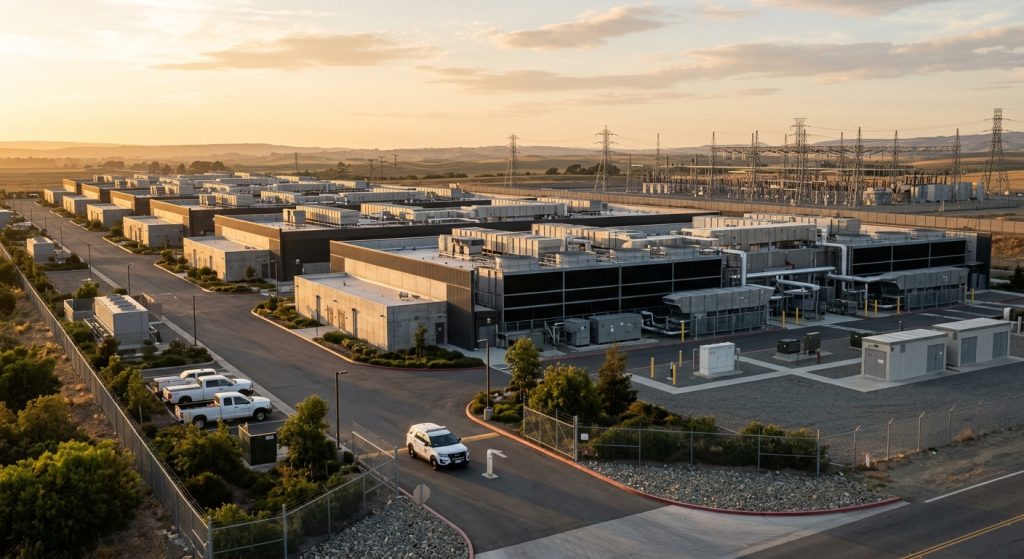
Amazon told investors this week that it now expects to spend approximately $220 billion on capital expenditures in 2026, up from a prior estimate of about $200 billion. For an audience that tracks real estate and construction, that revision matters less as a stock story and more as a signal: the overwhelming majority of that money is going into land, buildings, and power infrastructure for data centers, making Amazon one of the single largest private drivers of industrial and data-center construction in the country right now.
The disclosure came alongside Amazon’s second-quarter 2026 results, released by the company on July 30, 2026. Net sales rose 20% year-over-year to $200.6 billion, and Amazon Web Services, the cloud unit that anchors most of the capital spending, posted $42.2 billion in net sales, up 37% from a year earlier and its fastest growth rate in 18 quarters. AWS operating income reached $16.6 billion, a 64% increase, with an operating margin of 39.4%.
Those AWS numbers are the business case for the capex increase. Cloud and AI workloads require physical capacity, and Amazon’s own release shows that capacity is already expensive to build: property and equipment purchases totaled $54.2 billion in the second quarter alone, up from $32.2 billion a year earlier, pushing trailing-twelve-month capital spending to $173.0 billion, a 64% year-over-year jump.
What Jassy told analysts
The $220 billion figure and a striking backlog number came from CEO Andy Jassy’s remarks on the earnings call following the release, not from the written press release itself. Jassy said the increase from the prior roughly $200 billion estimate was driven largely by higher memory costs, according to a Fortune report on the call, which quoted him saying Amazon “will still not have enough capacity to meet all the demand we have in 2026,” adding, “I believe this dynamic will also be true in 2027, too.”
Jassy also said AWS’s contracted backlog — customer commitments for future revenue that has not yet been recognized — jumped to $496 billion in the quarter, up from $364 billion previously. CNBC, which first reported the capex increase and memory-cost driver, also flagged the backlog jump as evidence that demand is outrunning Amazon’s ability to build capacity fast enough. Jassy separately noted that data centers require capital roughly two years before servers can be installed and start generating revenue, but once open can be monetized for more than 30 years without repeating that upfront cost — a framing that explains why Amazon keeps building even as the spending compresses near-term cash flow.
Where the concrete is actually going
Guidance numbers are abstract. The construction pipeline is not. Amazon’s regional announcements over the past several months show where this capital has been landing on the ground.
In northern Indiana, Amazon said in late 2025 it would invest $15 billion in new data center campuses, adding 2.4 gigawatts of capacity across multiple sites, on top of an $11 billion investment previously announced in St. Joseph County. The company structured a new subsidiary with utility NIPSCO to cover the cost of new power plants, and NIPSCO’s president said the arrangement would save existing ratepayers roughly $1 billion over 15 years. Amazon’s chief global affairs officer, David Zapolsky, called it a reaffirmation of “long-term investment and growth” in the state. Local outlets including the Fort Wayne Journal Gazette and the Northwest Indiana Times covered the project’s scale, which Indiana officials described as the largest construction project in the state’s history.
In northwest Louisiana, Amazon announced in February 2026 a $12 billion investment in interconnected data center campuses spanning Caddo and Bossier parishes — the company’s first data centers in the state, expected to create 540 direct jobs and support roughly 1,700 indirect positions. Louisiana officials called it the largest economic development project in the region’s history, according to local coverage from stations including WBRZ.
Further west, Amazon has reportedly purchased roughly 1,300 acres near the Columbia River in Boardman, Oregon, land that GeekWire reported could support a data center campus of up to 20 buildings and a potential investment near $12 billion. Amazon has not publicly confirmed the site’s intended use, so that figure should be treated as a reported estimate rather than a confirmed project.
These three sites alone represent tens of billions of dollars in land acquisition, site work, power infrastructure, and construction labor — and they are only a subset of a national buildout that also includes projects tied to other hyperscalers. RealtyWire has covered related activity in Georgia, where a developer has filed plans for a 1.25-gigawatt campus in Lovejoy, and in the data center real estate sector more broadly, where Equinix recently raised its own 2026 guidance after record bookings tied to the same AI-driven demand. Chipmaker-backed development deals, such as the $500 billion AI data center agreement between Nvidia and SK Group, point to the same underlying pressure on land, power, and construction capacity nationally.
What it means
Verified facts: Amazon’s own earnings release confirms Q2 2026 net sales of $200.6 billion, AWS net sales of $42.2 billion (up 37%), AWS operating income of $16.6 billion, and capital expenditures of $54.2 billion for the quarter, bringing trailing-twelve-month capex to $173.0 billion. Amazon’s own regional announcements confirm the $15 billion Indiana investment and $12 billion Louisiana investment.
Attributed to sources: The $220 billion full-year 2026 capex figure and the $496 billion AWS backlog number come from Jassy’s remarks on the earnings call, as reported by Fortune and CNBC. The Oregon land purchase and its potential use as a data center site is a report from GeekWire that Amazon has not confirmed.
RealtyWire analysis: Even using only the confirmed trailing-twelve-month capex figure of $173 billion, Amazon is spending at a pace that rivals the annual construction budgets of entire industry sectors, and the bulk of it is site-specific, physical, and dependent on land, power capacity, and construction labor markets. If the $220 billion figure holds for the full year, 2026 would mark another sharp step up in a spending curve that has been rising for several years running, with direct consequences for industrial land pricing, power-grid negotiations, and construction employment in the metros where hyperscalers choose to build.
What to watch next
Amazon’s third-quarter guidance, disclosed in the same release, calls for net sales between $197.0 billion and $202.0 billion. Analysts and reporters will likely press for more specificity on the full $220 billion capex figure and its site-level breakdown when Amazon reports third-quarter results later in 2026. For real estate and construction watchers, the more useful signals may come sooner: additional state economic-development announcements, utility filings for new power capacity, and local permitting activity in the regions — Indiana, Louisiana, Oregon, and beyond — where Amazon has already shown it is willing to commit billions of dollars in physical infrastructure.