
Current real estate market data, news and analysis for the Akron, OH metropolitan area — 701,780 residents across Portage and Summit counties.
Data as of May 2026. Sources: Redfin Data Center, U.S. Census Bureau.
Latest Akron Real Estate News
Akron Real Estate Market Overview
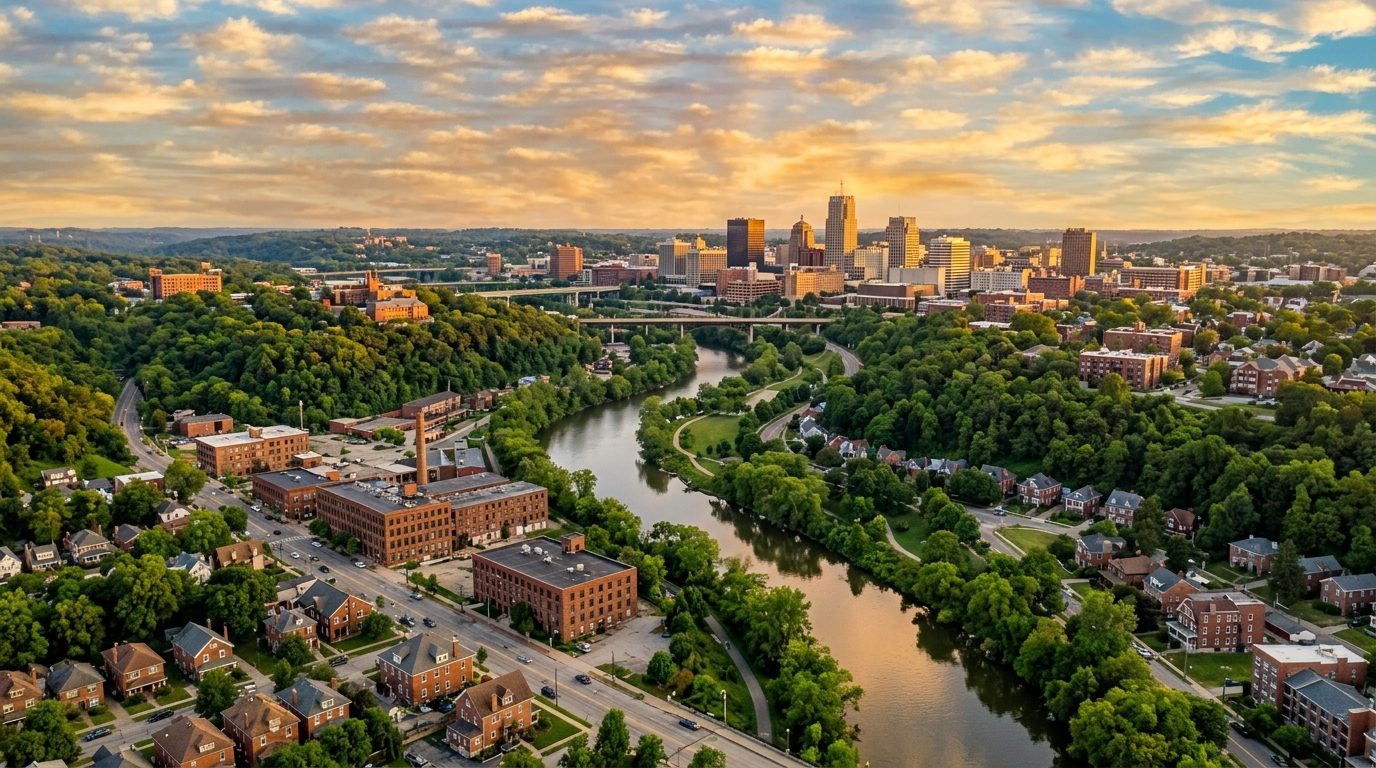
Akron sits in the rolling, glaciated terrain of northeastern Ohio, where the Cuyahoga and Little Cuyahoga rivers cut through wooded hills before the land flattens toward Lake Erie to the north. The metro covers Summit and Portage counties, running from the dense street grid of Akron itself, through the Cuyahoga Valley corridor, to lower-density farmland near the Portage County line. Akron’s core neighborhoods were built up quickly in the early twentieth century as the rubber industry expanded, leaving brick and frame bungalows, American foursquares, and worker-cottage duplexes on narrow lots, many now a century old. Cuyahoga Falls and Kent, river towns that predate the rubber boom, mix similarly aged housing with mid-century construction. Farther out, suburbs such as Hudson, Twinsburg, Aurora, and Green were largely built from the 1970s onward, with larger lots and late-twentieth-century floor plans.
Price tiers generally track the age and layout of the housing stock rather than distance from downtown alone. Akron’s older core neighborhoods, including Kenmore, Firestone Park, Goodyear Heights, and much of North Hill, carry smaller homes on tighter lots, more rental and multi-family conversions, and infrastructure dating to the early industrial era, which places them in the metro’s lower price tiers. Neighborhoods such as Merriman Valley, West Hill, and Fairlawn Heights sit closer to the middle, with larger older homes near parks and shopping. Higher-priced areas cluster in newer suburbs to the east and northeast, particularly Hudson, Aurora, and parts of Twinsburg and Bath Township, where subdivisions are more recent, lots are larger, and school district reputation drives demand. Portage County towns such as Kent and Ravenna tend to price below the Summit County suburbs.
The Akron economy still carries the imprint of the rubber and tire industry that built the city. Goodyear Tire & Rubber Company was founded in Akron in 1898 and still bases its global headquarters and technical center downtown, a legacy that shaped the city’s broader manufacturing and engineering base. Healthcare has grown into the region’s largest employment sector, anchored by Summa Health, Cleveland Clinic Akron General, and Akron Children’s Hospital, each operating major hospital campuses in the city. FirstEnergy Corporation, an electric utility holding company, is headquartered in Akron, and consumer products maker Gojo Industries, known for Purell, is also based in the area. Higher education adds to the base, with the University of Akron and Kent State University, in neighboring Portage County, both serving as major employers.
Buyers should weigh a few conditions specific to this part of Ohio. Winters bring lake-effect snow bands off Lake Erie that can drop heavier accumulations on the northern and eastern parts of the metro than farther south, and hillier streets can be slow to clear. Ohio levies a state income tax along with local municipal income taxes that vary by city, so take-home pay and school funding depend on which jurisdiction a property sits in. Public transit is limited to bus service through Metro RTA in Summit County and PARTA in Portage County, with no rail transit, so most households rely on cars. Zoning and design standards vary by municipality and township, from Hudson’s design-control overlay to looser township rules. Given the age of Akron’s core housing stock, buyers should have older homes checked for lead-based paint, aging water and sewer lines, and foundation condition before closing.
Cities and Towns in the Akron Metro Area
Notable Communities and Neighborhoods
Akron Real Estate Market FAQ
How is the Akron metro area organized geographically?
The metro covers two counties in northeastern Ohio: Summit County, anchored by the city of Akron along the Cuyahoga River, and Portage County to the east, home to Kent and Ravenna. Akron’s older neighborhoods sit on a dense street grid near downtown and the Cuyahoga Valley, while suburbs like Cuyahoga Falls, Stow, Hudson, Twinsburg, Aurora, and Green ring the core along the region’s rolling, wooded terrain.
Which areas of the Akron metro are pricier, and why?
Newer suburbs to the east and northeast of Akron, including Hudson, Aurora, and parts of Twinsburg and Bath Township, tend to command higher prices because of newer construction, larger lots, and well-regarded school districts. Akron’s older core neighborhoods, built during the early rubber-industry boom, generally sit in lower price tiers due to smaller lot sizes, older infrastructure, and a larger share of rental housing.
What should buyers verify locally before purchasing in the Akron area?
Because much of Akron’s core housing stock dates to the early twentieth century, buyers should have inspections check for lead-based paint, aging water and sewer lines, outdated electrical wiring, and foundation condition. It’s also worth confirming which municipal income tax jurisdiction a property falls under, since rates and local zoning or design rules vary from city to city and township to township across Summit and Portage counties.
What regional risk factors are specific to this part of Ohio?
Winters in the Akron metro can bring lake-effect snow bands off nearby Lake Erie, with the northern and eastern parts of the region sometimes seeing heavier accumulation than areas farther south. Combined with hilly terrain in parts of Summit County, this can mean slower snow removal on some streets and driveways during winter storms.
Nearby Markets