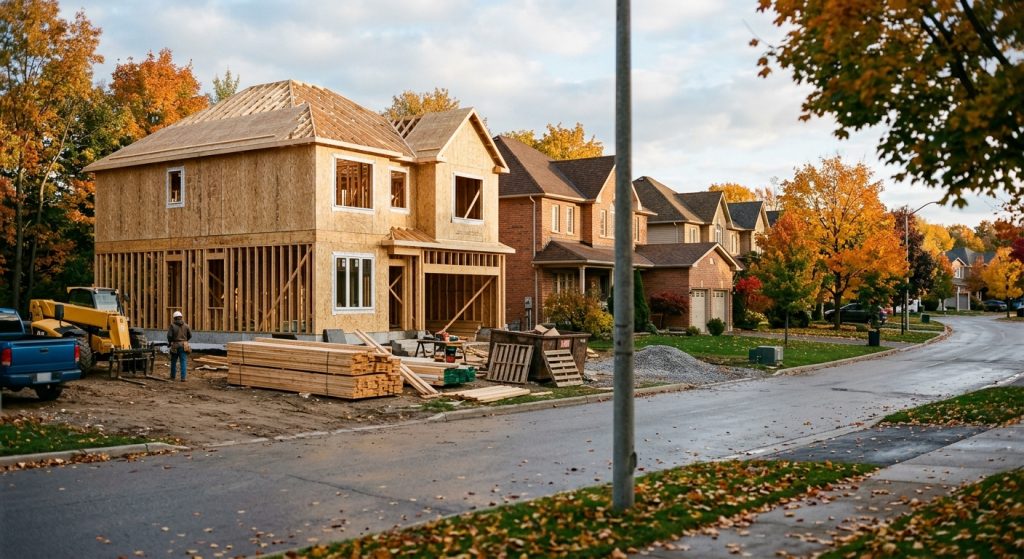
U.S. construction spending fell 1.9% in September to a seasonally adjusted annual rate of $2.186 trillion, the U.S. Census Bureau reported Nov. 2. The decline came almost entirely from housing: private residential spending dropped 5.5% in a single month, while builders of data centers and power projects kept adding to their totals.
The September figure was down from a revised $2.227 trillion in August and 2.7% below the $2.246 trillion pace of September 2025. Through the first nine months of 2026, construction spending totaled $1.650 trillion, 2.9% less than the $1.699 trillion recorded in the same period a year earlier, according to the release.
Residential construction spending takes the hit
Private residential construction ran at an annual rate of $848.8 billion in September, down from $898.0 billion in August. That $49.2 billion drop is larger than the $40.9 billion decline in all private construction, meaning the rest of the private market grew slightly. Census put the residential decline at 5.5% with a margin of plus or minus 1.3 percentage points, so the drop is statistically significant.
New-home building itself was flat. Spending on new single-family homes held at $403.4 billion, essentially unchanged from August and 2.4% below a year earlier. New multifamily spending edged up 0.1% to $115.9 billion and was 0.2% below September 2025.
Census counts improvements to existing homes inside the residential total without breaking them out in its main release table. Subtracting new single-family and multifamily spending from the private residential figure leaves about $329.5 billion in September, by RealtyWire’s calculation. That is down roughly 13% from about $378.7 billion in August and about 18% below September 2025. Census cautions that monthly changes in its seasonally adjusted series can be irregular and that a trend in a single category can take as long as eight months to establish. Even so, with new single-family and multifamily spending flat, the improvements portion accounts for essentially all of this month’s residential decline.
The single-family figure fits a weak year for homebuilding. Through September, not-seasonally-adjusted spending on new single-family homes totaled $306.1 billion, 4.8% less than in the first nine months of 2025. Earlier this fall Dodge Construction Network reported that single-family construction starts fell 7% in September.
Data centers keep climbing
Private nonresidential construction rose 1.1% (plus or minus 0.5 percentage points) to $790.6 billion. Census files data centers under its office category, and that is where the growth was concentrated. Private office spending rose 5.5% in September to $145.6 billion and is up 39.5% from a year earlier.
Census’s detailed private construction table shows data center spending alone at an annual rate of $96.5 billion in September, up from $88.8 billion in August and $50.7 billion in September 2025. That is about 8.6% growth in a month and roughly 90% in a year, by RealtyWire’s arithmetic. Data centers now make up about 12% of all private nonresidential construction spending. Spending on conventional general-purpose office buildings, by contrast, was $46.0 billion, about 8% below a year earlier.
The August report had already shown data center building up 73% from a year ago. The September reading extends that run. Private power construction, which covers electric generation and transmission as well as gas and oil projects, rose 1.2% to $171.7 billion and is 12.1% higher than a year ago. Private electric power alone was $146.9 billion, up 14% from September 2025.
Factories and warehouses keep shrinking
The weak spots in commercial real estate were the ones that have been fading for more than a year. Private manufacturing construction slipped 0.3% to $167.2 billion and is 17.9% below its year-earlier level. Within it, spending on computer, electronic and electrical manufacturing plants was $52.6 billion, down about 42% from $90.2 billion in September 2025.
Warehouse construction was $51.6 billion, about 8% below a year earlier. Private commercial construction overall, which includes warehouses, retail and other commercial buildings, eased 0.3% to $115.9 billion and is down 4.4% year over year. Lodging was $23.6 billion, down 2.8% from a year ago.
Public construction flat
Public construction spending was essentially unchanged at $546.8 billion, 0.1% below August, a change Census said was not statistically significant. Educational construction held at $113.1 billion and highway and street spending was $149.2 billion, down 0.3%. Public spending is 1.0% higher than a year ago, which kept the headline decline smaller than the private-sector drop.
What the September report adds
On our reading, the report shows two separate construction economies. One, led by data centers and power projects, is still growing quickly. The other, made up of homes, factories, warehouses and stores, is flat or shrinking. September’s drop was concentrated in residential improvements, which are among the most volatile pieces of the series, so the size of the monthly decline may change when Census revises the figure. The pattern behind it has held for months: new-home spending is below last year’s level, and nonresidential growth is concentrated in a narrow set of building types.
The September figures are preliminary. Census said the average revision from first estimate to first revision has been 0.65% for total construction and 0.75% for private construction. The October report is scheduled for Dec. 1, 2026. More coverage of building activity is in RealtyWire’s housing market section.