Nvidia and South Korea’s SK Group have signed letters of intent for a partnership valued at more than $500 billion that includes a 2-gigawatt data center SK Telecom will build to run Nvidia’s newest AI computing platform, the companies announced on July 24. The agreement pairs a specific, large-scale data center construction commitment with a separate long-term memory-chip supply deal, another sign that chipmakers are now underwriting the physical buildings that house AI computing, not just the processors inside them.
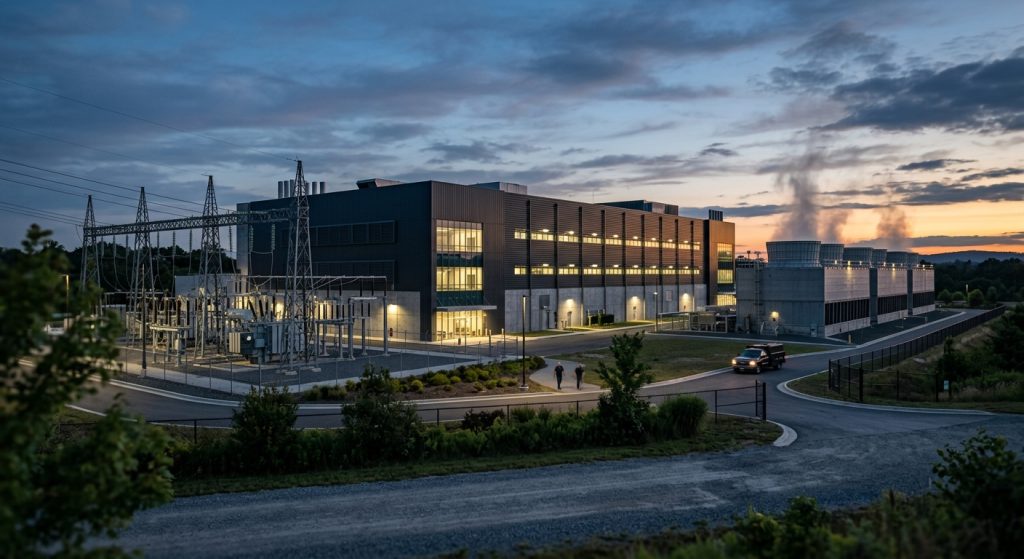
The data center piece is the one with the clearest ties to real property. SK Telecom will construct and operate a 2-gigawatt “AI factory” in South Korea built on Nvidia’s DSX platform and equipped with Nvidia’s upcoming Vera Rubin computing systems, according to Nvidia’s press release, which was mirrored in a joint statement from SK hynix. The first phase is targeted to come online in 2027. Neither company’s release names a specific city or site for the facility.
At 2 gigawatts, the planned facility would be roughly double the size of the 1-gigawatt Hut 8 campus in Texas that RealtyWire covered earlier this year, and comparable in scale to the 2-gigawatt data center project now advancing in West Texas. It underscores how quickly gigawatt-scale campuses, once unusual, have become the baseline unit for new AI infrastructure announcements.
The second component of the deal is a memory-supply arrangement rather than a real estate one: Nvidia and SK hynix will deepen an existing collaboration to develop and supply HBM4, the next generation of high-bandwidth memory chips used in AI training hardware. Nvidia’s release ties that supply agreement directly to the new Korean data center, saying the facility’s Vera Rubin systems will run on SK hynix HBM4 memory.
SK Group Chairman Chey Tae-won said the company would draw on “SK hynix’s AI memory and SK Telecom’s AI infrastructure capabilities” to “build a world-class AI factory” with Nvidia, according to the companies’ joint statement. Nvidia founder and CEO Jensen Huang said South Korea “has all the ingredients to become a global AI powerhouse — world-class networks and data centers, leadership in chip technology and vast industrial scale,” per the same release.
Nvidia’s own release describes the arrangement as letters of intent rather than a signed, binding contract, meaning deal terms, site selection and financing structure still have to be worked out before construction financing closes. That is a standard first step for megaprojects of this size, but it also means the $500 billion figure is a ceiling on the scope of the partnership rather than a confirmed construction budget for the data center alone.
For added context on construction costs in the region, SK Telecom has separately disclosed, on its own newsroom site, that it is pursuing a broader, multi-site AI data center buildout across South Korea targeting 15 gigawatts of capacity by 2030, and has estimated the construction cost of a single 1-gigawatt-class facility at roughly 70 trillion won, or about $51 billion. Nvidia and SK hynix’s releases do not say whether the new 2-gigawatt Vera Rubin facility will be part of that same broader buildout or a standalone site.
What it means
Verified: Nvidia and SK Group have signed non-binding letters of intent for a partnership described by both companies as worth more than $500 billion, including a 2-gigawatt Nvidia-powered data center SK Telecom will build in South Korea, targeted for a 2027 first phase, alongside a separate HBM4 memory supply deal between Nvidia and SK hynix.
Attributed interpretation: Company executives frame the deal as positioning South Korea as a regional AI infrastructure hub; those are self-interested characterizations from the companies involved, not independently verified market outcomes.
RealtyWire analysis: The real estate story here is the construction commitment itself — a discrete, gigawatt-scale physical site with a public capacity figure and a target completion year — rather than the memory-supply half of the deal, which involves chip production, not land or buildings.
What to watch
Investors and local officials will be watching for the site or sites SK Telecom selects, since land, power interconnection and water access typically determine where these campuses actually get built once letters of intent turn into construction contracts. Also worth tracking: whether the $500 billion figure narrows once binding agreements replace the current letters of intent, and whether Nvidia helping finance the physical infrastructure of its customers — something it has separately been reported to be discussing for U.S. data center projects — becomes a broader pattern across its customer base.