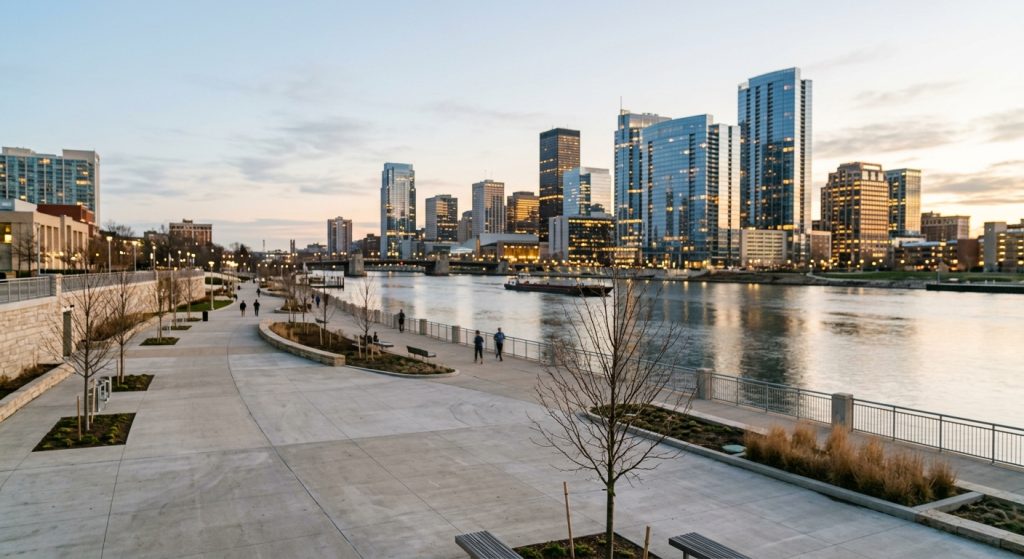
Rocket Companies and Bedrock founder Dan Gilbert has pledged about $1 billion of his own money to create a nonprofit that will redevelop, own and operate Detroit’s Renaissance Center and the 35-acre east riverfront district around it, under terms that bar him and his companies from taking any profit. The pledge, announced Oct. 19, 2026, in a release from Gilbert’s family office, ROCK, covers close to half of a redevelopment plan the release prices at $2.2 billion.
Gilbert’s contribution will not be repaid, according to the release, which calls the gift “believed to be the largest contribution to a non-profit redevelopment initiative in the history of American cities.” That is the organizers’ own characterization; the release does not say how the comparison was made.
Who owns the waterfront, and who gets paid
The unusual part is the ownership structure. Rather than a developer holding the finished complex and collecting its income, the new organization will hold the Renaissance Center and the surrounding district permanently. Once the project is complete, the release says, revenue will go first to operating expenses, debt payments, reserves and reinvestment in the properties. Any surplus “will go to support Detroiters and the community.”
The nonprofit will be organized as a 501(c)(4) social welfare organization focused on civic improvement. The release notes that contributions to such organizations are not deductible as charitable contributions for federal income tax purposes, meaning the gift does not carry the income-tax deduction a donation to a 501(c)(3) charity would.
Bedrock, Gilbert’s real estate company, will provide project management to the nonprofit at no cost. The release also points to an earlier commitment from General Motors, which in 2024 agreed to donate any profits it receives from the redevelopment toward education in Detroit.
Two board members have been named so far. The Rev. Dr. Wendell Anthony, president of the Detroit Branch of the NAACP, will sit on the inaugural board and help recruit the rest of it. Bill Emerson, former CEO of Rocket Companies, will also serve to guide the organization through its formation. The nonprofit does not yet have a published name, and the release says more details will come “as further steps are taken in its formation.”
What the plan calls for
The district is currently made up largely of surface parking lots, according to the release. The redevelopment plan, which Bedrock presents publicly at the Detroit East Riverfront project site, would reimagine the Renaissance Center itself and rebuild the surrounding acreage as what the organizers describe as a family-friendly waterfront destination. The release lists:
- Affordable housing and dedicated space for Detroit-based small businesses
- 18 acres of programmed, publicly accessible civic space
- More than 8,000 local construction jobs and 2,600 permanent jobs, by the organizers’ estimate
- An estimated $301.5 million in direct fiscal benefit to the City of Detroit over 30 years
- A projected $3.03 billion in new visitor spending over the same 30-year period
Those job, tax and spending figures are projections from the project’s backers rather than independent estimates. The release describes the Renaissance Center work as one of “the most complex and consequential adaptive reuse projects ever undertaken,” a measure of how much work the riverfront towers will require.
What officials said
“The Renaissance Center is a symbol of Detroit, and the riverfront is one of Detroit’s most treasured assets,” Gilbert said in the release. “I cannot think of better way to accomplish these goals than through a nonprofit organization dedicated to this mission in perpetuity.”
Detroit Mayor Mary Sheffield called the announcement “truly historic.” “This was already the largest, most transformative investment ever pledged in Detroit and one of the largest ever in any American city,” she said. “For Dan to make a billion-dollar investment – and to guarantee that only the city and its people can benefit – truly shows the depth of his generosity and of his commitment to Detroit.”
GM President Mark Reuss said the organization “will build upon the progress GM has already made in helping create the #1 ranked riverwalk in the nation.” Anthony described the reinvented complex as “Renaissance II” and said Gilbert is “openly establishing a new model for community development not only for Detroit but for cities across the nation.”
A larger pattern of Detroit commitments
The pledge follows other large commitments from Gilbert-linked entities. In 2021, the Gilbert Family Foundation and Rocket Community Fund announced a $500 million, 10-year commitment to Detroit neighborhoods; through the end of 2025 they had invested nearly $300 million of it, including more than $100 million in housing stability work such as foreclosure and eviction prevention, home repair and homeownership programs, according to the release. In 2023, the Gilbert Family Foundation committed nearly $375 million to bring Shirley Ryan AbilityLab to Detroit and to establish the Nick Gilbert Neurofibromatosis Research Institute, both part of Henry Ford Health’s campus expansion in the city’s New Center neighborhood.
On our reading, the structure matters as much as the dollar figure for anyone watching large downtown redevelopments. Large redevelopments typically return profits to a developer and its investors; this one routes surplus income to a mission-bound owner, with the founding capital written off from the start. How the remaining roughly $1.2 billion of the $2.2 billion plan is financed, and on what timeline construction proceeds, is not spelled out in the announcement. For related coverage of large-scale reuse projects, see RealtyWire’s report on the 500,000-square-foot office redevelopment in Playa Vista, Calif., and more on the commercial real estate page.