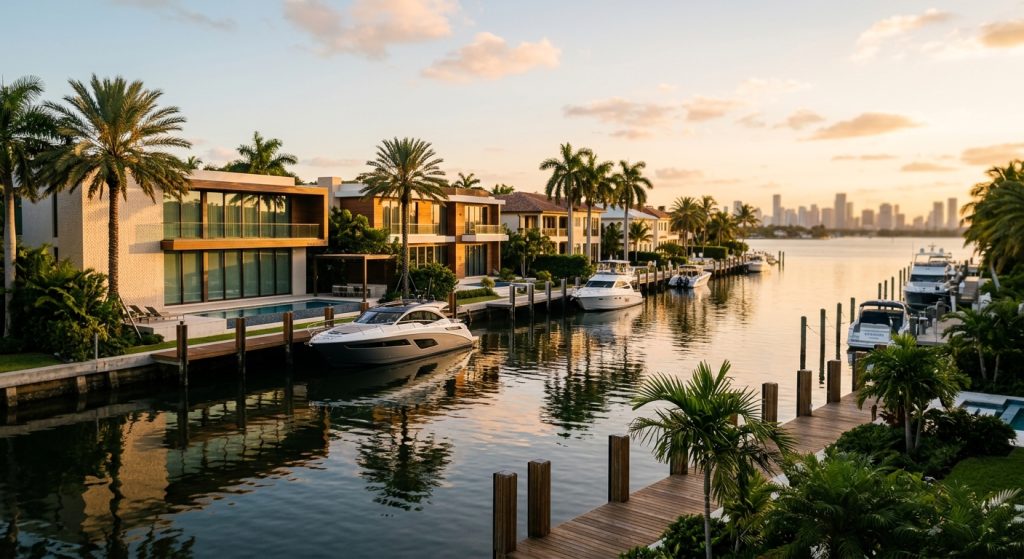
Miami-Dade County has already set a new full-year record for home sales of $30 million or more, with three months of 2026 still to go. The county recorded 24 single-family and condominium sales at or above that price through September, topping the 21 such sales it logged in all of 2025, according to September 2026 statistics released Oct. 16 by MIAMI REALTORS® + RWorld.
The association said the 24 sales are 14.3% above last year’s total and that, at the current pace, the county is on track for 32 sales of $30 million-plus by year-end. The record arrived in a month when the broader Miami-Dade market slipped: total home sales fell 2% from a year earlier as mortgage rates climbed.
Miami luxury home sales outrun the rest of the market
The split between the top of the market and everyone else runs through the September numbers. Miami-Dade closed 1,733 home sales in September, down from 1,769 a year earlier. Single-family transactions fell 4.7%, to 824 from 865, while condo sales edged up 1%, to 909 from 904.
Dollar volume moved the other way. Total sales volume rose 15.41% year over year to $1.8 billion, according to the release. Single-family dollar volume climbed 21.31% to $1.2 billion and condo volume rose 7.13% to $724 million — growth that came despite fewer single-family closings.
“South Florida ultra luxury real estate is booming, and the numbers are impressive,” said Alfredo Pujol, chairman of the board of MIAMI REALTORS® + RWorld. He added that “there are opportunities for buyers at many different price points,” pointing to condo sales near the roughly $400,000 median, which he said are up 15% from a year ago. The release puts the gain for condos priced from $300,000 to $400,000 at 14.5%, from 159 sales to 182.
Gay Cororaton, the association’s chief economist, tied the divergence to borrowing costs. “We are continuing to see the negative impact of soaring mortgage rates on homebuyers, but upper-end buyers have remained active, with this trend likely to continue through next year as mortgage rates remain elevated,” she said.
The association’s own figures help explain why the top end is less exposed to rates. In 2025, 82% of Miami condo sales of $1 million and up were all-cash, the release said, and the Miami metro leads the nation in all-cash sales.
Rates, a hurricane and prices
The association attributed the September sales decline to mortgage rates that rose nearly 0.6 percentage points from Sept. 1 to 7.46% as of Oct. 13, limited inventory in some price ranges, and uncertainty around Florida’s Oct. 6 state of emergency ahead of Hurricane Isaias. South Florida was not among the 29 counties covered by that emergency, but the release noted that hurricane threats can delay mortgage approvals, loan funding and closings. (RealtyWire covered the storm’s effect on the state insurer when Citizens suspended binding statewide.)
Miami-Dade’s total sales had risen year over year for 11 straight months before August, according to the release.
Prices held up better for houses than for condos. The median single-family sale price rose 4.06% to $692,000 from $665,000. The median condo price fell 0.69% to $417,090 from $420,000.
Supply kept shrinking. Active listings at the end of September totaled 16,242, down 10.1% from 18,057 a year earlier, with single-family inventory down 16.6% to 4,536 and condo inventory down 7.24% to 11,706 — the eighth straight monthly decline for condos. That leaves 5.1 months of supply for single-family homes, which the association characterizes as a seller’s market, and 12.3 months for existing condos, a buyer’s market by its definition.
Homes are taking longer to sell. The median time from listing to contract was 41 days for single-family homes and 67 days for condos. Single-family sellers received a median 95% of their original list price; condo sellers received 94%. Distressed sales were 0.5% of closings.
Condo financing remains a drag
The release again flagged condo financing as a constraint. Of 2,397 condominium buildings in Miami-Dade, Broward and Palm Beach counties, only 21 are approved for Federal Housing Administration loans, according to HUD figures cited by the association — about 0.9% of South Florida condo buildings. It also noted that Fannie Mae and Freddie Mac eliminated the limited review option for many condo loans on Aug. 3, a change it said should produce a more transparent lending environment.
How Miami compares with Florida and the nation
Statewide, Florida closed 20,537 single-family sales in September, down 3.5% from a year earlier, and 7,179 condo-townhouse sales, down 0.1%, according to Florida Realtors data cited in the release. The statewide single-family median rose 1.2% to $415,000, while the condo-townhouse median fell 1.8% to $293,500. That follows an August in which Florida’s year-long sales streak ended.
Nationally, the release cites National Association of Realtors figures showing existing-home sales up 2.2% from a year earlier to a seasonally adjusted annual rate of 3.99 million, and a median price of $417,500, up 1.3% — the 39th consecutive month of annual gains.
A note on the record: counts of Miami’s $30 million-plus sales vary by source. When RealtyWire reported in July that Miami had overtaken New York and the Bay Area in ultra-luxury sales, that tally came from Analytics Miami and used a different count of 2025 sales. The association’s release says its sales totals exclude new-construction, pre-construction and condo-conversion sales, which are largely not reported in the MLS. The figures in this article are the association’s, and are not directly comparable with the earlier count.
On either measure, the direction is the same: the most expensive end of the Miami market is setting records in a year when higher rates are slowing ordinary sales. More coverage of high-end markets is in RealtyWire’s luxury real estate section.