Boards of directors at four of the 12 Federal Reserve banks had formally asked for a higher discount rate by early September, and directors in most Fed districts reported that the artificial-intelligence buildout was making skilled workers harder to hire and supplies harder to secure. Both findings come from the Federal Reserve Board’s minutes of its discount rate meetings on Aug. 17, Sept. 9 and Sept. 16, released Oct. 13 at 2 p.m. Eastern time.
The discount rate is the interest the Fed charges banks that borrow directly from it, and the Board sets it separately from the federal funds target the Federal Open Market Committee controls. Each Reserve bank’s own board of directors votes to request a rate, and the Board of Governors then approves or declines. Those votes are one of the few regular public records of what regional bank directors, whose ranks are drawn from banks and businesses in their districts, are telling the Fed.
The vote count moved toward a hike through the summer
At the Aug. 17 meeting, 10 Reserve bank boards had voted to keep the primary credit rate where it was, at 3.75 percent. Directors at the Federal Reserve Bank of New York, Richmond, Atlanta and Dallas voted on Aug. 6, and directors at Boston, Philadelphia, Chicago, St. Louis, Minneapolis and San Francisco voted on Aug. 13. Only two boards — Kansas City, voting Aug. 6, and Cleveland, voting Aug. 13 — asked for 4 percent. The Board took no action and left the rate at 3.75 percent.
By the Sept. 9 meeting the split had widened. Eight boards voted on Sept. 3 to hold at 3.75 percent; four — Cleveland, Chicago, Minneapolis and Kansas City — voted the same day for 4 percent. The Board again declined to act.
A week later, on Sept. 16, the FOMC raised its target range for the federal funds rate by 25 basis points to 3.75 to 4 percent, effective Sept. 17. In the joint meeting that followed, the Board approved a matching increase in the primary credit rate to 4 percent and lifted the interest paid on reserve balances from 3.65 percent to 3.9 percent. By then seven Reserve bank boards had requested the higher rate: Cleveland, Chicago and Minneapolis on Sept. 3, and Richmond, Atlanta, Kansas City and Dallas on Sept. 10. The minutes record “consensus for a 25-basis-point increase.” The Board’s secretary subsequently notified the Boston, New York, Philadelphia, St. Louis and San Francisco banks that their own moves to 4 percent were approved as well.
The minutes list the September increase as approved by Chairman Warsh, Vice Chair Jefferson, Vice Chair for Supervision Bowman and Governors Powell, Waller, Cook and Barr — the full Board. Under the Board’s standing formula, the secondary credit rate sits 50 basis points above the primary rate.
What the directors reported about labor and costs
The substance for anyone building anything is in the Sept. 9 minutes, which summarize what Reserve bank directors reported about conditions in their districts. Directors described economic conditions as stable and labor markets as “generally characterized as stable, with adequate labor supply and moderate wage pressures.”
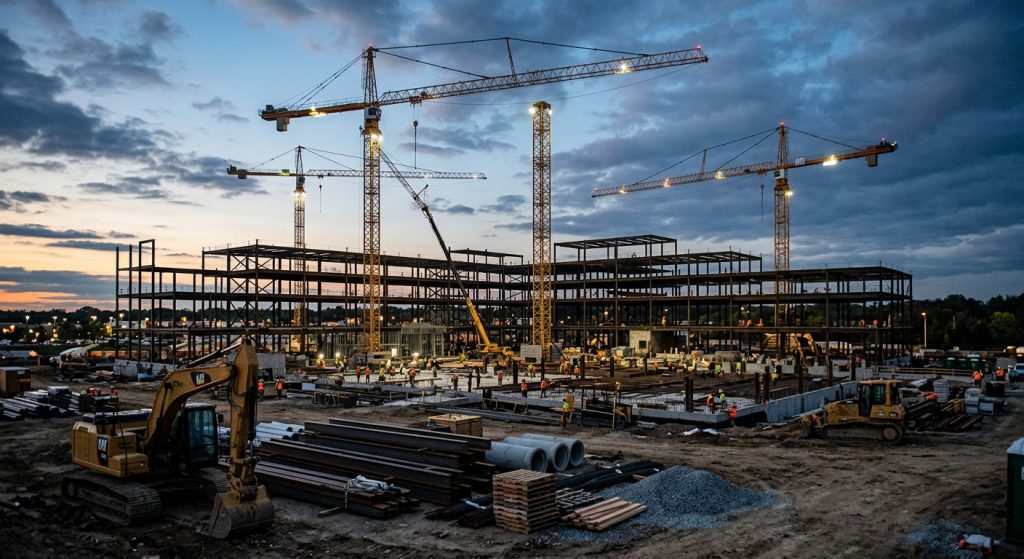
Then the qualifier: “However, hiring difficulties and elevated wages for certain skilled positions persisted in most Districts, including for jobs related to firms’ artificial intelligence (AI) strategies and the construction of data centers.”
On costs, the minutes say: “Most directors observed input cost pressures from many sources, including oil and fuel prices, tariffs, rising healthcare expenses, and competition for resources and supplies with the AI buildout.”
That is the Fed’s own regional business boards saying, in a document about interest rates, that data-center work is competing for labor and supplies in most of the country. It lines up with what contractor data has been showing: construction job openings have stayed above year-ago levels while data center work pulls crews, and roughly one in six contractors reported data center work in backlog surveys this summer. The minutes do not quantify the effect, name districts, or separate AI-driven wage pressure from the other cost sources listed alongside it.
Where this leaves rates
The discount-rate record is a lagging one — these meetings happened weeks ago — but it fills in the FOMC minutes released Oct. 7, which showed that most participants expected another increase by year end. The regional boards were pushing in that direction before the September decision, and the number pushing grew each month.
Two FOMC meetings remain this year, on Oct. 27-28 and Dec. 8-9, according to the Fed’s published calendar. Borrowing costs for housing have already moved: Freddie Mac’s Primary Mortgage Market Survey put the 30-year fixed mortgage at 7.40 percent for the week ending Oct. 8, up from 7.28 percent a week earlier and 6.30 percent a year before — the highest reading since November 2023. The 15-year fixed averaged 6.73 percent.
On our reading, the directors’ comments cut two ways for real estate. Cost pressure concentrated in skilled trades and materials raises the price of delivering new supply, residential and commercial alike. And to the extent regional boards keep reading those pressures as inflationary, they are an argument for the higher-for-longer path that has kept mortgage rates above 7 percent. More rate and policy coverage is collected on our Mortgage page.