ICON has raised a $200 million Series D co-led by Baillie Gifford and funds managed by BlackRock, money the construction-technology company says will put Titan, its multi-story robotic printing system, into production at its Austin, Texas, factory.
The round was announced Oct. 13 and also drew Capital Factory, CAZ Investments, Moderne Ventures, Moonshots Capital, Norwest, Overmatch, The Syndicate and Tiger Global, among others. ICON did not disclose a valuation or its total funding to date.
Beyond Titan production, ICON said the capital will fund a large-scale research and development facility in Austin, further work on Titan and Olympus — its lunar construction program with NASA — and expansion into Texas, Florida, Washington, D.C., and other U.S. markets.
Why multi-story matters
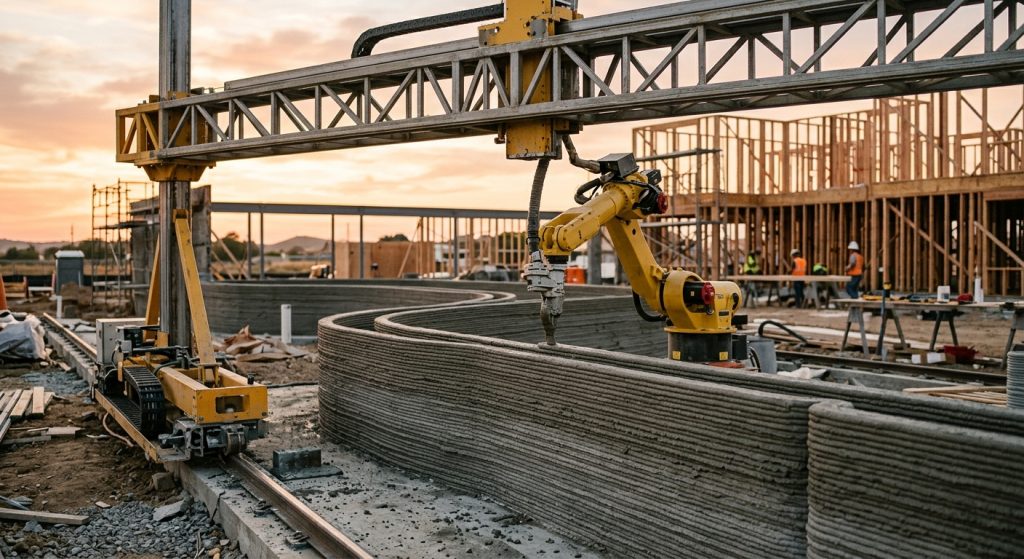
The distinction is the business case. ICON describes Titan, which it brought to commercial release in March, as a multi-story robotic construction system, and lists homes, commercial and hospitality buildings and military structures as its targets. Height is what opens the technology beyond detached houses to the mid-rise multifamily and hospitality work where most urban construction dollars sit.
ICON’s performance claims for the system are its own. It says Titan is engineered to cut the construction time of an average home by six weeks at 40% lower cost than the national average, a figure the release footnotes to internal cost modeling compared against a National Association of Home Builders annual report rather than to independent testing. FormCrete, its proprietary printing material, is rated for winds of 175 mph or more against 40 mph for traditional stick framing, the company says, and carries a fire rating of two hours or more versus half an hour for conventional construction.
“When we started ICON, we believed intelligent machines could fundamentally change the way the world builds. What the last decade taught us is that belief only matters if you can back it with real structures, real deployments, and real demand. We have all three,” said Jason Ballard, co-founder and CEO of ICON. “Construction automation has crossed from potential into proven reality.”
What is already built
ICON says it has completed more than 270 homes and structures across five states and two countries. That includes Wolf Ranch in Georgetown, Texas, built with Lennar and which ICON describes as the world’s first and largest community of 3D-printed homes, and more than a hundred homes for people experiencing homelessness at Community First! Village in Austin.
The government business has become a significant piece of it. ICON Prime, the defense and space division the company launched in April, has been awarded more than $370 million in government contracts, according to the release. In January ICON broke ground on 10 barracks at Fort Bliss in West Texas — what it called the largest deployment of robotic construction technology in Department of War history and the first additively manufactured structures to meet the Pentagon’s Unified Facilities Criteria.
The company said it is on pace for fourfold revenue growth in 2026. It did not disclose revenue in dollars, so the multiple cannot be checked against a base.
A bet on the labor math
ICON’s pitch to investors leans on workforce arithmetic as much as on printing speed. Its release cites a construction industry of $16 trillion globally, a U.S. housing shortfall of roughly 4 million homes, and a trade workforce in which only 10% of U.S. construction workers are under 25 while 41% of the current workforce is expected to retire by 2031.
“The industries hardest to change often have the most to gain, and the companies that transform them tend to become some of the most important of their generation,” said Luke Ward, private companies investment manager at Baillie Gifford, which reported $262 billion under management as of June 30. “ICON’s construction system is compelling not just for its technology, but because it works with, rather than against, the business realities that shape a project’s success.”
That last clause is the tell. ICON’s commercial model now sells systems and capability to other builders rather than asking them to hand over the job, the same posture other construction-automation firms have taken in courting production homebuilders.
Five years and a changed market
The Series D is roughly the size of ICON’s last headline round, but it lands in a different market. In a release dated Aug. 24, 2021, ICON announced a $207 million Series B led by Norwest Venture Partners, bringing its total raised at that point to $266 million. Norwest is back in the Series D.
Capital has continued to move toward construction automation this year: SoftBank put $200 million into Gravis Robotics in August. ICON has also joined the industry’s supply-side lobbying effort, signing on last month to the Let America Build campaign organized with Zillow, Realtor.com and NAHB.
What the round does not settle is whether printed walls pencil out for a production builder at scale, a question that only shows up in delivered cost per house. More technology and AI coverage tracks how these systems perform in the field.