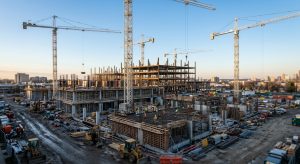
Rexford Industrial Realty raised its 2026 earnings outlook on Oct. 22 after occupancy across its stabilized Southern California warehouse portfolio climbed 200 basis points in three months. The infill industrial landlord has now sold $1.5 billion of property this year and has used the proceeds to buy back stock and retire debt.
The Los Angeles-based real estate investment trust reported third-quarter results in a release filed with the Securities and Exchange Commission. Same Property Portfolio occupancy ended September at 96.9%, up from 94.9% on June 30. Rexford raised its full-year Core FFO guidance to $2.41 to $2.44 per diluted share, from $2.38 to $2.43. Core FFO, or funds from operations, is the cash-flow measure REITs use in place of earnings per share.
Leasing improves, but rents still roll down on a cash basis
Rexford signed 116 new and renewal leases totaling about 3.7 million square feet in the quarter, including 599,369 square feet in repositioned buildings and new developments. Net effective rents on comparable space rose 7.1% from prior rents. Measured in cash, they fell 3.0%. New leases came in 7.0% below prior cash rents, while renewals were roughly flat at 0.1% above.
Net effective figures spread concessions and scheduled rent increases over the whole lease term; cash figures compare starting rents. On our reading, the gap between the two suggests that starting rents in Rexford’s markets are still below where many expiring leases were signed, even as the full-term economics of the new deals come out ahead.
“Infill Southern California industrial market fundamentals continue to improve, with increasing tenant demand driving our strong leasing activity in the quarter,” Chief Executive Officer Laura Clark said in the release. “We’ve made significant progress on our portfolio realignment, sharpening our portfolio, strengthening our balance sheet and enhancing our financial flexibility.”
Income from the existing portfolio is still lower than a year ago. Same Property Portfolio net operating income fell 2.6% from the third quarter of 2025, and cash NOI fell 1.1%. The company attributed the decline to lower effective rents, lower average occupancy and higher bad-debt expense, plus higher rent abatement on the cash measure. Average occupancy for the quarter was 95.6%, below the quarter-end figure. Core FFO came in at $0.60 per diluted share, the same as a year earlier.
$1.5 billion of sales, $708.7 million of buybacks
Most of the quarter’s activity was about shrinking and reshaping the portfolio. Rexford sold 25 properties for $1.3 billion in the third quarter. That included the 22-property, 5.2 million-square-foot portfolio it had agreed in August to sell to an EQT Real Estate affiliate for $1.2 billion. Rexford also sold three buildings to owner-users for $86.0 million. Year to date it has sold 37 properties covering 6.4 million square feet for $1.5 billion, and it raised the low end of its full-year disposition target to $1.7 billion, from $1.5 billion. The top of the range stays at $2.0 billion.
The proceeds went into stock buybacks and debt repayment. Rexford repurchased 10.9 million shares for $408.7 million, at an average of $37.59 a share, during and just after the quarter. That brings repurchases through Oct. 22 to $708.7 million at an average of $36.90, with $591.3 million left under the current authorization. It also repaid $485.0 million of debt, including $425.0 million due in 2027. Net debt to adjusted EBITDA fell to 3.8 times from 4.5 times at the end of June.
The company ended September with $2.8 billion of debt at a weighted average rate of 3.70%, none of it floating-rate, and about $1.7 billion of liquidity. The board declared a fourth-quarter dividend of $0.435 per share, payable Jan. 15, 2027.
Impairments and a smaller development pipeline
The realignment has been costly on a GAAP basis. Third-quarter net income attributable to common stockholders was $14.6 million, or $0.07 per diluted share, down from $87.1 million, or $0.37, a year earlier. The quarter included $71.8 million of impairments and $23.2 million of gains on sales. For the first nine months of 2026, Rexford reported a net loss of $404.4 million, or $1.80 per diluted share, with $703.4 million of impairments. It widened its full-year net loss guidance to $1.55 to $1.52 per share, from $1.32 to $1.27.
Rexford also cut back on new construction and repositioning. It now expects to start about 800,000 square feet of those projects this year, down from 1.2 million in its previous guidance, with total estimated costs of $125 million to $130 million instead of $160 million to $170 million. The one project it stabilized in the quarter, a 46,653-square-foot repositioning that cost $14.5 million, achieved a 13.8% unlevered return on cost, the company said. Its improved land and industrial outdoor storage sites, about 189.7 acres, were 94.5% leased.
Guidance for the rest of the year also moved up. Rexford now expects Same Property Portfolio cash NOI growth of 0.25% to 0.75% for 2026, compared with negative 0.75% to positive 0.25% before. It raised its expected average occupancy to 95.8% to 96.0%.
On our reading, the results describe a landlord being paid to wait. Tenants are taking space again, and Rexford has more of its income coming from occupied buildings. But cash rents on rolling leases are still resetting lower, and the release credits the flat quarterly Core FFO to capital recycling and lower general and administrative expense, which offset lower same-property income and lower interest income. That fits other forecasts that industrial demand will catch up with supply by late 2027, but it does not yet show rent growth returning to Southern California’s infill markets. Management was scheduled to discuss the results on a conference call at 11 a.m. Eastern on Oct. 23. More industrial and REIT coverage is in our commercial real estate section.