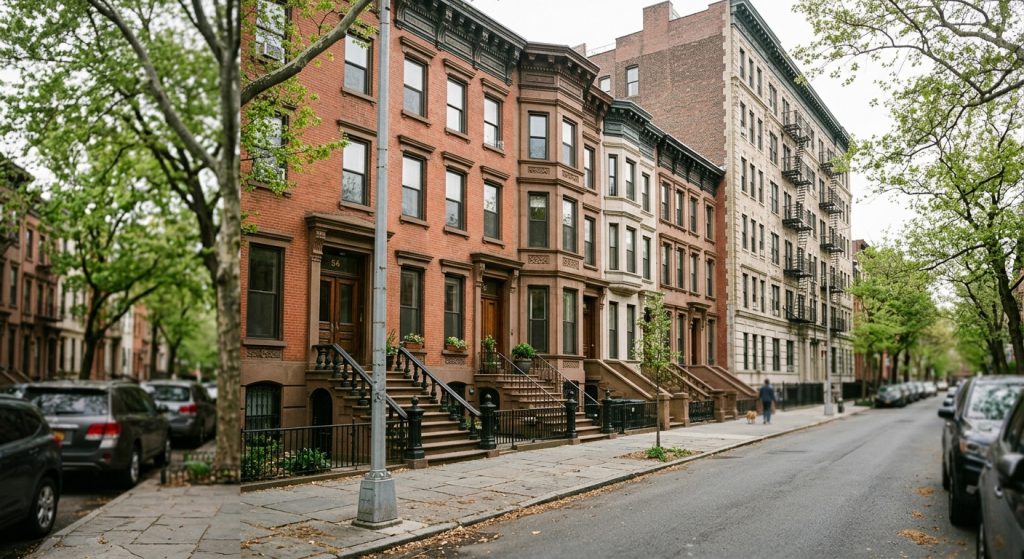
New York City’s rent-stabilized housing stock covers roughly one million apartments, and new government data show a wide income gap between those tenants and market-rate renters. A public dispute over exactly who benefits from stabilization, and how much, has moved to the center of this year’s rent-setting debate at City Hall.
The New York City Rent Guidelines Board (RGB), the mayoral-appointed panel that sets annual rent adjustments for stabilized apartments, released its 2026 Income and Affordability Study on April 16. Drawing on the city’s 2023 Housing and Vacancy Survey (HVS), the study found that the median household income for rent-stabilized tenants was $60,000, compared with $90,800 for market-rate renters and $70,000 for renters citywide. Median rent in stabilized units was $1,500 a month, versus $2,000 in market-rate units, according to the same survey — a gap that has widened as Manhattan asking rents hit a record high in June 2026, even as rent growth has cooled nationally.
A regulated system covering close to a million units
Rent stabilization limits annual rent increases on close to a million apartments, mostly in buildings built before 1974. Increases are set each year by the nine-member RGB, whose current members were largely appointed by Mayor Zohran Mamdani. On June 25, the board voted to freeze rents on one- and two-year stabilized leases running from October 2026 through September 2027 — the decision that put the board’s income data under fresh public scrutiny.
The study also found that 45.5% of rent-stabilized tenants who do not receive rental assistance were “rent burdened” (spending more than 30% of income on rent) in 2023, compared with 40.6% of market-rate tenants. That burden varied by building vintage: 43.8% in stabilized buildings built before 1974, versus 53.0% in those built after 1973, which tend to include more recently deregulated or higher-end stock. The RGB and Census Bureau note that the American Community Survey, the main source for citywide income data, cannot isolate rent-stabilized units — only the triennial HVS can, which limits year-to-year comparisons.
The six-figure estimate, and where it comes from
The sharpest public statement on tenant income has come from Arpit Gupta, an NYU Stern finance professor and RGB public member who cast the board’s lone vote against the freeze. In a City Journal essay published June 26, and in a Fox News interview on July 3, Gupta said: “About 30% of the tenants in rent-stabilized housing make six figures or more. At the same time, many individuals in market-rate housing are below the poverty line.”
Gupta has said the figure is his own reading of the 2023 HVS “selected initial findings” released by the city’s Department of Housing Preservation and Development — his interpretation of that government data, not a headline figure published by the RGB itself. His broader argument is that rent stabilization, which has had no income-eligibility test since a 2019 state law change, distributes its benefits by “tenure and chance” rather than by need: “So, to have a system that provides so many benefits for one sector of the housing stock while completely leaving out the market-rate tenants … means that we have an incompletely targeted program,” he said. Gupta has also argued the freeze could weaken older stabilized buildings over time by limiting revenue for repairs, calling it “a little bit of a slow burn” that risks “deferred maintenance.”
A more complicated distribution
Research from NYU’s Furman Center, which has tracked the socioeconomic makeup of stabilized tenants for more than a decade, points to a different emphasis: roughly two-thirds of rent-stabilized households have incomes below 80% of area median income, the federal threshold generally used to define low-income housing need. That share, in the Furman Center’s framing, makes stabilization the largest single source of housing for lower-income tenants in the city, even as incomes vary substantially by building age and neighborhood.
The Community Service Society of New York (CSS), a tenant-focused research and advocacy group, made a related point to the RGB ahead of the freeze vote, citing its own survey finding that 67% of rent-stabilized tenants said they were struggling financially and 83% said they had little or no savings. CSS also pointed to landlord finances over the same period: the RGB’s companion 2026 Income and Expense Study found net operating income for stabilized buildings rose 6.2% from 2023 to 2024 (2.2% after inflation), though 9.2% of stabilized buildings still had negative net operating income that year.
What it means
Two verified facts sit side by side here. Median income for stabilized tenants is well below that of market-rate tenants, and roughly two-thirds of stabilized households fall under standard low-income thresholds — a base tenant advocates cite to defend broad-based protections. At the same time, income within the stabilized population is not uniform: a meaningful share of tenants, by Gupta’s own estimate, earn six-figure incomes, and rent burden is markedly higher in newer stabilized buildings than older ones. Both can be true at once, since stabilization attaches to buildings and leases rather than to tenants selected by income.
Where the two sides diverge is interpretation, not the numbers. Gupta and like-minded economists argue the spread shows the program is poorly targeted and favor weighing tenant income or building distress directly. Tenant advocates argue that, whatever the spread at the margins, stabilization remains the primary source of affordable housing for lower-income renters, and that narrowing broad protections would put those households at greatest risk. RealtyWire takes no position on which approach is preferable; both are attributed views drawn from the same survey data.
What to watch
The RGB’s own data, not any single income estimate, will keep shaping the debate. The board’s June rent freeze is being challenged in court by landlord groups, and the RGB has said future studies will keep relying on the triennial HVS, last conducted in 2023, as the only survey that separates stabilized and market-rate incomes; the next cycle could sharpen or complicate current estimates. Watch for whether any board member or lawmaker formally proposes tying rent relief to tenant income or building condition, rather than a uniform adjustment across the entire stabilized stock.