
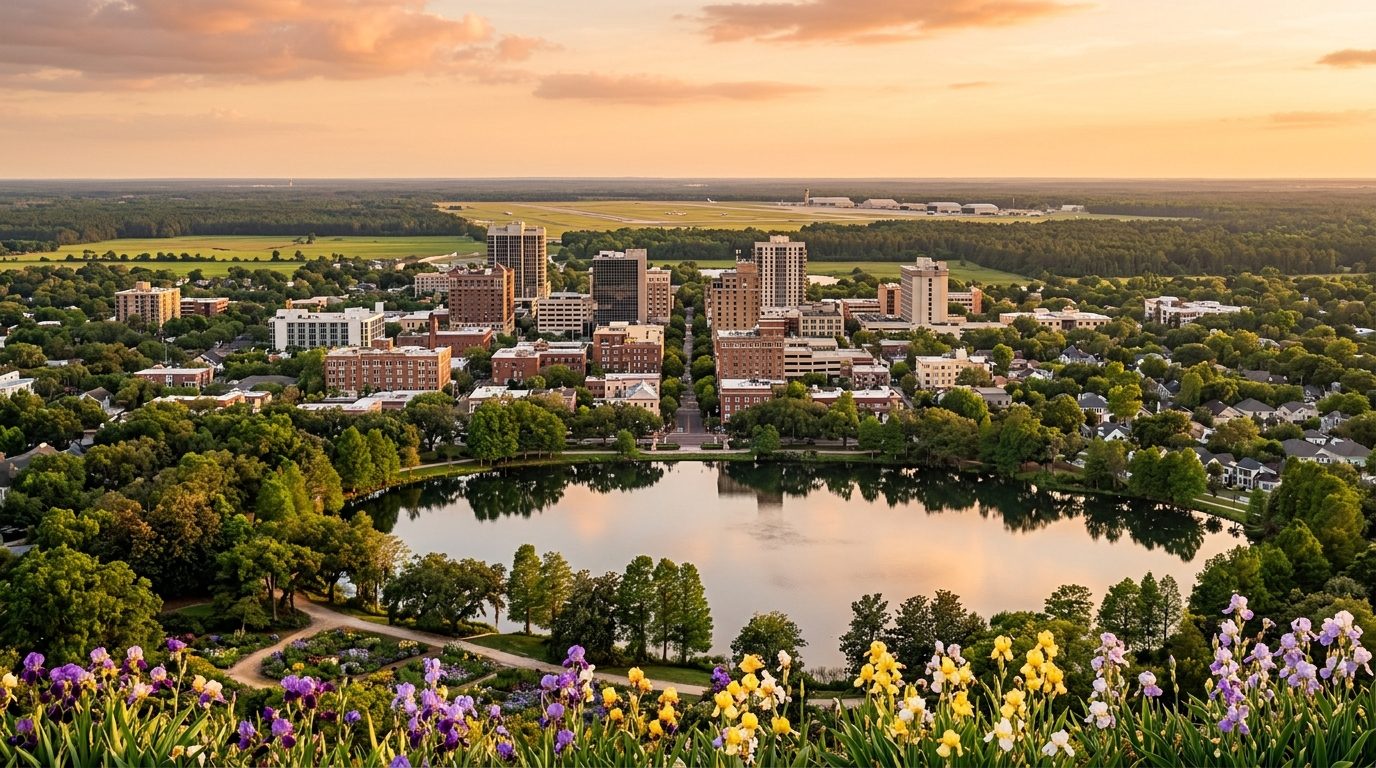
Current real estate market data, news and analysis for the Sumter, SC metropolitan area — 105,067 residents across Sumter county.
Data as of May 2026. Sources: Redfin Data Center, U.S. Census Bureau.
Latest Sumter Real Estate News
Coverage of this market is coming soon. Browse all housing market news.
Sumter Real Estate Market Overview
Sumter County sits in east-central South Carolina, where the Fall Line hills along the Wateree River give way to flatter, often swampy Coastal Plain land. The Wateree forms the county’s western boundary and feeds toward Lake Marion to the south, while Shaw Air Force Base occupies a large tract north of the city of Sumter, the county seat and largest population center. Housing stock mirrors this settlement pattern: early-twentieth-century brick and frame homes line streets in and around downtown Sumter, mid-century brick ranch houses fill inner-ring neighborhoods grown up around the base and local industry, and newer subdivisions extend along the city’s southern and western edges. Outside the city, the mix shifts toward manufactured homes, older farmhouses, and larger-lot construction on agricultural and forested land.
Downtown Sumter and the adjoining Hampton Park neighborhood sit toward the higher end of the local price range, reflecting period architecture, mature tree cover, and proximity to Swan Lake Iris Gardens and the historic core. The Millwood area in southwestern Sumter also trends higher, largely because of newer construction and well-regarded schools. Neighborhoods closer to Shaw Air Force Base, including Dalzell just north of the runway, see steady but different demand: a rotating population of military families supports a deep market of starter homes and rentals rather than premium pricing. Older sections of south Sumter, built up around historic mill and rail corridors, generally sit at the lower end. In the unincorporated county, around Wedgefield, Rembert, and Horatio, near Manchester State Forest and Lake Marion, pricing depends more on lot size and rural privacy than distance to any job center.
Shaw Air Force Base, home to the 20th Fighter Wing and Ninth Air Force headquarters, anchors the local economy and is the area’s largest employer, supporting active-duty personnel, military dependents, and civilian defense workers. Manufacturing forms the other main pillar: Continental Tire operates a large tire plant in the county, Becton Dickinson manufactures medical devices and blood-collection products at its Sumter facility, and Eaton maintains a local manufacturing presence. Prisma Health Tuomey Hospital is the region’s principal medical center and a major employer in its own right. Agriculture remains woven into the county’s identity, with row crops grown across Coastal Plain land beyond the city. Morris College and Central Carolina Technical College provide local higher education, and the Sumter School District itself ranks among the area’s larger employers.
Sumter lies inland and does not face direct hurricane storm surge, but the county has experienced serious flooding from tropical rainfall, including a multi-day rain event that overwhelmed dams and waterways regionally; buyers should check a property’s FEMA flood zone status and ask about any dam, levee, or drainage history rather than assume distance from the coast removes water risk. South Carolina taxes an owner-occupied primary residence at a lower assessment rate than a second home or rental, so buyers should confirm with the county assessor whether a property qualifies for the legal-residence rate. Because Shaw Air Force Base drives a meaningful share of housing demand, rental and starter-home activity can move with military transfer cycles, and homes near the base may fall under noise contours or accident-potential zoning tied to flight operations, worth checking with the base or county planning office. In the unincorporated county, well and septic systems are common and should be inspected individually.
Cities and Towns in the Sumter Metro Area
Notable Communities and Neighborhoods
Sumter Real Estate Market FAQ
How is the Sumter, SC housing market organized geographically?
The metro centers on the city of Sumter, the county seat, with Shaw Air Force Base occupying a large tract just north of the city. Around this core, the county is largely rural, with small unincorporated communities such as Wedgefield, Rembert, Horatio, and Dalzell scattered across farmland and forest, and the towns of Pinewood and Mayesville anchoring the southern and western parts of the county. The Wateree River forms the western county line, and the county borders Lake Marion to the south, giving the western and southern edges a more rural, water- and timber-oriented character than the built-up areas closer to the city and the base.
Which parts of the Sumter area tend to have higher home prices, and why?
Downtown Sumter and the adjoining historic Hampton Park neighborhood tend toward the higher end because of period architecture, mature landscaping, and walkable proximity to Swan Lake Iris Gardens and the historic commercial district. The Millwood area in southwestern Sumter also trends higher on the strength of newer construction and schools with strong local reputations. By contrast, areas immediately around Shaw Air Force Base see high housing activity but not necessarily premium pricing, since much of that demand is for starter homes and rentals tied to a transient military population rather than long-term luxury buyers.
What should buyers verify locally before purchasing in the Sumter metro?
Buyers should confirm a property’s FEMA flood zone designation and ask locally about any history of dam, levee, or drainage issues, since the county has experienced serious rain-driven flooding despite being inland. They should also check with the county assessor whether a home will qualify for South Carolina’s lower owner-occupied tax assessment rate, verify well and septic systems on rural parcels, and, for property near Shaw Air Force Base, ask the base or county planning office about noise contours or accident-potential zoning that can affect use and future development near the flight line.
How does Shaw Air Force Base affect housing demand in Sumter?
Shaw Air Force Base is the area’s largest employer, and its population of active-duty service members, military dependents, and civilian defense workers creates a steady, cyclical source of housing demand concentrated in starter homes and rental properties, particularly in neighborhoods close to the base such as Dalzell. Because military members relocate on set transfer schedules, rental and entry-level home turnover in these areas tends to follow permanent-change-of-station cycles rather than the slower-moving patterns seen in the historic core or in outlying rural parts of the county.
Nearby Markets